203 posters, 14 topics, 5 sessions, 817 authors, 256 institutions
ePostersLive by SciGen Technologies S.A. All rights reserved.
The AAPS 102nd Annual Meeting
May 18-21, 2024 | The Westin Copley Place, Boston, MA

D97
The Impact Of Human Immunodeficiency Virus And Antiretroviral Therapy Status On Distal Radius Fractures Management And Complications
Poster Presenter
Authors
Helia Hosseini, Alex Kammien, Karen Bach, Omar Allam, Jonathan Grauer, David Colen
Affiliations
Part of Topic
Hand/Extremity
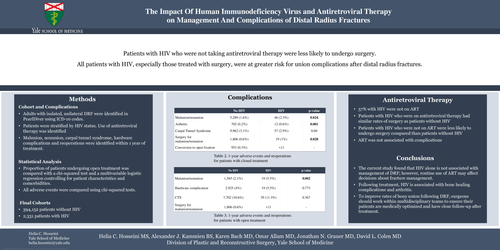
Patients with HIV who were not taking antiretroviral therapy were less likely to undergo surgery.
All patients with HIV, especially those treated with surgery, were at greater risk for union complications after distal radius fractures.
Methods
Cohort and Complications
•Adults with isolated, unilateral DRF were identified in PearlDiver using ICD-10 codes.
•Patients were stratified by HIV status. Use of antiretroviral therapy was identified
•Malunion, nonunion, carpal tunnel syndrome, hardware complications and reoperations were identified within 1 year of treatment.
Statistical Analysis
•Proportion of patients undergoing open treatment was compared with a chi-squared test and a multivariable logistic regression controlling for patient characteristics and comorbidities.
•All adverse events were compared using chi-squared tests.
Final Cohorts
•394,152 patients without HIV
•2,331 patients with HIV
Antiretroviral Therapy
•57% with HIV were not on ART
•Patients with HIV who were on antiretroviral therapy had similar rates of surgery as patients without HIV
•Patients with HIV who were not on ART were less likely to undergo surgery compared than patients without HIV
•ART was not associated with complications
Conclusions
•The current study found that HIV alone is not associated with management of DRF; however, routine use of ART may affect decisions about fracture management.
•Following treatment, HIV is associated with bone healing complications and arthritis.
•To improve rates of bony union following DRF, surgeons should work within multidisciplinary teams to ensure their patients are medically optimized and have close follow-up after treatment.