203 posters, 14 topics, 5 sessions, 817 authors, 256 institutions
ePostersLive by SciGen Technologies S.A. All rights reserved.
The AAPS 102nd Annual Meeting
May 18-21, 2024 | The Westin Copley Place, Boston, MA

D96
Same-day Plastic Surgery: Evaluating The Association Of Facility Ownership With Access, Surgical Cost, And Unexpected Postoperative Visits Among Propensity-matched Patients
Poster Presenter
Authors
Joseph Fahmy, Trista Benitez, Zhongzhe Ouyang, Lu Wang, Kevin Chung
Affiliations
University of Michigan, Research Fellow, Section of Plastic Surgery, Department of Surgery, University of Michigan Medical School, Department of Biostatistics, University of Michigan School of Public Health, Medical Student, Section of Plastic Surgery, Department of Surgery, University of Michigan Medical School, Professor, Section of Plastic Surgery, Department of Surgery, University of Michigan Medical School
Part of Topic
Education/Practice Management/Other
Same-day Plastic Surgery: Evaluating The Association Of Facility Ownership With Access, Cost, And Unexpected Postoperative Visits Among Propensity-matched Patients
Joseph N. Fahmy, MD, MS 1; Trista M. Benítez, MPH1; Zhongzhe Ouyang, MS2; Lu Wang, PHD2; Kevin C. Chung, MD, MS1
1.Section of Plastic Surgery, Department of Surgery, University of Michigan Medical School, Ann Arbor, MI, USA 2. Department of Biostatistics, University of Michigan School of Public Health, Ann Arbor, MI, USA
STUDY PURPOSE
42% of cosmetic and 25% of reconstructive surgeries are performed in Ambulatory Surgery Centers (ASCs). Freestanding ASCs (F-ASCs) and Hospital-owned ASCs (HO-ASCs) are 50% less costly than hospital outpatient departments (HOPDs). Plastic Surgeons frequently own and operate ASCs. Studies evaluating cost and access trends among ASCs by ownership are necessary in the setting of current policy initiatives aiming to reduce spending on surgical care and shift care to ASCs.
METHODS
The 2016-2019 State Ambulatory Surgery Databases from Florida, New York, and Maryland were queried for common plastic surgery procedures, including laceration repair, local tissue rearrangement, skin grafting, panniculectomy, reduction mammaplasty, breast reconstruction, and revision breast reconstruction. The resulting 128,805 patients were propensity matched using individual comorbidity data for all three same-day surgery facility types. Access, charges, and postoperative visits were evaluated using logistic regression.
Medicare FFS
39% less likely to use HO-ASCs (95% CI: 0.55 to 0.69, p<0.001)
*increased by 2%/quarter (95% CI: 1.01 to 1.03, p<0.001)
22% less likely to use F-ASCs (95% CI: 0.70 to 0.88, p<0.001)
*increased by 1%/quarter (95% CI: 1.00 to 1.02, p=0.04)
Medicaid
32% less likely to use HO-ASCs (95% CI: 0.55 to 0.76, p<0.001) 84% less likely to use F-ASCs (95% CI: 0.14 to 0.19, p<0.001) *increased by 3% per quarter (95% CI: 1.02 to 1.05, p<0.001)
7-day ED or Hospital Admissions_______________
F-ASC 70% lower odds versus HOPD
95% CI: 0.27 to 0.33, p<0.001
HO-ASC: 53% lower odds versus HOPD
95% CI: 0.49 to 0.57, p<0.001
Surgery Charges____________________________
HO-ASC: $7,523 less than HOPD
95% CI:-$7,899 to –$7,147, p<0.001
F-ASC: $19,058 less than HOPD
95% CI:-$19,446 to -$18,669, p<0.001
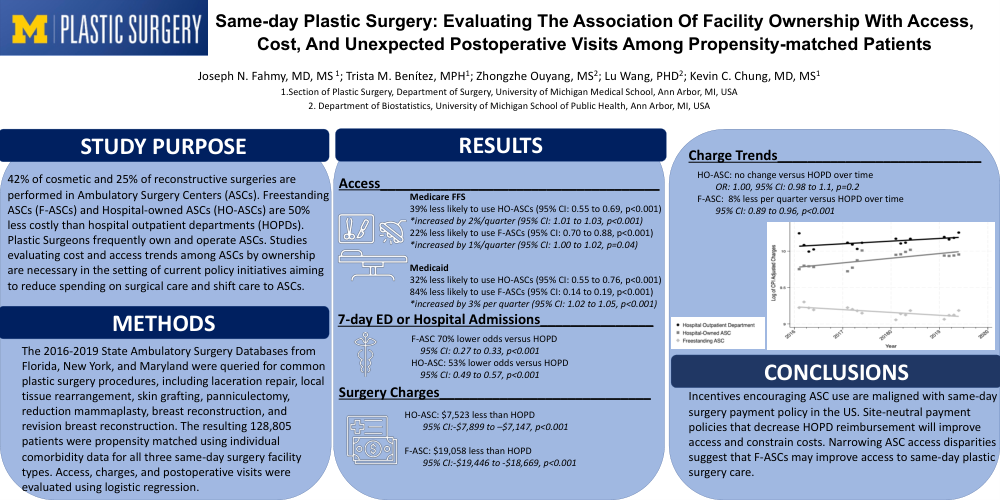
Charge Trends___________________________
HO-ASC: no change versus HOPD over time
OR: 1.00, 95% CI: 0.98 to 1.1, p=0.2
F-ASC: 8% less per quarter versus HOPD over time
95% CI: 0.89 to 0.96, p<0.001
CONCLUSIONS
Incentives encouraging ASC use are maligned with same-day surgery payment policy in the US. Site-neutral payment policies that decrease HOPD reimbursement will improve access and constrain costs. Narrowing ASC access disparities suggest that F-ASCs may improve access to same-day plastic surgery care.