203 posters, 14 topics, 5 sessions, 817 authors, 256 institutions
ePostersLive by SciGen Technologies S.A. All rights reserved.
The AAPS 102nd Annual Meeting
May 18-21, 2024 | The Westin Copley Place, Boston, MA

P15
Another Look At The Medial And Lateral Rows: 18 Month Follow-up In Over 200 DIEP Flaps
Poster Presenter
Part of Topic
Aesthetic Face/Breast/Body/ Body Contouring
Background
• Optimal choice between medial and lateral row perforators for deep
inferior epigastric artery perforator (DIEP) flaps remains contested.
• Medial row associated with lower abdominal wall morbidity
• Lateral row associated with lower rates of fat necrosis.
• These morbidities can take well over a year to declare themselves, and
there are few studies with >12 months follow-up.
Aims
To compare long-term outcomes between DIEP flaps supplied by perforators
from the medial row only, the lateral row only, and from a combination of
both rows.
Methods
• Retrospective review of patients who underwent mastectomy with DIEP
reconstruction between November 2004-December 2021
• > 18 months follow-up
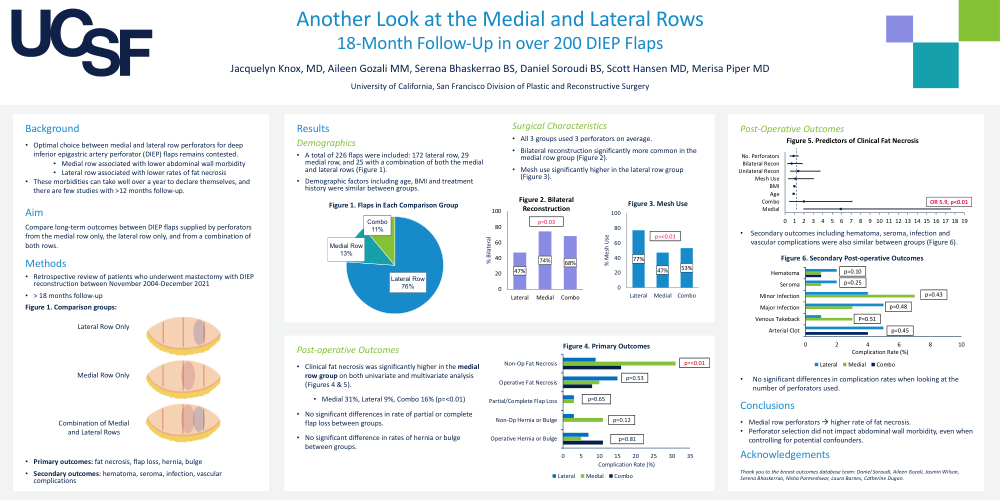
Figure 1. Comparison groups:
• Primary outcomes: fat necrosis, flap loss, hernia, bulge
• Secondary outcomes:
hematoma, seroma, infection, vascular
complications
Results
Demographics
• A total of 226 flaps were included: 172 lateral row, 29 medial
row, and 25 with a combination of both the medial and
lateral rows
• Demographic factors including age, BMI and treatment
history were similar between groups.
Surgical Characteristics
• All 3 groups used 3 perforators on average.
• Bilateral reconstruction significantly more common in the
medial row group (Figure 2).
• Mesh use significantly higher in the lateral row group.
Post-operative Outcomes
• Clinical fat necrosis was significantly higher in the medial
row group on both univariate and multivariate analysis
(Figure 4 & 5).
• Medial 31%, Lateral 9%, Combo 16% (p=<0.01)
• No significant differences in rate of partial or complete
flap loss between groups.
• No significant difference in rates of hernia or bulge
between groups.
Post-Operative Outcomes
• Secondary outcomes including hematoma, seroma, infection and
vascular complications were also similar between groups (Figure 6).
• No significant differences in complication rates when looking at the
number of perforators used.
Conclusions
• Medial row perforators yielded higher rate of fat necrosis.
• Perforator selection did not impact abdominal wall morbidity, even when
controlling for potential confounders.
Acknowledgements
Thank you to the breast outcomes database team: Daniel Soroudi, Aileen Gozali, Jasmin Wilson,
Serena Bhaskerrao, Nisha Parmeshwar, Laura Barnes, Catherine Dugan.