203 posters, 14 topics, 5 sessions, 817 authors, 256 institutions
ePostersLive by SciGen Technologies S.A. All rights reserved.
The AAPS 102nd Annual Meeting
May 18-21, 2024 | The Westin Copley Place, Boston, MA

D78
Does Targeted Muscle Reinnervation (TMR) And Regenerative Peripheral Nerve Interface (RPNI) Improve Post-amputation Pain? A Systematic Review And Meta-analysis
Poster Presenter
Part of Topic
Hand/Extremity
Does Targeted Muscle Reinnervation (TMR) And Regenerative Peripheral Nerve Interface (RPNI) Improve Post-amputation Pain? A Systematic Review and Meta-analysis
Elemosho Abdulaziz, MD1, Syed A Farhan, MD1, Muhammad M Nasir, MBBS2, Jude Kluemper, BS1, Kerry-Anne Mitchell, MD, PhD1, Jason Souza, MD1
1Ohio State University, Columbus, OH, USA, 2Dow University of Health Sciences, Karachi, Pakistan
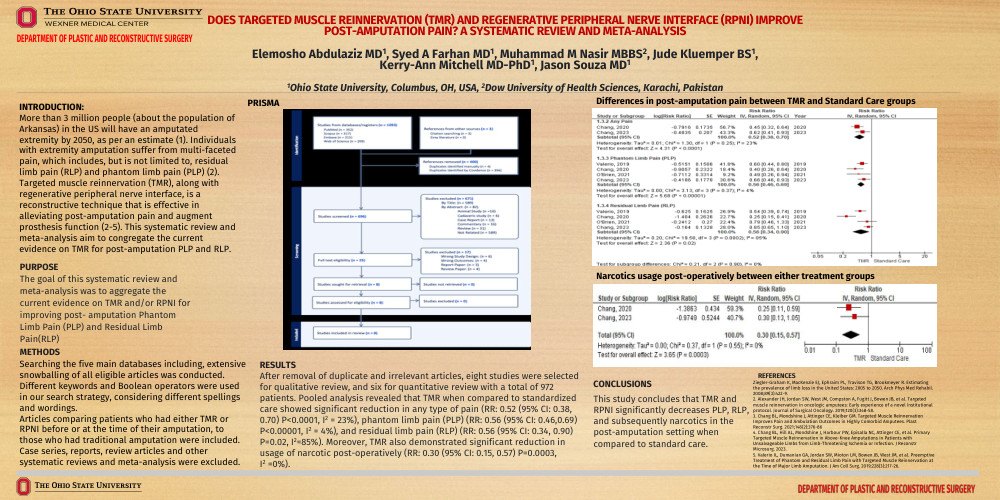
Purpose:The goal of this systematic review and meta-analysis was to aggregate the current evidence on TMR and/or RPNI for improving post- amputation Phantom Limb Pain (PLP) and Residual Limb Pain(RLP).Methods:A systematic review of the 5 main databases was conducted according to PRISMA guidelines, utilizing, different keywords and Boolean operators. Cohort studies comparing patients who had either TMR or RPNI before or at the time of their amputation, to those who had traditional amputation were included. ResultsAfter removal of duplicate and irrelevant articles, eight studies were selected for qualitative review, and six for quantitative review with a sum total of 972 patients. Pooled analysis revealed that TMR when compared to standardized care showed significant reduction in any type of pain (RR: 0.52 (95% CI: 0.38, 0.70) P<0.0001, I2 = 23%), phantom limb pain (PLP) (RR: 0.56 (95% CI: 0.46,0.69) P<0.00001, I2 = 4%), and residual limb pain (RLP) (RR: 0.56 (95% CI: 0.34, 0.90) P=0.02, I2=85%). Moreover, TMR also demonstrated significant reduction in usage of narcotic post-operatively (RR: 0.30 (95% CI: 0.15, 0.57) P=0.0003, I2 =0%). ConclusionThis study concludes that TMR and RPNI significantly decreases PLP, RLP, and subsequently narcotics in the post-amputation setting when compared to standard care.