203 posters, 14 topics, 5 sessions, 817 authors, 256 institutions
ePostersLive by SciGen Technologies S.A. All rights reserved.
The AAPS 102nd Annual Meeting
May 18-21, 2024 | The Westin Copley Place, Boston, MA

D76
Endoscopic Versus Open Treatment Of Carpal Tunnel Syndrome: Postoperative Complications In Patients With Diabetes Mellitus
Poster Presenter
Authors
Arman Kishan, Mark Haft, Steve Li, Dawn Laporte, Sami Tuffaha, Duc Nguyen
Affiliations
Part of Topic
Hand/Extremity
Endoscopic Versus Open Treatment of Carpal Tunnel Syndrome: Postoperative Complications in Patients with Diabetes Mellitus
ABSTRACT
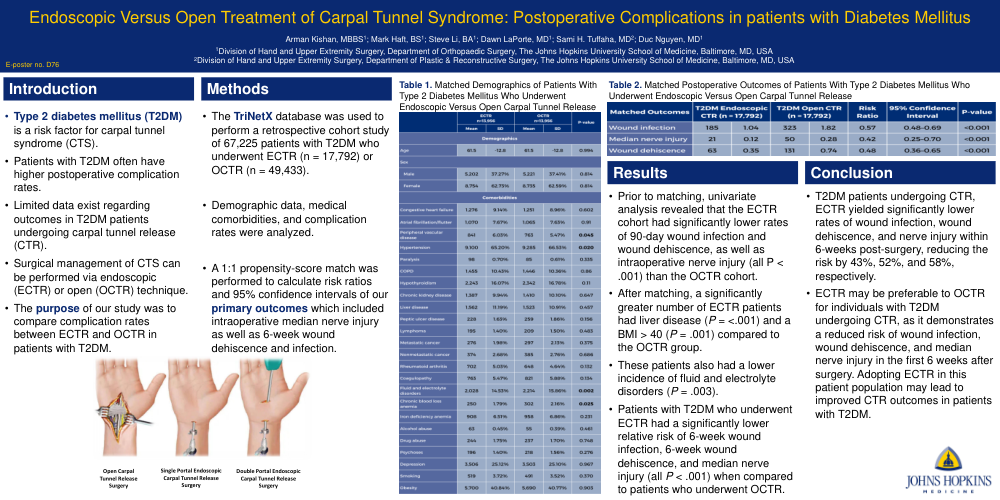
Purpose Patients with type 2 diabetes mellitus (T2DM) often face higher postoperative complication rates. Limited data exist regarding outcomes in T2DM patients undergoing carpal tunnel release (CTR). This study compares complication rates between endoscopic CTR (ECTR) and open CTR (OCTR) in patients with T2DM.
Methods The TriNetX database was used to perform a retrospective cohort study of 67,225 patients with T2DM who underwent ECTR (n = 17,792) or OCTR (n = 49,433). Demographic data, medical comorbidities, and complication rates were analyzed. A 1:1 propensity-score match was performed to calculate risk ratios and 95% confidence intervals of postoperative median nerve injury, 6-week wound dehiscence, and 6-week wound infection.
Results After matching, a significantly greater number of ECTR patients had liver disease (P = <.001) and a BMI > 40 (P = .001) compared to the OCTR group. These patients also had a lower incidence of fluid and electrolyte disorders (P = .003). Patients with T2DM who underwent ECTR had a significantly lower relative risk of 6-week wound infection, 6-week wound dehiscence, and median nerve injury (all P < .001) when compared to patients who underwent OCTR.
Conclusion In our analysis of T2DM patients undergoing CTR, ECTR yielded significantly lower rates of wound infection, wound dehiscence, and nerve injury within 6-weeks post-surgery, reducing the risk by 43%, 52%, and 58%, respectively. These findings suggest that ECTR may result in a lower complication rate in this patient population.