203 posters, 14 topics, 5 sessions, 817 authors, 256 institutions
ePostersLive by SciGen Technologies S.A. All rights reserved.
The AAPS 102nd Annual Meeting
May 18-21, 2024 | The Westin Copley Place, Boston, MA

D67
Growing Pains To Collaborative Gains: A Longitudinal Evaluation Of A Multi-decade Clinical Research Fellowship Program
Poster Presenter
Authors
Jane Ewing, Mehdi Lemdani, Zachary Gala, Chris Amro, Robyn Broach, Joseph Serletti, John Fischer
Affiliations
Part of Topic
Education/Practice Management/Other
Growing Pains to Collaborative Gains: A Longitudinal Evaluation of a Multidecade Clinical Research Program
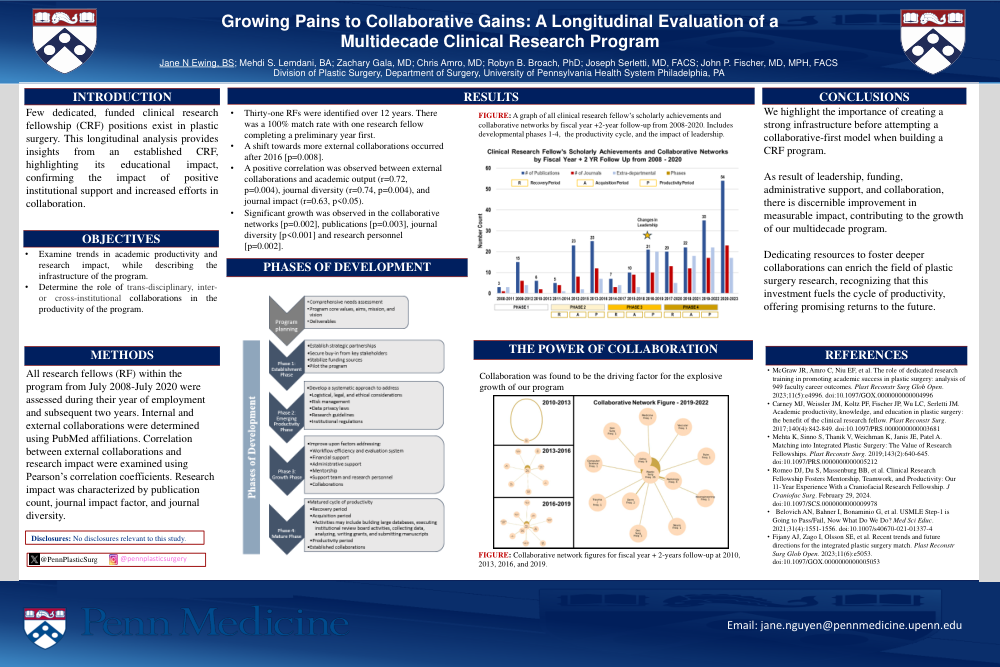
INTRODUCTION: Few dedicated, funded clinical research fellowship (CRF) positions exist in plastic surgery. This longitudinal analysis provides insights from an established CRF, highlighting its educational impact, confirming the impact of positive institutional support and collaborative first approach.
METHODS: All research fellows (RF) within the program from July 2008-July 2020 were examined during their year of employment and subsequent two years. Internal and external collaborations trends were assessed using PubMed affiliations. Correlation between external collaborations and research impact were examined using Pearson’s correlation coefficients. Research impact was characterized by publication count, journal impact factor, and journal diversity.
RESULTS: Thirty-one RFs were identified over 12 years. There was a 100% match rate with one RF completing a preliminary year first. Four phases of development were identified, and a 3-period cycle of productivity was noted to occur every three years. A shift towards more external collaborations occurred after 2016 [p=0.008]. A positive correlation was observed between external collaborations and academic output (r=0.72, p=0.004), journal diversity (r=0.74, p=0.004), and journal impact (r=0.63, p<0.05). Overall, significant growth was observed in the collaborative networks [p=0.002], publications [p=0.003], journal diversity [p<0.001] and research personnel [p=0.002].
CONCLUSIONS: As result of institutional support and our strategic decision to engage collaborators across multiple disciplines, there is discernible improvement in measurable impact, contributing to the growth of our multidecade program. Dedicating resources to foster deeper collaborations can enrich the field of plastic surgery research, recognizing that this investment fuels the cycle of productivity, offering promising returns to the future.