Loading...

203 posters, 14 topics, 5 sessions, 817 authors, 256 institutions

ePostersLive by SciGen Technologies S.A. All rights reserved.

The AAPS 102nd Annual Meeting

May 18-21, 2024 | The Westin Copley Place, Boston, MA

The AAPS 102nd Annual Meeting banner

D66

Linguistic Analysis Of Race And Gender Bias In Narrative Letters Of Recommendation For Plastic Surgery Residency Applicants
Part of Topic

Education/Practice Management/Other

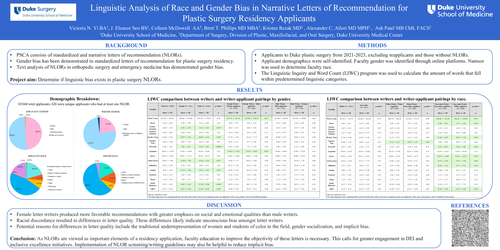
Linguistic Analysis of Race and Gender Bias in Narrative Letters of Recommendation for Plastic Surgery Residency Applicants

Background

•PSCA consists of standardized and narrative letters of recommendation (NLORs).
•Gender bias has been demonstrated in standardized letters of recommendation for plastic surgery residency.
•Text analysis of NLORs in orthopedic surgery and emergency medicine has demonstrated gender bias.


Project aim: Determine if linguistic bias exists in plastic surgery NLORs.


Methods

•Applicants to Duke plastic surgery from 2021-2023, excluding reapplicants and those without NLORs.
•Applicant demographics were self-identified. Faculty gender was identified through online platforms. Namsor was used to determine faculty race.
•The Linguistic Inquiry and Word Count (LIWC) program was used to calculate the amount of words that fell within predetermined linguistic categories.
 
Results

Demographic Breakdown:

Of 666 total applicants, 626 were unique applicants who had at least one NLOR.

LIWC comparison between writers and writer-applicant pairings by gender. 

LIWC comparison between writers and writer-applicant pairings by race.


Discussion

•Female letter writers produced more favorable recommendations with greater emphasis on social and emotional qualities than male writers.
•Racial discordance resulted in differences in letter quality. These differences likely indicate unconscious bias amongst letter writers.
•Potential reasons for differences in letter quality include the traditional underrepresentation of women and students of color in the field, gender socialization, and implicit bias.

Conclusion: As NLORs are viewed as important elements of a residency application, faculty education to improve the objectivity of these letters is necessary. This calls for greater engagement in DEI and inclusive excellence initiatives. Implementation of NLOR screening/writing guidelines may also be helpful to reduce implicit bias.

The AAPS 102nd Annual Meeting » banner
Copyright © 2015-2026, ePostersLive® SciGen is a registered trademark of SciGen Technologies S.A. Patent pending.

This website and third-party tools we use rely on cookies for the best user experience. By selecting "I agree", you agree to cookie usage as described in our Privacy Policy.