203 posters, 14 topics, 5 sessions, 817 authors, 256 institutions
ePostersLive by SciGen Technologies S.A. All rights reserved.
The AAPS 102nd Annual Meeting
May 18-21, 2024 | The Westin Copley Place, Boston, MA

D59
The Long-term Postoperative Pain Course Following Primary And Secondary Targeted Muscle Reinnervation In Amputees
Part of Topic
Hand/Extremity
Introduction
Targeted muscle reinnervation (TMR) has been demonstrated to be effective in the surgical treatment of neuropathic pain for amputees.1,2 However, the long-term postoperative pain course for patients that undergo Primary TMR (<14 days since amputation) or Secondary TMR (≥14 days) TMR surgery is not clearly known. This study aims to describe the long-term post-operative pain course for these patients to aid in managing pain expectations.
Methods
Chart review was performed for amputees who underwent primary and secondary TMR and who were prospectively enrolled between 2018 and 2024, with a minimum follow-up up of 12 months. Pain scores reported on the Numerical Rating Scale (NRS, pain on a 0-10 scale) were collected up to latest follow-up. Mean NRS pain levels were compared between primary and secondary TMR cohorts. Multilevel mixed-effects models were utilized to analyze the difference in pain and visualize average postoperative pain courses.
Results
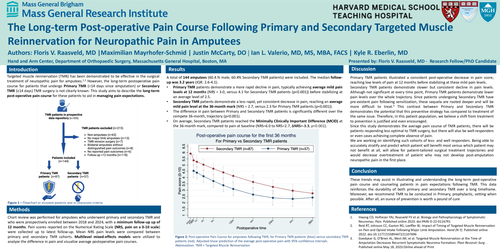
A total of 144 amputees (60.4.% male; 60.4% Secondary TMR patients) were included. The median follow-up was 3.2 years (IQR: 2.6-4.1).
Primary TMR patients illustrated a consistent post-operative decrease in pain score, reaching low levels of pain at 12 months before stabilizing at these mild pain levels.
Secondary TMR patients demonstrate slower but consistent decline in pain levels. Although not significant at every time point, Primary TMR patients demonstrate lower pain levels over the whole trajectory. Since patients undergoing Secondary TMR have pre-existent pain following sensitization, these sequela are rooted deeper and will be more difficult to treat.3 This contrast between Primary and Secondary TMR demonstrates the potential that this preventive strategy has compared to treatment of the same issue. Therefore, in this patient population, we believe a shift from treatment to prevention is justified and even encouraged.
Since this study demonstrates the average pain course of TMR patients, there will be patients responding less optimal to TMR surgery, but there will also be well-responders or even cases achieving complete absence of pain.
We are working on identifying such cohorts of less- and well responders. Being able to accurately stratify and predict which patient will benefit most versus which patient may not benefit at all, will allow for patient-tailored surgical treatment trajectories and would decrease overtreatment of patient who may not develop post-amputation neuropathic pain in the first place.
These trends may assist in illustrating and understanding the long-term post-operative pain course and counseling patients in pain expectations following TMR. This data reinforces the durability of both primary and secondary TMR over a long timeframe. Moreover, we recommend TMR to be conducted in Primary, prophylactic, setting when possible. After all, an ounce of prevention is worth a pound of cure.
References