203 posters, 14 topics, 5 sessions, 817 authors, 256 institutions
ePostersLive by SciGen Technologies S.A. All rights reserved.
The AAPS 102nd Annual Meeting
May 18-21, 2024 | The Westin Copley Place, Boston, MA

D58
A Comparative Analysis Of Patient-reported Outcomes Following Free Tissue Transfer, Partial Foot Amputation, And Below-knee Amputation In High-risk Limb Salvage Patients
Poster Presenter
Authors
Christian Lava, Samuel Huffman, Karen Li, John DiBello, Christopher Ply, Rachel Rohrich, Jayson Atves, John Steinberg, Richard Youn, Christopher Attinger, Karen Evans
Affiliations
Georgetown University School of Medicine, Department of Plastic and Reconstructive Surgery, MedStar Georgetown University Hospital, Department of Podiatric Surgery, Medstar Georgetown University Hospital
Part of Topic
Hand/Extremity
A Comparative Analysis of Patient-Reported Outcomes Following Free Tissue Transfer, Partial Foot Amputation, and Below-Knee Amputation in High-Risk Limb Salvage Patients
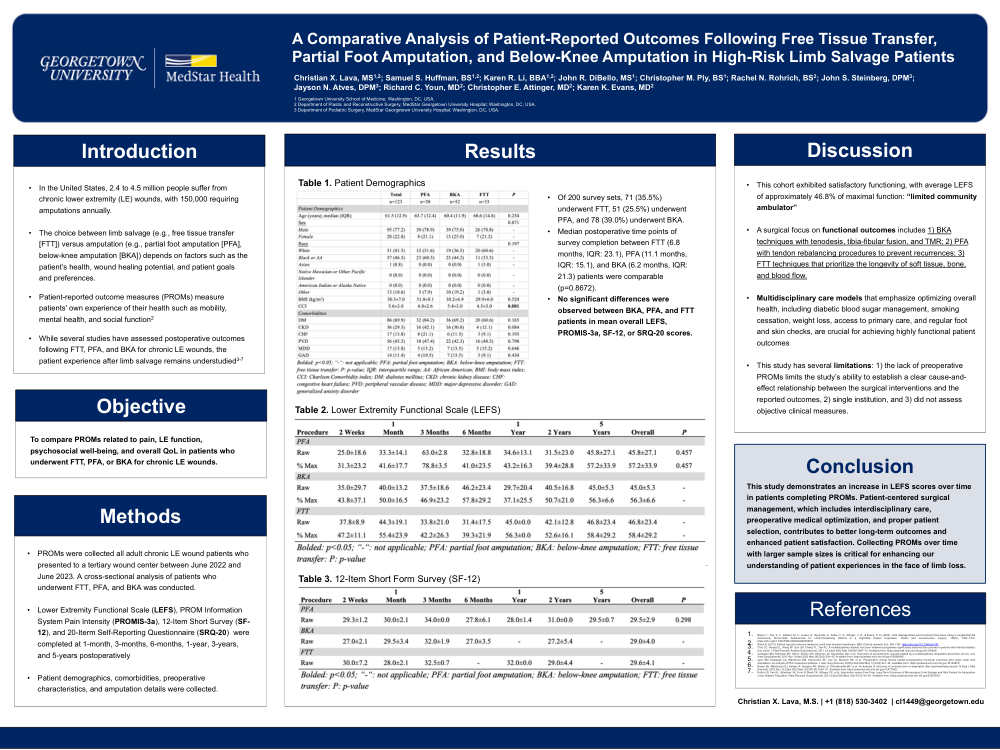
Background: The surgical decision for limb-salvage with free tissue transfer (FTT), partial foot amputation (PFA), or below-knee amputation (BKA) for complex lower extremity (LE) wounds hinges on several factors, including patient choice and baseline function. However, patient-reported outcome measures (PROMs) on LE function, pain, and QoL for chronic LE wound interventions are limited. Thus, the study aim was to compare PROMs in patients who underwent FTT, PFA, or BKA for chronic LE wounds.
Methods: PROMs were collected via QR code for all adult chronic LE wound patients who presented to a tertiary wound center between June 2022 and June 2023. A cross-sectional analysis of patients who underwent FTT, PFA, or BKA was conducted. The 12-Item Short Survey (SF-12), PROM Information System Pain Intensity (PROMIS-3a), and Lower Extremity Functional Scale (LEFS), were completed at 1-month, 3-months, 6-months, 1-year, 3-years, and 5-years postoperatively. Patient demographics, comorbidities, preoperative characteristics, and amputation details were collected.
Results: Of 200 survey sets, 71 (35.5%) underwent FTT, 51 (25.5%) underwent PFA, and 78 (39.0%) underwent BKA. Median postoperative time points of survey completion between FTT (6.8 months, IQR: 23.1), PFA (11.1 months, IQR: 15.1), and BKA (6.2 months, IQR: 21.3) patients were comparable (p=0.8672). Most patients were male (n=92, 76.0%) with an average age and body mass index (BMI) of 61.8±12.6 years and 30.3±7.0 kg/m2, respectively. Comorbidities for FTT, PFA, and BKA patients included diabetes mellitus (DM; 60.6% vs. 81.6% vs. 67.3%; p=0.165), peripheral vascular disease (PVD; 48.5% vs. 47.4% vs. 42.3%; p=0.790), and chronic kidney disease (CKD; 12.1% vs. 28.8% vs. 42.1%; p=0.084). No significant differences were observed between BKA, PFA, and FTT patients in mean overall PROMIS-3a T-scores (49.6±14.8 vs. 54.2±11.8 vs. 49.6±13.7; p=0.0976), LEFS scores (37.5±18.0 vs. 34.6±18.3 vs. 38.5±19.4; p=0.4567), or SF-12 scores (28.0±8.6 vs. 29.5±2.9 vs. 29.0±4.0; p=0.298).
Conclusion: Patients receiving FTT, PFA, or BKA for chronic LE wounds achieve comparable levels of LE function, pain, and QoL postoperatively. Patient-centered functionally-based surgical management for chronic LE wounds using interdisciplinary care, preoperative medical optimization, and proper patient selection optimizes postoperative PROMs.