203 posters, 14 topics, 5 sessions, 817 authors, 256 institutions
ePostersLive by SciGen Technologies S.A. All rights reserved.
The AAPS 102nd Annual Meeting
May 18-21, 2024 | The Westin Copley Place, Boston, MA

D55
Surgical Specialty Most Implicated In The Treatment Of Gunshot Wound-related Injuries Stratified By State Gun Law Strength
Poster Presenter
Authors
George Corpuz, Ishani Premaratne, Chunhui Wang, Sophia Salingaros, Yoshiko Toyoda, Paul Kurlansky, Christine Rohde
Affiliations
Division of Plastic and Reconstructive Surgery, Department of Surgery, Weill Cornell Medicine/NewYork-Presbyterian Hospital, Division of Plastic and Reconstructive Surgery, Department of Surgery, Weill Cornell Medicine/NewYork-Presbyterian Hospital, New York, New York, Division of Plastic and Reconstructive Surgery, Department of Surgery, University of Southern California, Los Angeles, California, Division of Plastic Surgery, Department of Surgery, University of Pennsylvania, Philadelphia, Pennsylvania, Division of Plastic and Reconstructive Surgery, Department of Surgery, Columbia University Medical Center/NewYork-Presbyterian Hospital, New York, New York, Center for Innovation and Outcomes Research, Department of Surgery, Columbia University Medical Center, New York, New York
Part of Topic
Education/Practice Management/Other
Surgical Specialty Most Implicated in the Treatment of Gunshot Wound-related Injuries Stratified by State Gun Law Strength
George S. Corpuz BA BS*1,2, Ishani D. Premaratne MD*2,3, Chunhui Wang PhD*5, Sophia Salingaros BA1,2, Yoshiko Toyoda MD4, Paul A. Kurlansky MD5, Christine H. Rohde MD MPH2
1 Division of Plastic and Reconstructive Surgery, Department of Surgery, Weill Cornell Medicine/NewYork-Presbyterian Hospital, New York, New York; 2 Division of Plastic and Reconstructive Surgery, Department of Surgery, Columbia University Medical Center/NewYork-Presbyterian Hospital, New York, New York; 3 Division of Plastic and Reconstructive Surgery, Department of Surgery, University of Southern California, Los Angeles, California; 4 Division of Plastic Surgery, Department of Surgery, University of Pennsylvania, Philadelphia, Pennsylvania; 5 Center for Innovation and Outcomes Research, Department of Surgery, Columbia University Medical Center, New York, New York; *These authors contributed equally and are co-first authors.
Background
Gunshot wound (GSW) injuries are estimated to cost the healthcare system as much as $126 billion annually. Prior studies examining the national cost of the surgical treatment of GSWs have demonstrated that reconstructive orthopedic and plastic surgery are most implicated in terms of both number of procedures and cost. Given the wide variety in state-based approaches to gun safety laws, we sought to evaluate the incidence of surgical GSW injuries with an emphasis on surgical subspecialties.
Methods
Thirteen states were chosen based on available data using the Healthcare Cost and Utilization Project — State Inpatient Database (HCUP-SID) and stratified by their gun law strength ranking as validated by the Giffords Law Center. HCUP-SID was queried for GSW injuries and subsequent surgical procedures using ICD-10 codes for the following specialties: neurosurgery, head and neck surgery, thoracic surgery, cardiac surgery, vascular surgery, gastrointestinal surgery, genitourinary surgery, and reconstructive (orthopedic and plastic) surgery. A Cochran-Armitage statistical model was then used to determine correlations between number of procedures performed and state gun law strength.
Results
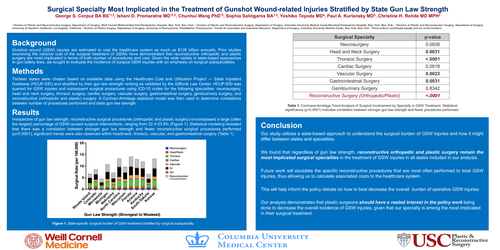
Irrespective of gun law strength, reconstructive surgical procedures (orthopedic and plastic surgery) encompassed a large (often the largest) percentage of GSW-caused surgical interventions, ranging from 32.4-53.9% (Figure 1). Statistical modeling revealed that there was a correlation between stronger gun law strength and fewer reconstructive surgical procedures performed (p<0.0001); significant trends were also observed within head/neck, thoracic, vascular, and gastrointestinal surgery (Table 1).
Figure 1. State-specific surgical burden of GSW treatment stratified by surgical subspecialty
Table 1. Cochrane-Armitage Trend Analysis of Surgical Involvement by Specialty in GSW Treatment. Statistical significance (p<0.0001) indicates correlation between stronger gun law strength and fewer procedures performed.
Conclusion
Our study utilizes a state-based approach to understand the surgical burden of GSW injuries and how it might differ between states and specialties. We found that regardless of gun law strength, reconstructive orthopedic and plastic surgery remain the most implicated surgical specialties in the treatment of GSW injuries in all states included in our analysis. Future work will elucidate the specific reconstructive procedures that are most often performed to treat GSW injuries, thus allowing us to calculate associated costs to the healthcare system. This will help inform the policy debate on how to best decrease the overall burden of operative GSW injuries. Our analysis demonstrates that plastic surgeons should have a vested interest in the policy work being done to decrease the overall incidence of GSW injuries, given that our specialty is among the most implicated in their surgical treatment.