4,068 posters, 219 videos, 101 topics, 69 sessions, 14,365 authors, 6,128 institutions
ePostersLive by SciGen Technologies S.A. All rights reserved.
Alzheimer's Association International Conference 2026
July 12-15, 2026 | London, United Kingdom, and Online

13798
Characterizing Exceptional Gait Speed In Late Life: The Super Mover Phenotype Among Adults 80+ In Colombia
Poster Presenter
Authors
Isabella Bonilla-Arbelaez, Daniel Vasquez, Alejandro Guerrero, Elkin Garcia-Cifuentes, Eugenia Hurtado, Jonathan Ruiz-Triviño, María José Hidalgo, Diana Alzate, Yamile Bocanegra, Claudia Muñoz, Claudia Aponte, Juan Camilo Becerra, Liliana Hincapie, Joseph F. Arboleda-Velasquez, Yakeel T Quiroz, David Aguillón
Affiliations
Grupo de Neurociencias de Antioquia, Facultad de Medicina, Universidad de Antioquia, Medellín, Colombia, University of Toronto, Toronto, Canada, Schepens Eye Research Institute of Mass Eye and Ear and Department of Ophthalmology, Harvard Medical School, Boston, USA, Department of Psychiatry, Massachusetts General Hospital, Boston, Massachusetts, USA. Boston University, Boston, Massachusetts, USA
Part of Topic
Clinical Manifestations -> Neuropsychiatry and Behavioral Neurology -> Geriatrics / Allied Health
Characterizing Exceptional Gait Speed in Late Life: The Super Mover Phenotype Among Adults 80+ in Colombia
Isabella Bonilla-Arbeláez 1, Daniel Vasquez 1, Alejandro Guerrero 1, Elkin Garcia-Cifuentes 1,2, Eugenia Hurtado 1, Jonathan Ruiz-Triviño 1, María José Hidalgo 1, Diana Alzate 1, Yamile Bocanegra 1, Claudia Muñoz 1, Claudia Aponte 1, Juan Camilo Becerra 1, Liliana Hincapie 1, Joseph F. Arboleda-Velasquez 3, Yakeel T Quiroz 4,5, David Aguillón 1
Affiliation:
-
Grupo de Neurociencias de Antioquia, Facultad de Medicina, Universidad de Antioquia, Medellín, Colombia
-
University of Toronto, Toronto, Canada
-
Schepens Eye Research Institute of Mass Eye and Ear and Department of Ophthalmology, Harvard Medical School, Boston, USA
-
Department of Psychiatry, Massachusetts General Hospital, Boston, Massachusetts, USA
-
Boston University, Boston, Massachusetts, USA
Correspondence: david.aguillon@gna.org.co
Introduction
Healthy aging involves preservation of physical and cognitive function, with gait speed (GS) serving as a marker of neurocognitive complexity. Motoric cognitive risk syndrome identifies slow gait as an early marker of cognitive decline. The potential for fast gait speed as a marker of resilience remains underexplored. The Super Mover (SM) phenotype is a novel term described for the first time in 2025, defined as individuals aged 80 and older with GS of ≥ 1.5 standard deviations above sex-adjusted cut scores .
Objective
To identify and characterize the SM phenotype in a Colombian sample, comparing their sociodemographic profile and cognitive performance withNormal Movers (NM). To examine whether there is a relationship between exceptional physical performance and better cognitive function.
Methods
A cross-sectional, observational study was conducted with 50 participants from the Grupo de Neurociencias de Antioquia. Inclusion criteria were: age ≥80 years and availability of motor and neuropsychological assessments. They were classified as SM if their GS exceeded 1.5 SD above age - and sex - specific colombian means. Cut-offs were set at GS ≥ 0.805 m/s for women and ≥0.975 m/s for men;participants below these were classified as NM. Assessment included handgrip strength, functional independence, and a comprehensive neuropsychological battery. Analyses were performed using R.
Results
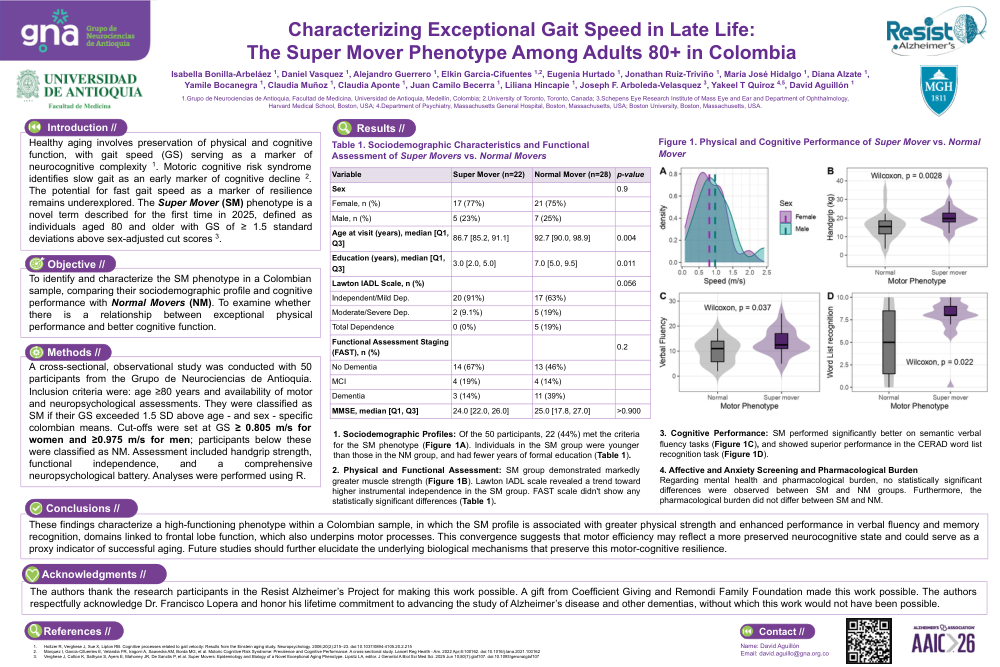
1. Sociodemographic Profiles: Of the 50 participants, 22 (44%) met the criteria for the SM phenotype (Figure 1A). Individuals in the SM group were younger than those in the NM group, and had fewer years of formal education (Table 1).
2. Physical and Functional Assessment: SM group demonstrated markedly greater muscle strength (Figure 1B). Lawton IADL scale revealed a trend toward higher instrumental independence in the SM group. FAST scale didn't show any statistically significant differences (Table 1).
3. Cognitive Performance: SM performed significantly better on semantic verbal fluency tasks (Figure 1C), and showed superior performance in the CERAD word list recognition task (Figure 1D).
4. Affective and Anxiety Screening and Pharmacological Burden Regarding mental health and pharmacological burden, no statistically significant differences were observed between SM and NM groups. Furthermore, the pharmacological burden did not differ between SM and NM.
Conclusions
Comments
Email is required but is not shown publicly.
Loading comments...