4,068 posters, 219 videos, 101 topics, 69 sessions, 14,365 authors, 6,128 institutions
ePostersLive by SciGen Technologies S.A. All rights reserved.
Alzheimer's Association International Conference 2026
July 12-15, 2026 | London, United Kingdom, and Online

11829
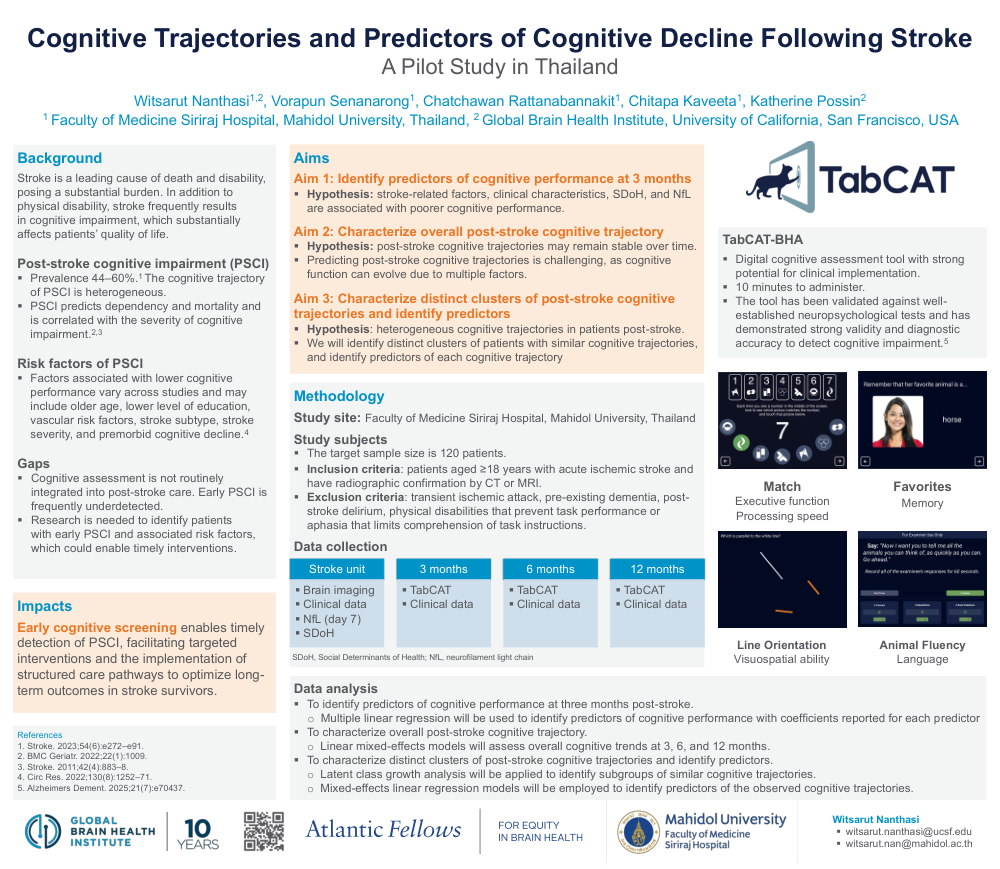
Cognitive Trajectories And Predictors Of Cognitive Decline Following Stroke
Poster Presenter
Authors
Part of Topic
Clinical Manifestations -> Neuropsychiatry and Behavioral Neurology -> Diagnosis and Staging - Symptomatic (mild cognitive impairment and dementia)
Background: Post-stroke cognitive impairment (PSCI) significantly affects quality of life, functional outcomes, and survival among stroke patients, with a reported prevalence of 44-60% of stroke survivors. Although cognitive trajectories vary, patients with low to moderate cognitive performance three months after stroke rarely improve and are at increased risk of dependency and mortality, particularly when multiple cognitive domains are affected. Risk factors for PSCI vary across studies and populations. Despite its clinical importance, cognitive assessment is often underemphasized in routine stroke care due to time constraints, the need for specialized training, and a clinical focus that prioritizes motor and physical outcomes.
Methods: Cognitive performance in post-stroke patients will be assessed longitudinally using the Brain Health Assessment, a brief, tablet-based tool (TabCAT-BHA) with strong potential for clinical implementation due to its simple administration and automated scoring. Assessments will be conducted in 120 patients at discharge, followed by outpatient follow-ups at 3, 6 and 12 months post-stroke. Linear mixed-effects models will be used to characterize overall cognitive trajectories over time, and latent class growth analysis will be applied to identify clusters of patients with similar cognitive trajectories. Clinical data and social determinants of health will also be collected to identify factors predicting cognitive trajectories.
Results: Cognitive trajectories within each cluster will be characterized, and factors predicting each trajectory will be identified. We hypothesize that cognitive trajectories can be classified into three groups (improved, stable, and decline) and that distinct predictive factors will be associated with each group. We anticipate that poor control of vascular risk factors, larger infarct volume, and greater social disadvantage will be associated with a higher likelihood of belonging to the decline trajectory group. These findings will support the development of care pathways and inform personalized interventions to prevent further cognitive decline.
Conclusion: Post-stroke cognitive trajectories will be identified along with their predictive factors. This project will provide valuable clinical insights into PSCI, help identify potential intervention strategies, and demonstrate the benefits of integrating cognitive assessment into routine stroke care.
Comments
Email is required but is not shown publicly.
Loading comments...