4,068 posters, 219 videos, 101 topics, 69 sessions, 14,365 authors, 6,128 institutions
ePostersLive by SciGen Technologies S.A. All rights reserved.
Alzheimer's Association International Conference 2026
July 12-15, 2026 | London, United Kingdom, and Online

11788
A Brief Digital Symbol-coding Task Outperforms Clinical Benchmarks For Alzheimer’s Trial Pre-enrichment
Poster Presenter
Part of Topic
Clinical Manifestations -> Neuropsychology -> Computerized / Digital Neuropsychological Assessments
A Brief Digital Symbol-Coding Task Outperforms Clinical Benchmarks For Alzheimer’s Trial Pre-enrichment
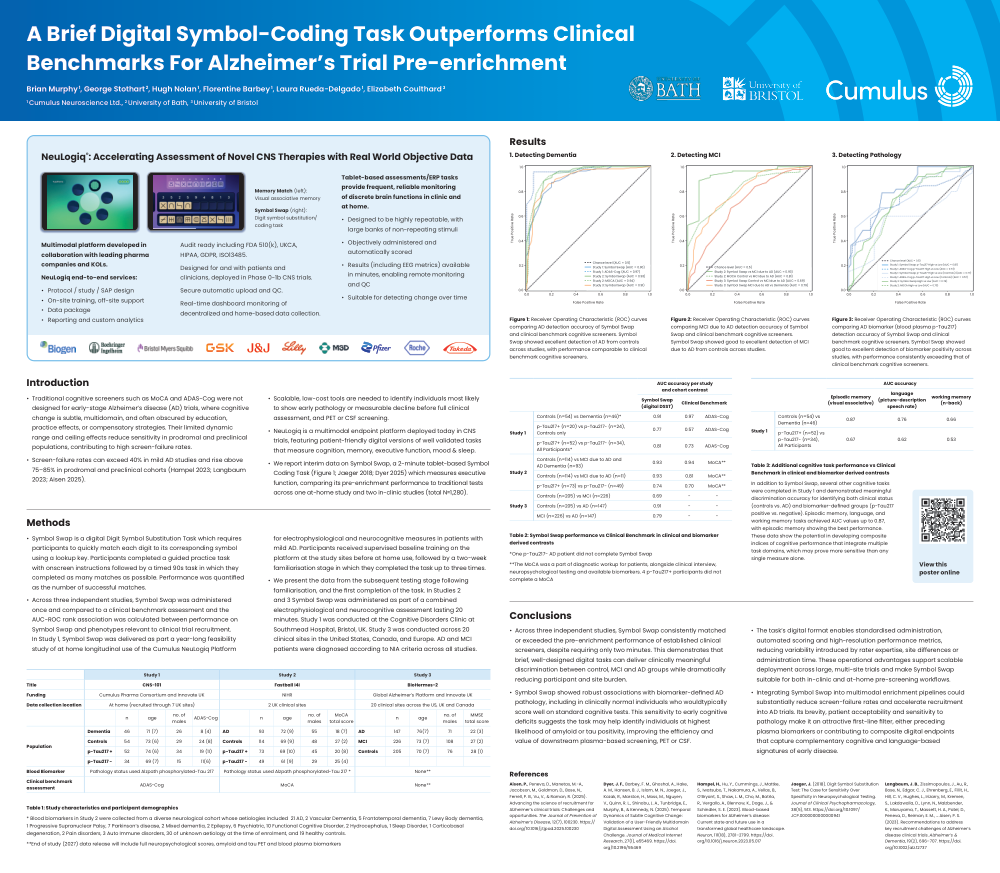
Introduction • Traditional cognitive screeners such as MoCA and ADAS-Cog were not designed for early-stage Alzheimer’s disease (AD) trials, where cognitive change is subtle, multidomain, and often obscured by education, practice effects, or compensatory strategies. Their limited dynamic range and ceiling effects reduce sensitivity in prodromal and preclinical populations, contributing to high screen-failure rates. • Screen-failure rates can exceed 40% in mild AD studies and rise above 75–85% in prodromal and preclinical cohorts (Hampel 2023; Langbaum 2023; Aisen 2025). • Scalable, low-cost tools are needed to identify individuals most likely to show early pathology or measurable decline before full clinical assessment, and PET or CSF screening. • NeuLogiq is a multimodal endpoint platform deployed today in CNS trials, featuring patient-friendly digital versions of well validated tasks that measure cognition, memory, executive function, mood & sleep. • We report interim data on Symbol Swap, a 2‑minute tablet‑based Symbol Coding Task (Figure 1; Jaeger 2018; Dyer 2025) which measures executive function, comparing its pre-enrichment performance to traditional tests across one at‑home study and two in‑clinic studies (total N≈1,280)
Methods • Symbol Swap is a digital Digit Symbol Substitution Task which requires participants to quickly match each digit to its corresponding symbol using a lookup key. Participants completed a guided practice task with onscreen instructions followed by a timed 90s task in which they completed as many matches as possible. Performance was quantified as the number of successful matches. • Across three independent studies, Symbol Swap was administered once and compared to a clinical benchmark assessment and the AUC-ROC rank association was calculated between performance on Symbol Swap and phenotypes relevant to clinical trial recruitment. In Study 1, Symbol Swap was delivered as part a year-long feasibility study of at home longitudinal use of the Cumulus NeuLogiq Platform for electrophysiological and neurocognitive measures in patients with mild AD. Participants received supervised baseline training on the platform at the study sites before at home use, followed by a two-week familiarisation stage in which they completed the task up to three times. • We present the data from the subsequent testing stage following familiarisation, and the first completion of the task. In Studies 2 and 3 Symbol Swap was administered as part of a combined electrophysiological and neurocognitive assessment lasting 20 minutes. Study 1 was conducted at the Cognitive Disorders Clinic at Southmead Hospital, Bristol, UK. Study 3 was conducted across 20 clinical sites in the United States, Canada, and Europe. AD and MCI patients were diagnosed according to NIA criteria across all studies.
Results • see poster
Conclusions • Across three independent studies, Symbol Swap consistently matched or exceeded the pre-enrichment performance of established clinical screeners, despite requiring only two minutes. This demonstrates that brief, well-designed digital tasks can deliver clinically meaningful discrimination between control, MCI and AD groups while dramatically reducing participant and site burden. • Symbol Swap showed robust associations with biomarker‑defined AD pathology, including in clinically normal individuals who wouldtypically score well on standard cognitive tests. This sensitivity to early cognitive deficits suggests the task may help identify individuals at highest likelihood of amyloid or tau positivity, improving the efficiency and value of downstream plasma-based screening, PET or CSF. • The task’s digital format enables standardised administration, automated scoring and high-resolution performance metrics, reducing variability introduced by rater expertise, site differences or administration time. These operational advantages support scalable deployment across large, multi-site trials and make Symbol Swap suitable for both in‑clinic and at‑home pre‑screening workflows. • Integrating Symbol Swap into multimodal enrichment pipelines could substantially reduce screen-failure rates and accelerate recruitment into AD trials. Its brevity, patient acceptability and sensitivity to pathology make it an attractive first‑line filter, either preceding plasma biomarkers or contributing to composite digital endpoints that capture complementary cognitive and language-based signatures of early disease.
Comments
Email is required but is not shown publicly.
Loading comments...