Loading...

4,068 posters, 219 videos, 101 topics, 69 sessions, 14,365 authors, 6,128 institutions

ePostersLive by SciGen Technologies S.A. All rights reserved.

Alzheimer's Association International Conference 2026

July 12-15, 2026 | London, United Kingdom, and Online

Alzheimer's Association International Conference 2026 banner

11825

Limited Utility Of The A/T/N Framework For Predicting Neurocognitive Outcomes In People With HIV
Part of Topic

Clinical Manifestations -> Neuropsychology -> Neuropsychological and Biomarker Correlations

Limited Utility Of The A/T/N Framework For Predicting Neurocognitive Outcomes In People With HIV

Kiely N. Bol, BA1, Erin E. Sundermann, PhD2, David J. Moore, PhD2

1SDSU / UC San Diego Joint Doctoral Program in Clinical Psychology, San Diego, CA, United States 

2Department of Psychiatry, University of California, San Diego, La Jolla, CA, United States


Background and Aim:

•Due to the success of antiretroviral therapy, people with HIV (PWH) are living to older ages at which Alzheimer's disease (AD) risk emerges, potentially amplified by the synergistic effects of HIV-related biological vulnerabilities and age on neural insult
•AD pathology has been found in some older PWH; however, evidence regarding their level in comparison to people without HIV and their relationship to cognition is inconsistent, making the clinical significance of this pathology unclear
•The A/T/N framework categorizes individuals based on biomarkers of amyloid deposition (A), tau pathology (T), and neurodegeneration or neuronal injury (N)
•Aim: To examine whether the A/T/N framework predicts neurocognitive functioning in PWH
 
Methods:
•A/T/N biomarkers—amyloid-beta (A), phosphorylated tau (T), and total tau (N)—were measured in the CSF of 101 PWH (44.8 ± 9.3 years, 80.2% male, 71.3% report ART usage) and dichotomized into positive/negative status
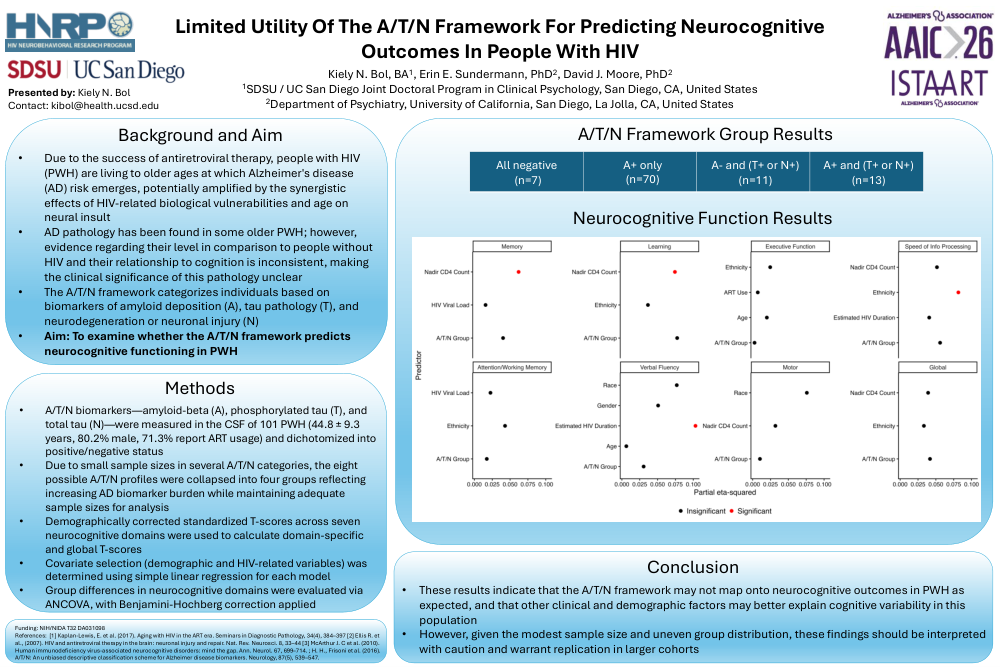
•Due to small sample sizes in several A/T/N categories, the eight possible A/T/N profiles were collapsed into four groups reflecting increasing AD biomarker burden while maintaining adequate sample sizes for analysis
•Demographically corrected standardized T-scores across seven neurocognitive domains were used to calculate domain-specific and global T-scores
•Covariate selection (demographic and HIV-related variables) was determined using simple linear regression for each model
•Group differences in neurocognitive domains were evaluated via ANCOVA, with Benjamini-Hochberg correction applied
 
A/T/N Framework Group Results:

All negative (n=7), A+ only (n=70), A- and (T+ or N+)(n=11), A+ and (T+ or N+)(n=13)

Neurocognitive Function Results:

*See e-poster*


Conclusion:

•These results indicate that the A/T/N framework may not map onto neurocognitive outcomes in PWH as expected, and that other clinical and demographic factors may better explain cognitive variability in this population
•However, given the modest sample size and uneven group distribution, these findings should be interpreted with caution and warrant replication in larger cohorts

Funding: NIH/NIDA T32 DA031098

References:  [1] Kaplan-Lewis, E. et al. (2017). Aging with HIV in the ART era. Seminars in Diagnostic Pathology, 34(4), 384–397 [2] Ellis R. et al., (2007). HIV and antiretroviral therapy in the brain: neuronal injury and repair. Nat. Rev. Neurosci. 8, 33–44 [3] McArthur J. C et al. (2010). Human immunodeficiency virus-associated neurocognitive disorders: mind the gap. Ann. Neurol. 67, 699–714. ; H. H., Frisoni et al. (2016). A/T/N: An unbiased descriptive classification scheme for Alzheimer disease biomarkers. Neurology, 87(5), 539–547. 

Comments

Email is required but is not shown publicly.

Loading comments...

aaic2026 banner
Copyright © 2015-2026, ePostersLive® SciGen is a registered trademark of SciGen Technologies S.A. Patent pending.

This website and third-party tools we use rely on cookies for the best user experience. By selecting "I agree", you agree to cookie usage as described in our Privacy Policy.