4,068 posters, 219 videos, 101 topics, 69 sessions, 14,365 authors, 6,128 institutions
ePostersLive by SciGen Technologies S.A. All rights reserved.
Alzheimer's Association International Conference 2026
July 12-15, 2026 | London, United Kingdom, and Online

13565
Remote, Unsupervised Administration Of The Online Repeatable Cognitive Assessment (ORCA) Is Feasible And Acceptable
Poster Presenter
Authors
Kaycee Sink, Karra Harrington, Annie Aitken, Gabriel Stellman, Paul Maruff
Affiliations
Part of Topic
Clinical Manifestations -> Neuropsychology -> Computerized / Digital Neuropsychological Assessments
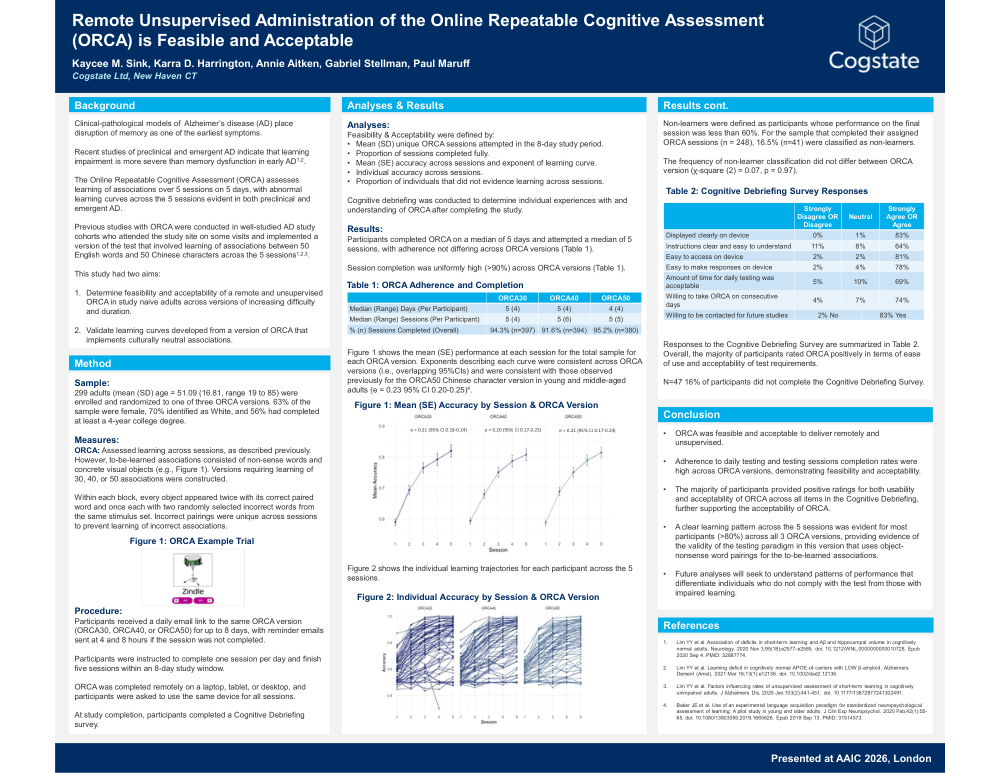
Background: Advances in Alzheimer’s disease biomarkers have enabled very early diagnosis and support the push towards treatment trials in asymptomatic individuals. However, sensitive measures of the earliest signs of decline, such as inefficiencies in learning which precede memory impairment, are needed to measure the effectiveness of early intervention and potentially enrich for optimal candidates. We evaluated feasibility, acceptability, and performance of the Online Repeatable Cognitive Assessment (ORCA), administered remotely and unsupervised.
Methods: ORCA measures learning using a burst-learning paradigm. Participants learn a nonsense language by associating pseudo-words with familiar images across repeated exposures. A total of 173 younger (YA, 18–45 years) and older (OA, 55–85 years) adults enrolled and were assigned to one of three ORCA versions (30, 40, or 50- stimulus pairs). They completed ORCA twice daily (back-to-back) for 5 days. Email reminders were sent each morning, with follow-ups at 4 and 8 hours if not completed. Outcomes were adherence, acceptability, and accuracy. Mean daily accuracy was used to generate learning curves for each version, stratified by age.
Results: After excluding 32 participants (23 completed only one visit; 9 enrolled more than once), mean ages were 35 (YA) and 65 (OA) years. Most participants were women (~65%), and all but two had ≥ high school education. Compliance was similar by age. OAs completed a mean (SD) of 4.3(0.9), 4.4(0.8), and 4.8(0.7) days of testing in the 30-, 40-, and 50-pair groups, respectively. Day 1 accuracy was similar between age groups; thereafter, YA learned faster and achieved higher mean daily accuracy than OA, as expected. Acceptability was high, with 89% willing to complete the assessment on consecutive days if asked again (Figure).
Conclusions: ORCA, a multiday learning assessment, was feasible to deliver remotely and acceptable to older adults, with high compliance to daily testing. Differences in learning curves between YA and OA across stimulus-pair counts support sensitivity to age-related differences in learning. Longitudinal outcomes and correlations with biomarkers are pending and will inform further development and use of this learning measure.
Comments
Email is required but is not shown publicly.
Loading comments...