4,068 posters, 219 videos, 101 topics, 69 sessions, 14,365 authors, 6,128 institutions
ePostersLive by SciGen Technologies S.A. All rights reserved.
Alzheimer's Association International Conference 2026
July 12-15, 2026 | London, United Kingdom, and Online

13473
Test Language Effects On Nonverbal California Cognitive Assessment Battery Performance In Spanish Speakers
Poster Presenter
Part of Topic
Clinical Manifestations -> Neuropsychology -> Computerized / Digital Neuropsychological Assessments
Introduction
US Latinos are 1.5x more likely than non-Latino white adults to develop Alzheimer's disease and related dementias (ADRD), and prevalence is projected to increase sevenfold by 2060. Accurate cognitive assessment in Spanish-speaking populations is critical for reducing disparities in ADRD detection and monitoring. The California Cognitive Assessment Battery (CCAB) is an automated, tablet-based battery with a validated Spanish-language protocol (CCAB-Español) for remote cognitive assessment. However, whether performance differences between Spanish- and English-language administrations reflect genuine cognitive differences or testing-context effects remains unclear.
Methods
Participants: The California Cognitive Assessment Battery (CCAB) was administered to 169 healthy adult native Spanish speakers during ongoing normative data collection. Participants completed a range of cognitive tasks, including verbal response tasks.1:1 nearest-neighbor matching from an English speaking Latino cohort on age, education, gender, and vocabulary yielded 169 matched pairs (Spanish: M age=47.1, SD=13.8, 59.8% female; English: M age=46.8, SD=13.6, 59.8% female; all p > .41).
Technology:Participants were tested using a tablet computer with circumaural headphones and a head-mounted microphone. Instructions and stimuli were delivered using text-to-speech (TTS) with intensities adjusted to the participant’s auditory threshold. Non-verbal responses were recorded via the tablet’s touch screen at a variable sample rate from 30 to 60 hz. Select tests were performed with a calibrated usb mouse. An examiner remotely monitored participant performance over audio and visual feeds.
Tasks: Participants performed seven nonverbal tasks spanning executive function, processing speed, visuospatial ability, and working memory, in addition to other verbal tasks and non-verbal tasks. Digitized CCAB versions of the following tasks were administered: Trails A/B, Design Fluency, Spatial Span, Hidden Patterns, Identical Pictures, and Figure Drawing.
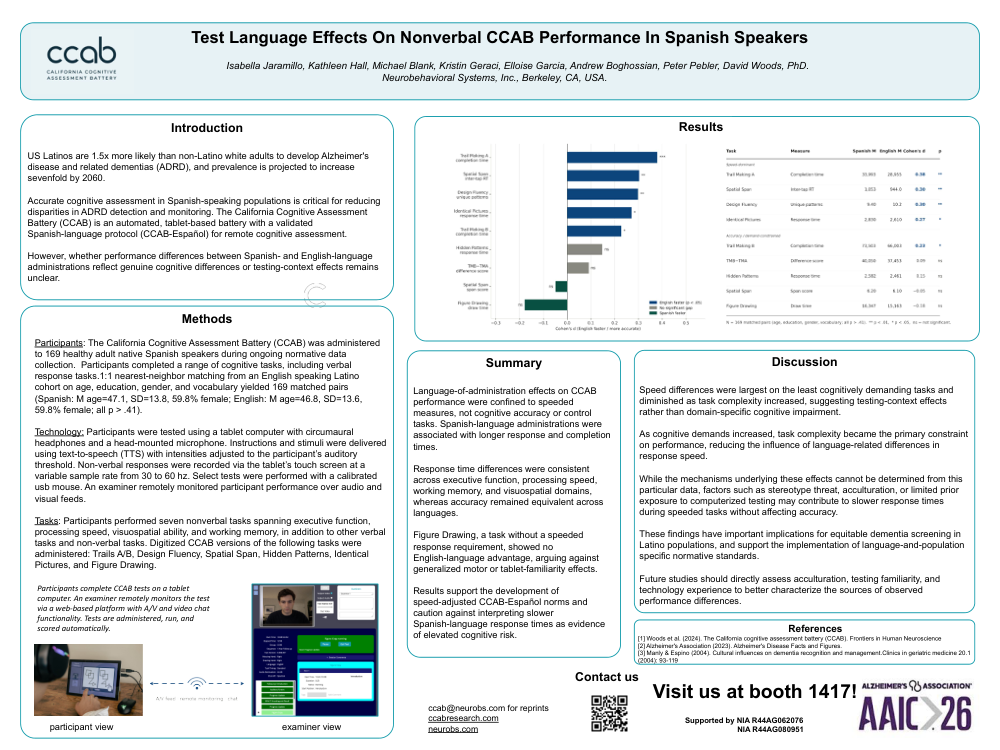
Summary:Language-of-administration effects on CCAB performance were confined to speeded measures, not cognitive accuracy or control tasks. Spanish-language administrations were associated with longer response and completion times.Response time differences were consistent across executive function, processing speed, working memory, and visuospatial domains, whereas accuracy remained equivalent across languages.. Figure Drawing, a task without a speeded response requirement, showed no English-language advantage, arguing against generalized motor or tablet-familiarity effects.Results support the development of speed-adjusted CCAB-Español norms and caution against interpreting slower Spanish-language response times as evidence of elevated cognitive risk.
Discussion: Speed differences were largest on the least cognitively demanding tasks and diminished as task complexity increased, suggesting testing-context effects rather than domain-specific cognitive impairment. As cognitive demands increased, task complexity became the primary constraint on performance, reducing the influence of language-related differences in response speed. While the mechanisms underlying these effects cannot be determined from this particular data, factors such as stereotype threat, acculturation, or limited prior exposure to computerized testing may contribute to slower response times during speeded tasks without affecting accuracy. These findings have important implications for equitable dementia screening in Latino populations, and support the implementation of language-and-population specific normative standards. Future studies should directly assess acculturation, testing familiarity, and technology experience to better characterize the sources of observed performance differences.
Comments
Email is required but is not shown publicly.
Loading comments...