4,068 posters, 219 videos, 101 topics, 69 sessions, 14,365 authors, 6,128 institutions
ePostersLive by SciGen Technologies S.A. All rights reserved.
Alzheimer's Association International Conference 2026
July 12-15, 2026 | London, United Kingdom, and Online

13367
Timing Of Sleep-Disordered Breathing And Alzheimer’s Disease - Apnoeas In REM Versus NREM Sleep
Poster Presenter
Part of Topic
Clinical Manifestations -> Neuropsychiatry and Behavioral Neurology -> Real-world Data / Real-world Evidence
Timing of sleep-disordered breathing and Alzheimer’s disease – Apnoeas in REM versus non-REM sleep
Background
Sleep is considered a potentially modifiable risk factor for dementia. Sleep apnoea, a common respiratory sleep disorder, has been shown to augment Alzheimer’s disease (AD) pathology (e.g. β-amyloid and tau).
Apnoeas can occur in different sleep stages. Apnoeas occurring in rapid eye movement (REM) versus non-REM (NREM) sleep may have differential mechanisms of accelerating neurodegenerative diseases and disrupting sleep and cognition performance.
Females are more likely to develop AD whereas males are more likely to have sleep apnoea. AD and the menopause may contribute to a different apnoea REM and NREM proportions between the sexes.
Objectives
Study design
An exploratory interim secondary analysis of the Sleep Apnoea and Memory study which is determining prevalence of sleep apnoea in memory clinics. Participants undergo one night using a respiratory polygraphy (WatchPAT300). An automated algorithm (zzzPAT) determined sleep architecture via 4 different channels including pulse rate, SpO2 levels, actigraphy and peripheral arterial tone (PAT) amplitude.
Participant criteria
AD --> clinically probable AD
Non-AD --> No evidence of AD
Cognitive Z score --> combination of Moca and ACE scores
REM and NREM apnoea proportion
ODI3% --> quantity of ODI3% per hour
(NREM ODI3%)/((NREM ODI3%+REM ODI3%))
Regression models
Objective 1) REM and NREM ODI3% Proportion ~ AD diagnosis
Objective 2) REM and NREM ODI3% Proportion ~ AD diagnosis * sex + age
Objective 3) Cognitive z-scores ~ REM and NREM ODI3% proportion + overall ODI3% + sex + age + AD diagnosis
Results
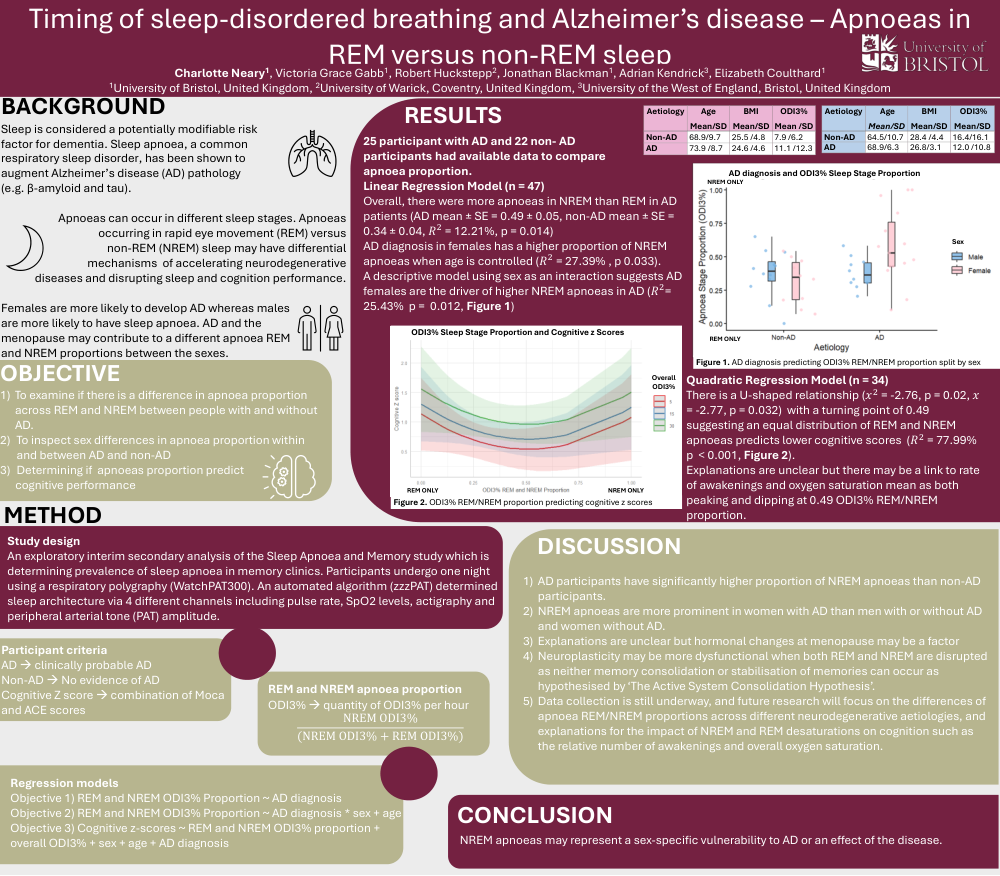
25 participant with AD and 22 non- AD participants had available data to compare apnoea proportion.
Linear Regression Model (n = 47)
Overall, there were more apnoeas in NREM than REM in AD patients (AD mean ± SE = 0.49 ± 0.05, non-AD mean ± SE = 0.34 ± 0.04, R^2 = 12.21%, p = 0.014)
AD diagnosis in females has a higher proportion of NREM apnoeas when age is controlled (R^2 = 27.39% , p 0.033).
A descriptive model using sex as an interaction suggests AD females are the driver of higher NREM apnoeas in AD (R^2= 25.43% p = 0.012, Figure 1)
Quadratic Regression Model (n = 34)
There is a U-shaped relationship (x^2 = -2.76, p = 0.02, x = -2.77, p = 0.032) with a turning point of 0.49 suggesting an equal distribution of REM and NREM apnoeas predicts lower cognitive scores (R^2 = 77.99% p < 0.001, Figure 2).
Explanations are unclear but there may be a link to rate of awakenings and oxygen saturation mean as both peaking and dipping at 0.49 ODI3% REM/NREM proportion.
Discussion
NREM apnoeas may represent a sex-specific vulnerability to AD or an effect of the disease.
Comments
Email is required but is not shown publicly.
Loading comments...