4,068 posters, 219 videos, 101 topics, 69 sessions, 14,365 authors, 6,128 institutions
ePostersLive by SciGen Technologies S.A. All rights reserved.
Alzheimer's Association International Conference 2026
July 12-15, 2026 | London, United Kingdom, and Online

13729
Test-time Scaling And Self-verification For Precision Alzheimer's Diagnostics: Thinking Slower To Think Better
Poster Presenter
Authors
Affiliations
Part of Topic
Clinical Manifestations -> Neuropsychiatry and Behavioral Neurology -> Artificial Intelligence / Machine Learning
ALZHEIMER'S ASSOCIATION
AAIC '26
Test-Time Scaling and Self-Verification for Precision Alzheimer's Diagnostics: Thinking Slower to Think Better
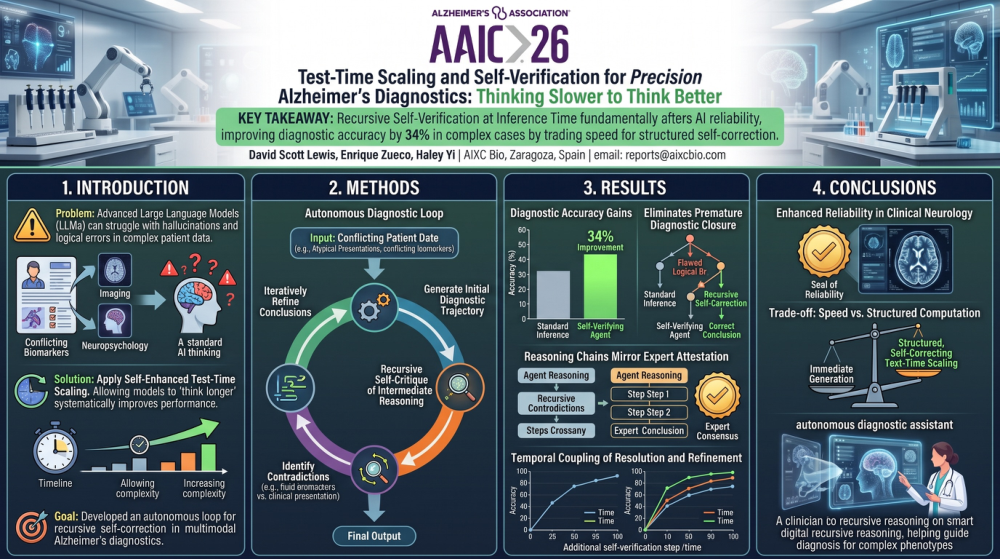
KEY TAKEAWAY: Recursive Self-Verification at Inference Time fundamentally alters AI reliability, improving diagnostic accuracy by 34% in complex cases by trading speed for structured self-correction.
David Scott Lewis, Enrique Zueco, Haley Yi | AIXC Bio, Zaragoza, Spain | email: reports@aixcbio.com
1. INTRODUCTION
Problem: Advanced Large Language Models (LLMs) can struggle with hallucinations and logical errors in complex patient data.
(Diagram: Conflicting Biomarkers, Imaging, Neuropsychology -> Standard AI thinking)
Solution: Apply Self-Enhanced Test-Time Scaling. Allowing models to 'think longer' systematically improves performance.
(Diagram: Timeline graph showing Increasing complexity vs. Allowing computation)
Goal: Developed an autonomous loop for recursive self-correction in multimodal Alzheimer's diagnostics.
2. METHODS
Autonomous Diagnostic Loop
Input: Conflicting Patient Data (e.g., Atypical Presentations, conflicting biomarkers)
-> Generate Initial Diagnostic Trajectory
-> Recursive Self-Critique of Intermediate Reasoning
-> Identify Contradictions (e.g., fluid biomarkers vs. clinical presentation)
-> Iteratively Refine Conclusions
-> (Loop repeats until) -> Final Output
3. RESULTS
Diagnostic Accuracy Gains
34% Improvement
(Bar chart showing Accuracy (%): Standard Inference vs. Self-Verifying Agent)
Eliminates Premature Diagnostic Closure
(Flowchart: Flawed Logical Branch -> Standard Inference vs. Recursive Self-Correction -> Self-Verifying Agent -> Correct Conclusion)
Reasoning Chains Mirror Expert Attestation
Agent Reasoning -> Recursive Contradictions -> Cross-check Steps -> Expert Consensus
Agent Reasoning -> Step 1 -> Step 2 -> Expert Conclusion
Temporal Coupling of Resolution and Refinement
(Two line graphs showing Accuracy vs. Additional self-verification steps/time)
4. CONCLUSIONS
Enhanced Reliability in Clinical Neurology
Seal of Reliability
Trade-off: Speed vs. Structured Computation
(Scale showing Immediate Generation vs. Structured, Self-Correcting Test-Time Scaling)
Autonomous diagnostic assistant
A clinical tool utilizing smart digital recursive reasoning, helping guide diagnosis for complex phenotypes
Comments
Email is required but is not shown publicly.
Loading comments...