4,068 posters, 219 videos, 101 topics, 69 sessions, 14,365 authors, 6,128 institutions
ePostersLive by SciGen Technologies S.A. All rights reserved.
Alzheimer's Association International Conference 2026
July 12-15, 2026 | London, United Kingdom, and Online

13695
Short-term And One-week Delayed Recall Latent Trajectory Analysis As A Sensitive Cognitive Marker Of Early Alzheimer’S Disease Pathology
Poster Presenter
Authors
Ana Perez-Mena, Gonzalo Sánchez-Benavides, Natalia Soldevila-Domènech, David López-Martos, Alba Cañas-Martínez, Ana Fernández-Arcos, Anna Brugulat-Serrat, Nina Gramunt-Fombuena, Andrea Horta-Barba, Carolina Minguillon, Jordi Huguet, David Vállez-García, Gwendlyn Kollmorgen, Clara Quijano Rubio, Kaj Blennow, Henrik Zetterberg, Marc Suárez-Calvet, Gemma Salvadó, Oriol Grau-Rivera
Affiliations
Barcelonaβeta Brain Research Center (BBRC), Pasqual Maragall Foundation, Wellington, 30, Sant Martí, 08005 Barcelona, Spain., Barcelona Brain Health Center (BBHC) at the Barcelonaβeta Brain Research Center (BBRC), Pasqual Maragall Foundation, Barcelona, Spain., Roche Diagnostics GmbH, Penzberg, Germany., Roche Diagnostics International Ltd, Rotkreuz, Switzerland., Department of Psychiatry and Neurochemistry, Institute of Neuroscience and Physiology, The Sahlgrenska Academy, University of Gothenburg, Mölndal, Sweden., Centre for Brain Research, Indian Institute of Science, Bangalore, India.
Part of Topic
Clinical Manifestations -> Neuropsychology -> Assessments for Early Detection
POSTER #Wednesday-1286
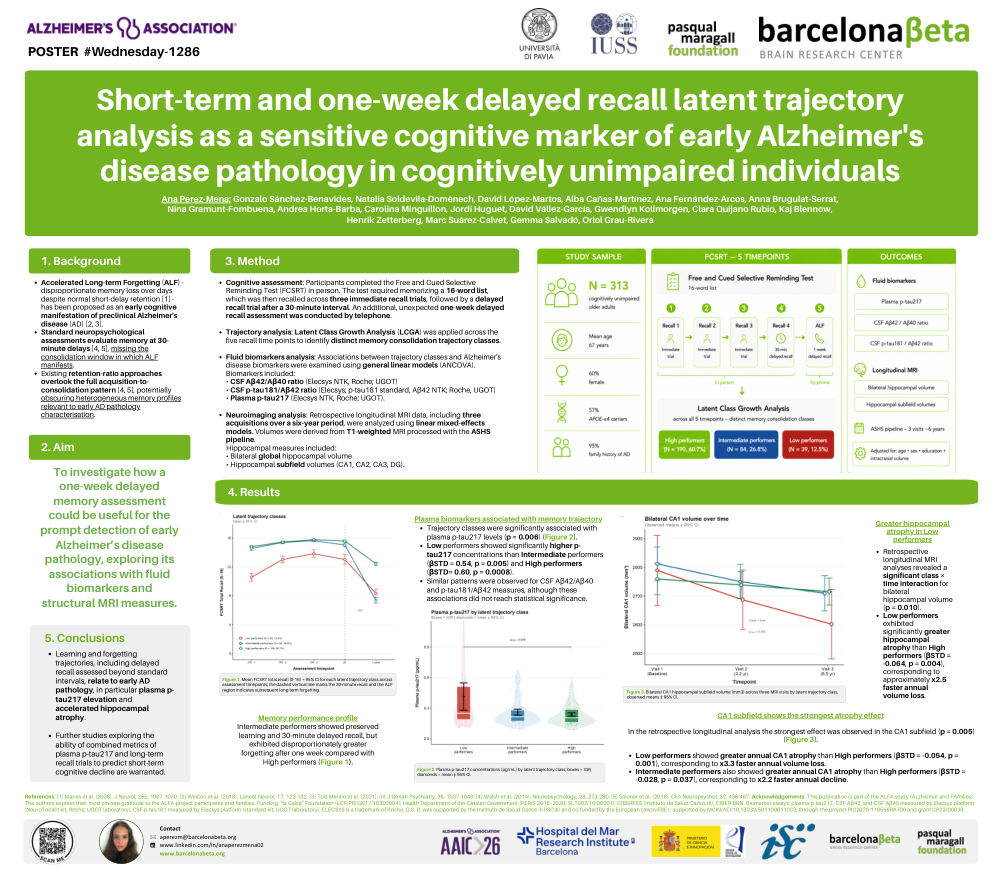
Short-term and one-week delayed recall latent trajectory analysis as a sensitive cognitive marker of early Alzheimer's disease pathology in cognitively unimpaired individuals
Ana Perez-Mena; Gonzalo Sánchez-Benavides, Natalia Soldevila-Domènech, David López-Martos, Alba Cañas-Martínez, Ana Fernández-Arcos, Anna Brugulat-Serrat,
Nina Gramunt-Fombuena, Andrea Horta-Barba, Carolina Minguillon, Jordi Huguet, David Vállez-García, Gwendlyn Kollmorgen, Clara Quijano Rubio, Kaj Blennow,
Henrik Zetterberg, Marc Suárez-Calvet, Gemma Salvadó, Oriol Grau-Rivera
1. Background
Accelerated Long-term Forgetting (ALF) - disproportionate memory loss over days despite normal short-delay retention [1] - has been proposed as an early cognitive manifestation of preclinical Alzheimer's disease (AD) [2, 3].
Standard neuropsychological assessments evaluate memory at 30- minute delays [4, 5], missing the consolidation window in which ALF manifests.
Existing retention-ratio approaches overlook the full acquisition-to-consolidation pattern [4, 5], potentially obscuring heterogeneous memory profiles relevant to early AD pathology characterisation.
2. Aim
To investigate how a
one-week delayed memory assessment could be useful for the prompt detection of early Alzheimer’s disease pathology, exploring its associations with fluid biomarkers and structural MRI measures.
5. Conclusions
Learning and forgetting trajectories, including delayed recall assessed beyond standard intervals, relate to early AD pathology, in particular plasma p-tau217 elevation and accelerated hippocampal atrophy.
Further studies exploring the ability of combined metrics of plasma p-tau217 and long-term recall trials to predict short-term cognitive decline are warranted.
3. Method
Cognitive assessment: Participants completed the Free and Cued Selective Reminding Test (FCSRT) in person. The test required memorizing a 16-word list, which was then recalled across three immediate recall trials, followed by a delayed recall trial after a 30-minute interval. An additional, unexpected one-week delayed recall assessment was conducted by telephone.
Trajectory analysis: Latent Class Growth Analysis (LCGA) was applied across the five recall time points to identify distinct memory consolidation trajectory classes.
Fluid biomarkers analysis: Associations between trajectory classes and Alzheimer's disease biomarkers were examined using general linear models (ANCOVA). Biomarkers included:
• CSF Aβ42/Aβ40 ratio (Elecsys NTK, Roche; UGOT)
• CSF p-tau181/Aβ42 ratio (Elecsys; p-tau181 standard, Aβ42 NTK; Roche, UGOT)
• Plasma p-tau217 (Elecsys NTK, Roche; UGOT).
Neuroimaging analysis: Retrospective longitudinal MRI data, including three acquisitions over a six-year period, were analyzed using linear mixed-effects models. Volumes were derived from T1-weighted MRI processed with the ASHS pipeline.
Hippocampal measures included:
• Bilateral global hippocampal volume
• Hippocampal subfield volumes (CA1, CA2, CA3, DG).
4. Results
Figure 1. Mean FCSRT total recall (0-16) + 95% Cl for each latent trajectory class across assessment timepoints; the dashed vertical line marks the 30-minute recall and the ALF region indicates subsequent long-term forgetting.
Memory performance profile
Intermediate performers showed preserved learning and 30-minute delayed recall, but exhibited disproportionately greater forgetting after one week compared with High performers (Figure 1).
Plasma biomarkers associated with memory trajectory
Trajectory classes were significantly associated with plasma p-tau217 levels (p = 0.006) (Figure 2).
Low performers showed significantly higher p-tau217 concentrations than Intermediate performers (βSTD = 0.54, p = 0.005) and High performers (βSTD= 0.60, p = 0.0008).
Similar patterns were observed for CSF Aβ42/Aβ40 and p-tau181/Aβ42 measures, although these associations did not reach statistical significance.
Figure 2. Plasma p-tau217 concentrations (pg/mL) by latent trajectory class; boxes = IQR, diamonds = mean ‡ 95% Cl.
Figure 3. Bilateral CA1 hippocampal subfield volume (mm3) across three MRI visits by latent trajectory class, observed means ‡ 95% CI.
Greater hippocampal atrophy in Low performers
Retrospective longitudinal MRI analyses revealed a significant class × time interaction for bilateral hippocampal volume (p = 0.010).
Low performers exhibited significantly greater hippocampal atrophy than High performers (βSTD = -0.064, p = 0.004), corresponding to approximately x2.5 faster annual volume loss.
CA1 subfield shows the strongest atrophy effect
In the retrospective longitudinal analysis the strongest effect was observed in the CA1 subfield (p = 0.005) (Figure 3).
Low performers showed greater annual CA1 atrophy than High performers (βSTD = -0.054, p = 0.001), corresponding to x3.3 faster annual volume loss.
Intermediate performers also showed greater annual CA1 atrophy than High performers (βSTD = -0.028, p = 0.037), corresponding to x2.2 faster annual decline.
References: [1] Manes et al. (2008). J Neurol, 255, 1067-1070. [2] Weston et al. (2018). Lancet Neurol, 17, 123-132. [3] Tort-Merino et al. (2021). Int J Geriatr Psychiatry, 36, 1037-1049. [4] Walsh et al. (2014). Neuropsychology, 28, 273-280. [5] Saloner et al. (2018). Clin Neuropsychol, 32, 456-467. Acknowledgements: This publication is part of the ALFA study (ALzheimer and FAmilies). The authors express their most sincere gratitude to the ALFA project participants and families. Funding: "la Caixa" Foundation (LCF/PR/GN17/10300004); Health Department of the Catalan Government (PERIS 2016–2020, SLT002/16/00201); CIBERFES (Instituto de Salud Carlos III); CIBER-BBN. Biomarker assays: plasma p-tau217, CSF Aβ42, and CSF Aβ40 measured by Elecsys platform (NeuroToolKit kit, Roche; UGOT laboratory); CSF p-tau181 measured by Elecsys platform (standard kit; UGOT laboratory). ELECSYS is a trademark of Roche. G.S.-B. was supported by the Instituto de Salud Carlos III (ISCIII) and co-funded by the European Union/FSE+, supported by MCIN/AEI/10.13039/501100011033, through the project PID2020-119556RA-I00 and grant CP23/00039.
Contact
aperezm@barcelonabeta.org
www.linkedin.com/in/anaperezmena02
www.barcelonabeta.org
Comments
Email is required but is not shown publicly.
Loading comments...