4,068 posters, 219 videos, 101 topics, 69 sessions, 14,365 authors, 6,128 institutions
ePostersLive by SciGen Technologies S.A. All rights reserved.
Alzheimer's Association International Conference 2026
July 12-15, 2026 | London, United Kingdom, and Online

12996
Return To Childhood: Loss Of Autobiographical Memory Recency In Alzheimer's Disease
Poster Presenter
Authors
Malte Dommes, Christine Kindler, Julia Taube, Pitshaporn Leelaarporn, Hannah Fischer, Chantal Reinecke, Hanna Huber, Annika Spottke, Rüdiger Stirnberg, Cornelia McCormick
Affiliations
German Center for Neurodegenerative Diseases (DZNE), Bonn, Germany, Clinic for Geriatric Psychiatry and Cognitive Disorders, University of Bonn, University Hospital Bonn, Bonn, Germany & German Center for Neurodegenerative Diseases (DZNE), Bonn, Germany, Clinic for Neurology and Competence Center for Epilepsy, Beta Klinik Bonn GmbH, Bonn, Germany & German Center for Neurodegenerative Diseases (DZNE), Bonn, Germany
Part of Topic
Clinical Manifestations -> Neuropsychology -> Neuropsychological and Biomarker Correlations
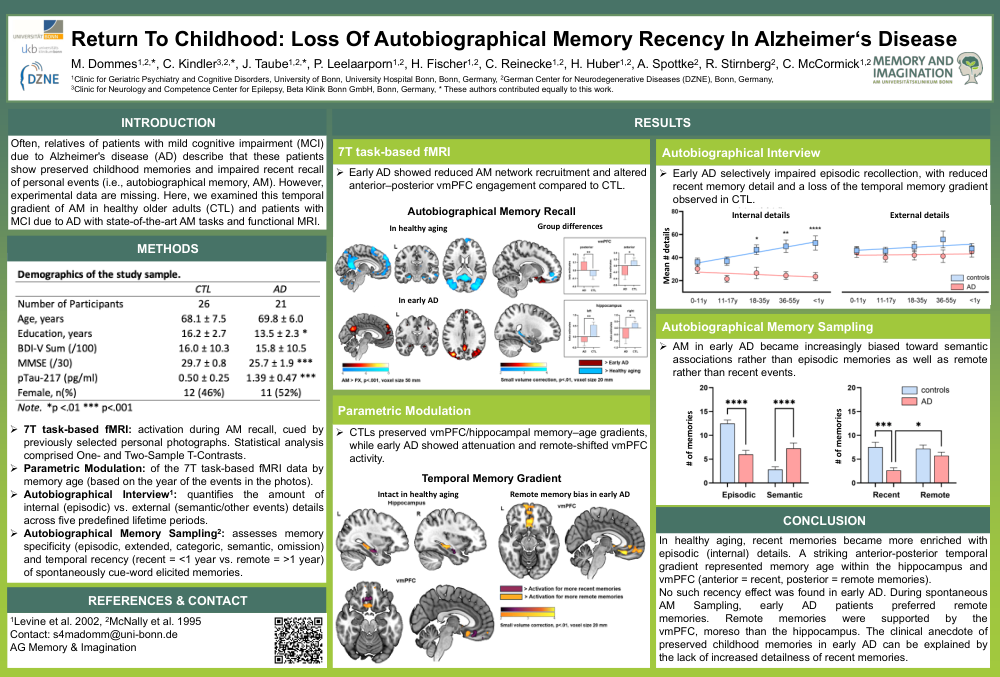
INTRODUCTION: Often, relatives of patients with mild cognitive impairment (MCI) due to Alzheimer's disease (AD) describe that these patients show preserved childhood memories and impaired recent recall of personal events (i.e., autobiographical memory, AM). However, experimental data are missing. Here, we examined this temporal gradient of AM in healthy older adults (CTL) and patients with MCI due to AD with state-of-the-art AM tasks and functional MRI.
METHODS: 7T task-based fMRI: activation during AM recall, cued by previously selectedpersonal photographs. Statistical analysiscomprised One- and Two-Sample T-Contrasts. Parametric Modulation: of the 7T task-based fMRI data by memory age (basedon the year of the events in the photos).Autobiographical Interview: quantifiesthe amount of internal (episodic) vs. external (semantic/other events) detailsacross five predefined lifetime periods.Autobiographical Memory Sampling:assesses memory specificity (episodic, extended, categoric, semantic, omission) and temporal recency (recent = <1 yearvs. remote = >1 year) of spontaneouslycue-word elicited memories.
7T task-based fMRI: Early AD showed reduced AM network recruitment and altered anterior–posteriorvmPFC engagement compared to CTL
Parametric Modulation: CTLs preserved vmPFC/hippocampalmemory–age gradients, while early AD showed attenuation and remote-shiftedvmPFC activity.
Autobiographical Interview: Early AD selectively impaired episodicrecollection, with reduced recent memorydetail and a loss of the temporal memorygradient observed in CTL.
Autobiographical Memory Sampling: AM in early AD became increasinglybiased toward semantic associationsrather than episodic memories as well asremote rather than recent events.
CONCLUSION: In healthy aging, recent memories became more enriched with episodic (internal) details. A striking anterior-posterior temporal gradient represented memory age within the hippocampus and vmPFC (anterior = recent, posterior = remote memories). No such recency effect was found in early AD. During spontaneous AM Sampling, early AD patients preferred remote memories. Remote memories were supported by the vmPFC, moreso than the hippocampus. The clinical anecdote of preserved childhood memories in early AD can be explained by the lack of increased detailness of recent memories.
Comments
Email is required but is not shown publicly.
Loading comments...