4,068 posters, 219 videos, 101 topics, 69 sessions, 14,365 authors, 6,128 institutions
ePostersLive by SciGen Technologies S.A. All rights reserved.
Alzheimer's Association International Conference 2026
July 12-15, 2026 | London, United Kingdom, and Online

13747
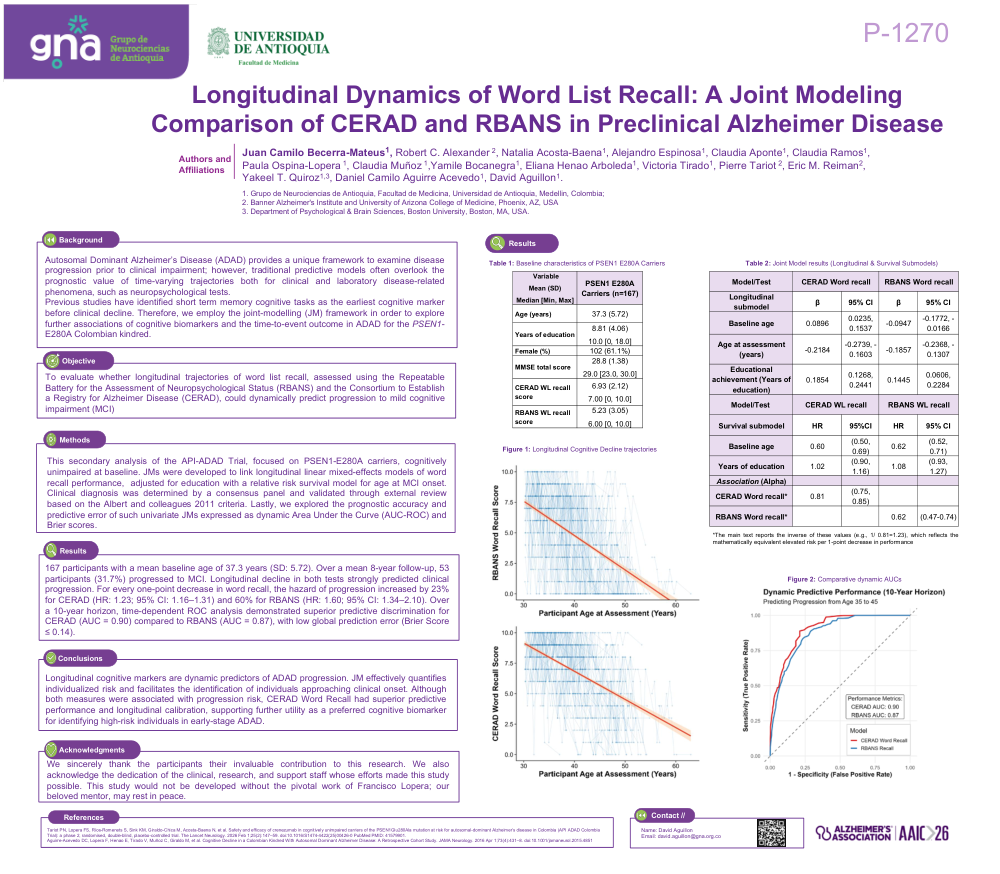
Longitudinal Dynamics Of Word List Recall: A Joint Modeling Comparison Of CERAD And RBANS In Preclinical Familiar Alzheimer Disease
Poster Presenter
Authors
Part of Topic
Clinical Manifestations -> Neuropsychology -> Assessments for Early Detection
Background: Autosomal Dominant Alzheimer’s Disease (ADAD) provides a unique framework to examine disease progression prior to clinical impairment; however, traditional predictive models often overlook the prognostic value of time-varying trajectories. We aimed to evaluate whether longitudinal trajectories of word list recall, assessed using the Repeatable Battery for the Assessment of Neuropsychological Status (RBANS) and the Consortium to Establish a Registry for Alzheimer Disease (CERAD), predict progression to mild cognitive impairment (MCI)
Methods: We analyzed 167 PSEN1-E280A carriers cognitively unimpaired at baseline from the API-ADAD-Colombia trial. Joint models were used to link longitudinal linear mixed-effects models of word recall performance (adjusted for education) with a relative risk survival model for age at MCI onset. Clinical diagnosis was determined by a consensus panel and validated through external review.
Results: At baseline, participants had a mean age of 37.4 years (SD: 5.84). Over a mean follow-up of 8 years, 53 participants (31.7%) progressed to MCI. Longitudinal decline in both CERAD and RBANS word recall predicted clinical progression. For every one-point decrease in word recall, the hazard of progression increased by 12% for CERAD (HR: 1.20; 95% CI: 1.12-1.31) and 66% for RBANS (HR: 1.66; 95% CI: 1.25-2.29). Time-dependent ROC analysis over a 10-year horizon demonstrated superior predictive discrimination for CERAD (AUC = 0.841) compared to RBANS (AUC = 0.779), with low global prediction error (Brier Score = 0.097).
Conclusion: Longitudinal cognitive markers serve as robust dynamic predictors of ADAD progression. Joint modeling effectively quantifies individualized real-time risk and may facilitate identification of individuals approaching clinical progression. Although both measures were associated with progression risk, CERAD Word Recall demonstrated superior predictive performance and longitudinal calibration, supporting its utility as a preferred cognitive biomarker for identifying high-risk individuals in early-stage ADAD.
Comments
Email is required but is not shown publicly.
Loading comments...