4,068 posters, 219 videos, 101 topics, 69 sessions, 14,365 authors, 6,128 institutions
ePostersLive by SciGen Technologies S.A. All rights reserved.
Alzheimer's Association International Conference 2026
July 12-15, 2026 | London, United Kingdom, and Online

13296
Interventions And Fnirs Brain Activity For Preventing Cognitive Frailty: A Systematic Review
Poster Presenter
Authors
Part of Topic
Clinical Manifestations -> Neuropsychology -> Neuropsychological and Biomarker Correlations
Interventions and fNIRS Brain Activity for Preventing Cognitive Frailty: A Systematic Review
INTRODUCTION
Cognitive frailty is a reversible pre-dementia stage, but traditional tests fail to track real-time brain dynamics or distinguish true neural efficiency from exhausting compensatory hyperactivation. Functional Near-Infrared Spectroscopy (fNIRS) overcomes this by monitoring prefrontal cortex oxygenated hemoglobin and hemodynamic changes during active movement. This systematic review analyzes fNIRS-based prefrontal changes during interventions to provide an objective, neuroscientific basis for tailored clinical rehabilitation.
METHODS
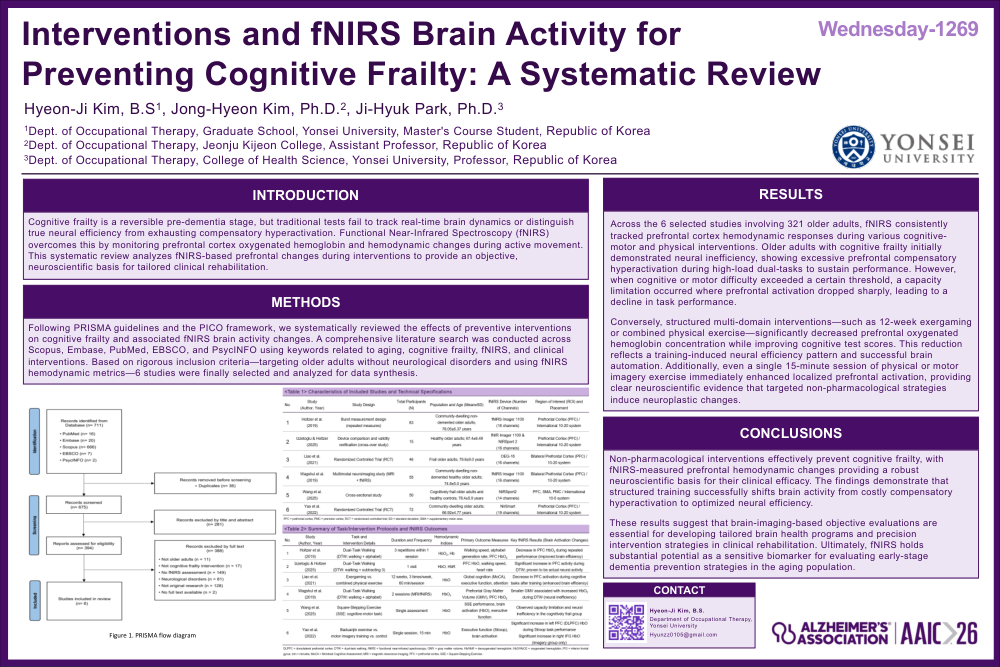
Following PRISMA guidelines and the PICO framework, we systematically reviewed the effects of preventive interventions on cognitive frailty and associated fNIRS brain activity changes. A comprehensive literature search was conducted across Scopus, Embase, PubMed, EBSCO, and PsycINFO using keywords related to aging, cognitive frailty, fNIRS, and clinical interventions. Based on rigorous inclusion criteria—targeting older adults without neurological disorders and using fNIRS hemodynamic metrics—6 studies were finally selected and analyzed for data synthesis.
RESULTS
Across the 6 selected studies involving 321 older adults, fNIRS consistently tracked prefrontal cortex hemodynamic responses during various cognitive-motor and physical interventions. Older adults with cognitive frailty initially demonstrated neural inefficiency, showing excessive prefrontal compensatory hyperactivation during high-load dual-tasks to sustain performance. However, when cognitive or motor difficulty exceeded a certain threshold, a capacity limitation occurred where prefrontal activation dropped sharply, leading to a decline in task performance.
Conversely, structured multi-domain interventions—such as 12-week exergaming or combined physical exercise—significantly decreased prefrontal oxygenated hemoglobin concentration while improving cognitive test scores. This reduction reflects a training-induced neural efficiency pattern and successful brain automation. Additionally, even a single 15-minute session of physical or motor imagery exercise immediately enhanced localized prefrontal activation, providing clear neuroscientific evidence that targeted non-pharmacological strategies induce neuroplastic changes.
CONCLUSIONS
Non-pharmacological interventions effectively prevent cognitive frailty, with fNIRS-measured prefrontal hemodynamic changes providing a robust neuroscientific basis for their clinical efficacy. The findings demonstrate that structured training successfully shifts brain activity from costly compensatory hyperactivation to optimized neural efficiency.
These results suggest that brain-imaging-based objective evaluations are essential for developing tailored brain health programs and precision intervention strategies in clinical rehabilitation. Ultimately, fNIRS holds substantial potential as a sensitive biomarker for evaluating early-stage dementia prevention strategies in the aging population.
Comments
Email is required but is not shown publicly.
Loading comments...