4,068 posters, 219 videos, 101 topics, 69 sessions, 14,365 authors, 6,128 institutions
ePostersLive by SciGen Technologies S.A. All rights reserved.
Alzheimer's Association International Conference 2026
July 12-15, 2026 | London, United Kingdom, and Online

12858
Executive Dysfunction As The Cardinal Cognitive Feature Of CADASIL: Baseline Findings From The United States CADASIL Consortium
Poster Presenter
Authors
Arash Salardini, Barbara L. Fischer, Alex Pinto, Jessica Saurman, Lorena Montserratt, Katie Stypulkowski, Thao Rodriguez, Lauren A. Garcia, Deven K. Burks, H. Jeremy Bockholt, Jane S. Paulsen
Affiliations
UTHSCSA, San Antonio, Texas, University of Wisconsin-Madison, Madison, Wisconsin, Emory School of Medicine, Atlanta, Georgia., UCLA Easton Center, Los Angeles, California., University of Colorado Colorado Springs, Colorado, TReNDS, Atlanta, Georgia.
Part of Topic
Clinical Manifestations -> Neuropsychology -> Neuropsychological profiles of neurodegenerative disease
AAIC 2026 · Poster WED-1263 · Developing Topics: Clinical Manifestations
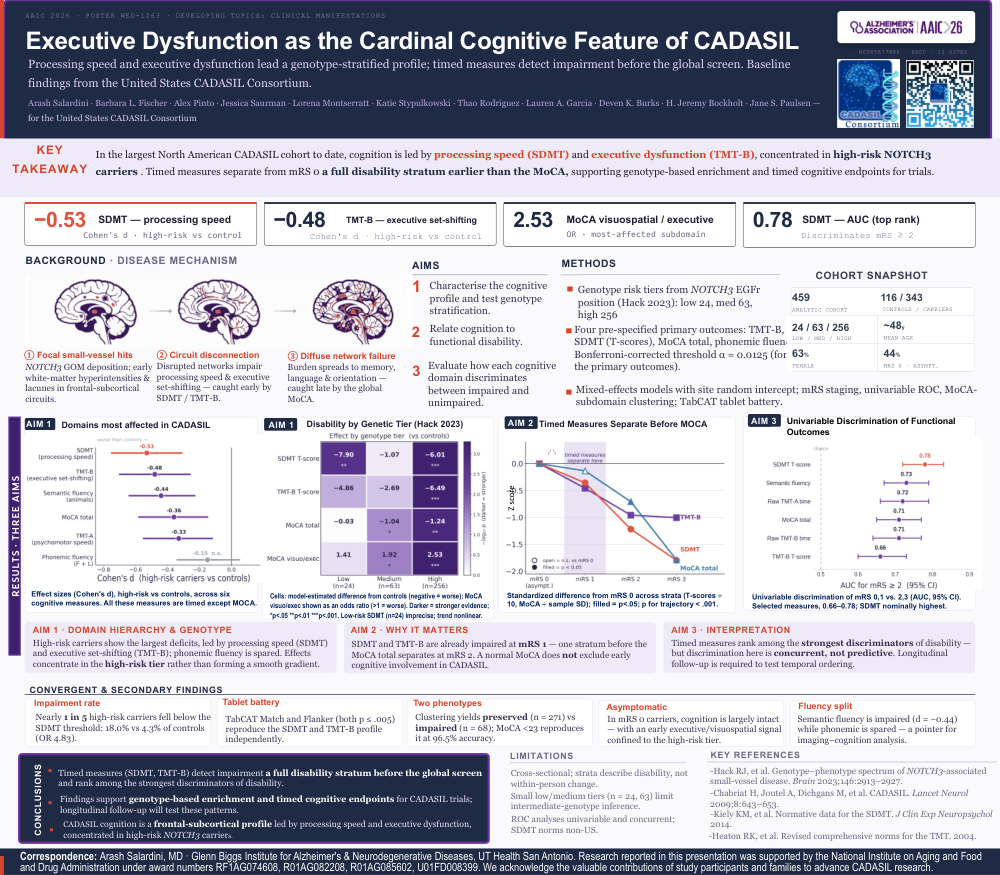
Title: Executive Dysfunction as the Cardinal Cognitive Feature of CADASIL
Subtitle: Processing speed and executive dysfunction lead a genotype-stratified profile; timed measures detect impairment before the global screen. Baseline findings from the United States CADASIL Consortium.
Authors: Arash Salardini · Barbara L. Fischer · Alex Pinto · Jessica Saurman · Lorena Montserratt · Katie Stypulkowski · Thao Rodriguez · Lauren A. Garcia · Deven K. Burks · H. Jeremy Bockholt · Jane S. Paulsen, for the United States CADASIL Consortium
NCT05677880 · USCC · 12 sites
Key takeaway: In the largest North American CADASIL cohort to date, cognition is led by processing speed (SDMT) and executive dysfunction (TMT-B), concentrated in high-risk NOTCH3 carriers. Timed measures separate from mRS 0 a full disability stratum earlier than the MoCA, supporting genotype-based enrichment and timed cognitive endpoints for trials.
Headline numbers:
- −0.53, SDMT processing speed (Cohen's d, high-risk vs control)
- −0.48, TMT-B executive set-shifting (Cohen's d, high-risk vs control)
- 2.53, MoCA visuospatial/executive (OR, most-affected subdomain)
- 0.78, SDMT AUC, top rank (discriminates mRS ≥ 2)
Background · Disease mechanism
CADASIL, pathogenic NOTCH3 variants, is the most common heritable cause of stroke and vascular dementia. Prospective USCC 12-site cohort (NCT05677880).
- Focal small-vessel hits: NOTCH3 GOM deposition; early white-matter hyperintensities and lacunes in frontal-subcortical circuits.
- Circuit disconnection: disrupted networks impair processing speed and executive set-shifting, caught early by SDMT/TMT-B.
- Diffuse network failure: burden spreads to memory, language, and orientation, caught late by the global MoCA.
Aims
- Characterise the cognitive profile and test genotype stratification.
- Relate cognition to functional disability.
- Evaluate how each cognitive domain discriminates between impaired and unimpaired.
Methods
- Genotype risk tiers from NOTCH3 EGFr position (Hack 2023): low 24, med 63, high 256.
- Four pre-specified primary outcomes: TMT-B, SDMT (T-scores), MoCA total, phonemic fluency; Bonferroni-corrected threshold α = 0.0125 (for the primary outcomes).
- Mixed-effects models with site random intercept; mRS staging, univariable ROC, MoCA-subdomain clustering; TabCAT tablet battery.
Cohort snapshot
459 analytic cohort; 116 / 343 controls / carriers; 24 / 63 / 256 low / med / high; ~48y mean age; 63% female; 44% mRS 0 (asymptomatic).
Results
Aim 1, Domains most affected in CADASIL. Effect sizes (Cohen's d), high-risk vs controls, across six cognitive measures. All these measures are timed except MoCA.
Figure values: SDMT (processing speed) −0.53; TMT-B (executive set-shifting) −0.48; semantic fluency (animals) −0.44; MoCA total −0.36; TMT-A (psychomotor speed) −0.33; phonemic fluency (F+L) −0.15, n.s.
Aim 1, Disability by Genetic Tier (Hack 2023). Effect by genotype tier vs controls. Cells show model-estimated difference from controls (negative = worse); MoCA visuo/exec shown as an odds ratio (>1 = worse). Darker = stronger evidence; p<.05 p<.01 p<.001. Low-risk SDMT (n=24) imprecise; trend nonlinear.
Figure values by Low (n=24) / Medium (n=63) / High (n=256): SDMT T-score −7.90 / −1.07 / −6.01; TMT-B T-score −4.86 / −2.69 / −6.49**; MoCA total −0.03 / −1.04* / −1.24**; MoCA visuo/exec 1.41 / 1.92* / 2.53***.
Aim 2, Timed Measures Separate Before MoCA. Standardized difference from mRS 0 across strata (T-scores ÷ 10, MoCA ÷ sample SD); filled = p<.05; p for trajectory < .001. Open marker = n.s. vs mRS 0; filled = p < 0.05.
Aim 3, Univariable Discrimination of Functional Outcomes. Univariable discrimination of mRS 0,1 vs. 2,3 (AUC, 95% CI). Selected measures, 0.66 to 0.78; SDMT nominally highest.
Figure values: SDMT T-score 0.78; semantic fluency 0.73; raw TMT-A time 0.72; MoCA total 0.71; raw TMT-B time 0.71; TMT-B T-score 0.66.
Interpretation
- Aim 1, domain hierarchy and genotype: high-risk carriers show the largest deficits, led by processing speed (SDMT) and executive set-shifting (TMT-B); phonemic fluency is spared. Effects concentrate in the high-risk tier rather than forming a smooth gradient.
- Aim 2, why it matters: SDMT and TMT-B are already impaired at mRS 1, one stratum before the MoCA total separates at mRS 2. A normal MoCA does not exclude early cognitive involvement in CADASIL.
- Aim 3, interpretation: timed measures rank among the strongest discriminators of disability, but discrimination here is concurrent, not predictive. Longitudinal follow-up is required to test temporal ordering.
Convergent and secondary findings
- Impairment rate: nearly 1 in 5 high-risk carriers fell below the SDMT threshold, 18.0% vs 4.3% of controls (OR 4.83).
- Tablet battery: TabCAT Match and Flanker (both p ≤ .005) reproduce the SDMT and TMT-B profile independently.
- Two phenotypes: clustering yields preserved (n = 271) vs impaired (n = 68); MoCA <23 reproduces it at 96.5% accuracy.
- Asymptomatic: in mRS 0 carriers, cognition is largely intact, with an early executive/visuospatial signal confined to the high-risk tier.
- Fluency split: semantic fluency is impaired (d = −0.44) while phonemic is spared, a pointer for imaging-cognition analysis.
Conclusions
- CADASIL cognition is a frontal-subcortical profile led by processing speed and executive dysfunction, concentrated in high-risk NOTCH3 carriers.
- Timed measures (SDMT, TMT-B) detect impairment a full disability stratum before the global screen and rank among the strongest discriminators of disability.
- Findings support genotype-based enrichment and timed cognitive endpoints for CADASIL trials; longitudinal follow-up will test these patterns.
Limitations
- Cross-sectional; strata describe disability, not within-person change.
- Small low/medium tiers (n = 24, 63) limit intermediate-genotype inference.
- ROC analyses univariable and concurrent; SDMT norms non-US.
Key references
- Hack RJ, et al. Genotype–phenotype spectrum of NOTCH3-associated small-vessel disease. Brain 2023;146:2913–2927.
- Chabriat H, Joutel A, Dichgans M, et al. CADASIL. Lancet Neurol 2009;8:643–653.
- Kiely KM, et al. Normative data for the SDMT. J Clin Exp Neuropsychol 2014.
- Heaton RK, et al. Revised comprehensive norms for the TMT. 2004.
Correspondence: Arash Salardini, MD · Glenn Biggs Institute for Alzheimer's and Neurodegenerative Diseases, UT Health San Antonio. Research reported in this presentation was supported by the National Institute on Aging and the Food and Drug Administration under award numbers RF1AG074608, R01AG082208, R01AG085602, U01FD008399. We acknowledge the valuable contributions of study participants and families to advance CADASIL research.
Comments
Email is required but is not shown publicly.
Loading comments...