4,068 posters, 219 videos, 101 topics, 69 sessions, 14,365 authors, 6,128 institutions
ePostersLive by SciGen Technologies S.A. All rights reserved.
Alzheimer's Association International Conference 2026
July 12-15, 2026 | London, United Kingdom, and Online

12808
Clinical Validity Of An App-based Cognitive Screening Tool In Mild Cognitive Impairment
Poster Presenter
Authors
Valeska Kozik, Annalisa E. Bozem, Lilli Ahrenberg, Daniel Scharfenberg, Carsten Finke, Elke Kalbe, Kathrin Finke
Affiliations
Department of Neurology, Jena University Hospital, Friedrich-Schiller-University Jena, Germany, Department of Neurology, Charité – Universitätsmedizin Berlin, Germany, Medical Psychology | Neuropsychology and Gender Studies, Centre for Neuropsychological Diagnostics and Intervention (CeNDI), Faculty of Medicine and University Hospital Cologne, University of Cologne, Germany
Part of Topic
Clinical Manifestations -> Neuropsychology -> Computerized / Digital Neuropsychological Assessments
Title: Clinical Validity of an App-based Cognitive Screening Tool in Mild Cognitive Impairment
Takeaway message: App-based screening captures a clinically meaningful cognitive signal in MCI, tracking cognition, not mood. Memory tasks align most closely with the reference standard; processing speed a secondary strength. Refined version now in formal validation with patients and healthy participants.
Introduction:
The global burden of cognitive impairment continues to rise, with dementia cases projected to roughly triple by 2050 [1]. As earlier intervention becomes feasible, timely identification of mild cognitive impairment is increasingly important.
Comprehensive neuropsychological assessment remains the clinical gold standard [2], but it is specialist-administered, time-intensive, and difficult to scale for screening, longitudinal follow-up, or underserved populations. Existing digital tools are frequently not validated for self-administered use or assess only a single cognitive domain.
In a large clinical F06.7 cohort, we examined whether app tasks in a self-administered, gamified, multi-domain screening app show convergent associations with an established battery, independence from affective symptoms, and robustness to age and education.
Methods:
Cohort: 292 patients with diagnosed mild neurocognitive disorder (ICD-11 F06.7).
Reference standard: Neuropsychological Assessment Battery (NAB) index and domain scores
App: Five tasks spanning memory, processing speed, executive/attention, and reasoning. This analysis focuses on the components with the clearest signal
Affective symptoms: Hospital Anxiety and Depression Scale (HADS)
Analysis: Spearman rank correlations between app tasks and NAB / HADS scores; partial correlations controlling for age and education, with a sensitivity re-analysis excluding education
Results:
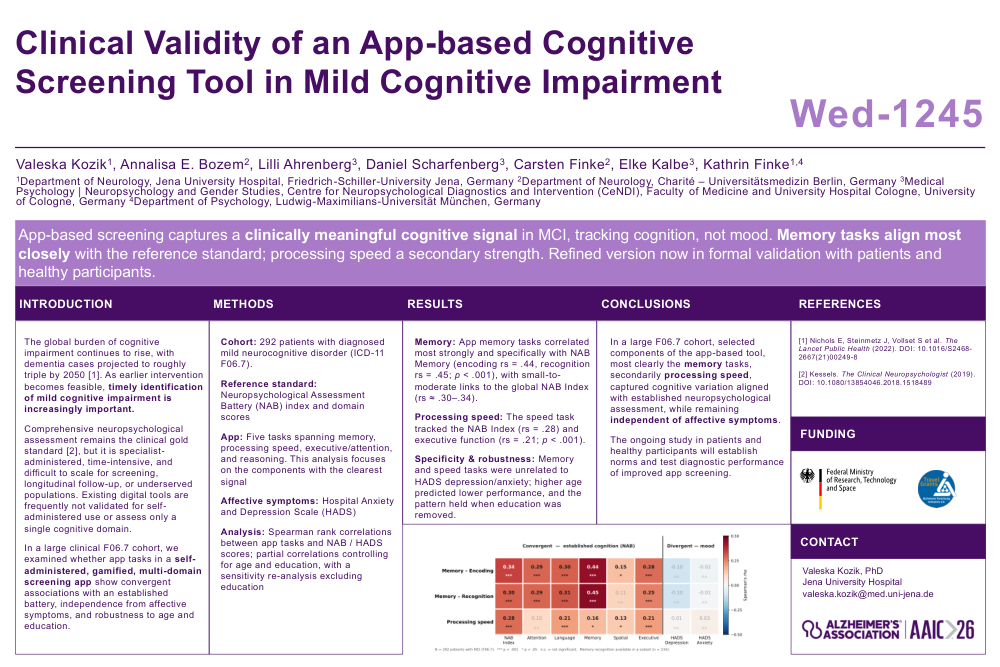
Memory: App memory tasks correlated most strongly and specifically with NAB Memory (encoding rs = .44, recognition rs = .45; p < .001), with small-to-moderate links to the global NAB Index (rs ≈ .30–.34).
Processing speed: The speed task tracked the NAB Index (rs = .28) and executive function (rs = .21; p < .001).
Specificity & robustness: Memory and speed tasks were unrelated to HADS depression/anxiety; higher age predicted lower performance, and the pattern held when education was removed.
Conclusions:
In a large F06.7 cohort, selected components of the app-based tool, most clearly the memory tasks, secondarily processing speed, captured cognitive variation aligned with established neuropsychological assessment, while remaining independent of affective symptoms.
The ongoing study in patients and healthy participants will establish norms and test diagnostic performance of improved app screening.
References:
[1] Nichols E, Steinmetz J, Vollset S et al. The Lancet Public Health (2022). DOI: 10.1016/S2468-2667(21)00249-8
[2] Kessels. The Clinical Neuropsychologist (2019). DOI: 10.1080/13854046.2018.1518489
Funding:
German Federal Ministry of Research, Technology and Space
Travel Grant: Alzheimer Forschung Initiative e.V. (German Alzheimer Research Initiative)
Contact:
Valeska Kozik, PhD
Jena University Hospital
valeska.kozik@med.uni-jena.de
Comments
Email is required but is not shown publicly.
Loading comments...