4,068 posters, 219 videos, 101 topics, 69 sessions, 14,365 authors, 6,128 institutions
ePostersLive by SciGen Technologies S.A. All rights reserved.
Alzheimer's Association International Conference 2026
July 12-15, 2026 | London, United Kingdom, and Online

13878
Cardiovascular And Lipid Profiles In Apoe3 Christchurch (r136s) Variant Carriers Within The Colombian Psen1-e280a Kindred
Poster Presenter
Authors
Alejandro Guerrero, Daniel Vasquez, Yesica Zuluaga, Ana Baena, Diana Alzate, Yamile Bocanegra, Liliana Hincapié, Lucia Madrigal, Laura Serna, Daniela Giraldo, Vincent Malotaux, Catarina Tristão-Pereira, Liliana Ramirez-Gomez, Lusiana Martinez, Paula Perez-Corredor, Guido N. Vacano, Yakeel T. Quiroz, Joseph F. Arboleda-Velásquez, David Aguillon
Affiliations
Grupo de Neurociencias de Antioquia, Facultad de Medicina. Universidad de Antioquia, Medellín, Colombia, Department of Psychological & Brain Sciences, Boston University, Boston, MA, USA. Department of Psychiatry, Massachusetts General Hospital, Boston, MA, USA, Schepens Eye Research Institute of Mass Eye and Ear and Department of Ophthalmology, Harvard Medical School, Boston, MA, USA, Vacano Informatics LLC, Arvada, CO, USA.
Part of Topic
Clinical Manifestations -> Neuropsychiatry and Behavioral Neurology -> Assessment and Management of Neurodegenerative disease
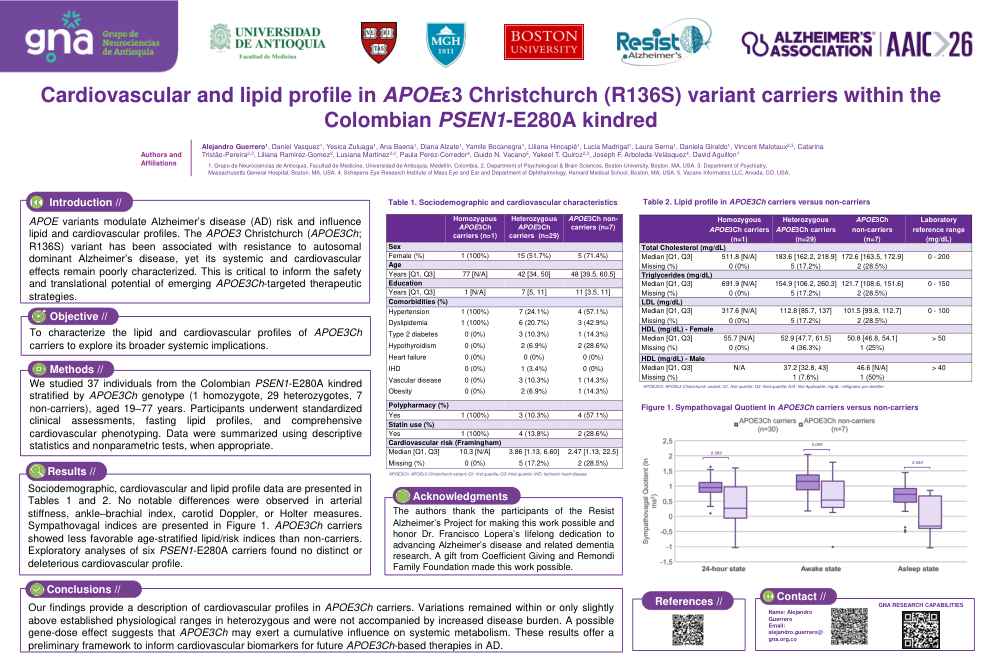
Cardiovascular and lipid profile in APOEε3 Christchurch (R136S) variant carriers within the Colombian PSEN1-E280A kindred
Introduction: APOE variants modulate Alzheimer’s disease (AD) risk and influence lipid and cardiovascular profiles. The APOE3 Christchurch (APOE3Ch; R136S) variant has been associated with resistance to autosomal dominant Alzheimer’s disease, yet its systemic and cardiovascular effects remain poorly characterized. This is critical to inform the safety and translational potential of emerging APOE3Ch-targeted therapeutic strategies
Objective: To characterize the lipid and cardiovascular profiles of APOE3Ch carriers to explore its broader systemic implications
Methods: We studied 37 individuals from the Colombian PSEN1-E280A kindred stratified by APOE3Ch genotype (1 homozygote, 29 heterozygotes, 7 non-carriers), aged 19–77 years. Participants underwent standardized clinical assessments, fasting lipid profiles, and comprehensive cardiovascular phenotyping. Data were summarized using descriptive statistics and nonparametric tests, when appropriate.
Results: Sociodemographic, cardiovascular and lipid profile data are presented in Tables 1 and 2. No notable differences were observed in arterial stiffness, ankle–brachial index, carotid Doppler, or Holter measures. Sympathovagal indices are presented in Figure 1. APOE3Ch carriers showed less favorable age-stratified lipid/risk indices than non-carriers. Exploratory analyses of six PSEN1-E280A carriers found no distinct or deleterious cardiovascular profile.
Conclusions: Our findings provide a description of cardiovascular profiles in APOE3Ch carriers. Variations remained within or only slightly above established physiological ranges in heterozygous and were not accompanied by increased disease burden. A possible gene-dose effect suggests that APOE3Ch may exert a cumulative influence on systemic metabolism. These results offer a preliminary framework to inform cardiovascular biomarkers for future APOE3Ch-based therapies in AD.
Acknowledgments: The authors thank the participants of the Resist Alzheimer’s Project for making this work possible and honor Dr. Francisco Lopera’s lifelong dedication to advancing Alzheimer’s disease and related dementia research. A gift from Coefficient Giving and Remondi Family Foundation made this work possible.
Comments
Email is required but is not shown publicly.
Loading comments...