4,068 posters, 219 videos, 101 topics, 69 sessions, 14,365 authors, 6,128 institutions
ePostersLive by SciGen Technologies S.A. All rights reserved.
Alzheimer's Association International Conference 2026
July 12-15, 2026 | London, United Kingdom, and Online

13020
Beyond Timing Gaps: Phonological Norming For The California Cognitive Assessment Battery In Spanish
Poster Presenter
Authors
Kathleen Hall, Isabella Jaramillo, Michael Blank, Kristin Geraci, Elloise Garcia, Andrew Boghossian, Peter Pebler, David Woods
Affiliations
null,
Part of Topic
Clinical Manifestations -> Neuropsychology -> Computerized / Digital Neuropsychological Assessments
Introduction: The California Cognitive Assessment Battery (CCAB) is a remotely-monitored automated assessment capturing speech measures from verbal tasks that may inform models of cognitive health. Speech-based timing metrics are subject to language-specific influences that can distort results and mischaracterize impairment. Spanish words are on average longer (more syllables) than English equivalents, inflating completion times independent of cognitive ability. Phonological length effects are well-documented in the working memory literature yet rarely accounted for in cross-language cognitive assessment.
Methods: The CCAB was administered to 169 healthy adult native Spanish speakers during ongoing normative data collection. 1:1 nearest-neighbor matching from an English speaking Latino cohort on age, education, gender, and vocabulary yielded 169 matched pairs (Spanish: M age=47.1, SD=13.8, 60% female; English: M age=46.9, SD=13.8, 60% female; all p > .49). Four verbal tasks are analyzed: Digit Span Forward (DSF), Digit Span Reverse (DSR), Symbol-Number (SN), and Continuous Picture Naming (CPN). Syllable counts were derived from actual transcripts produced by the CASR pipeline.
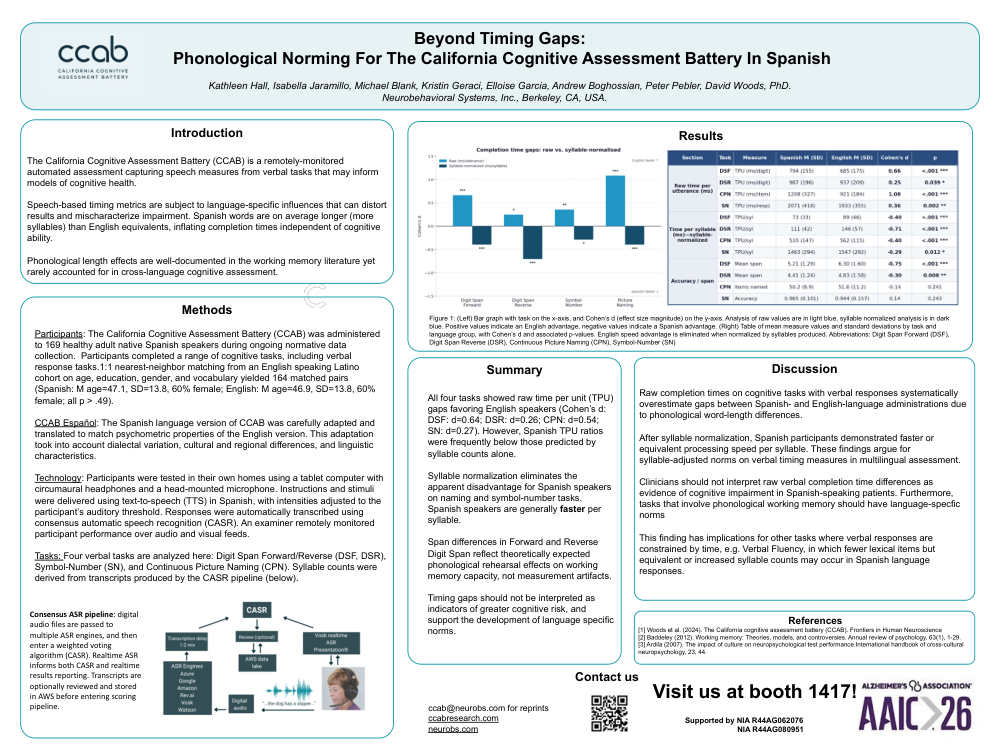
Results: All four tasks showed raw time per unit (TPU) gaps favoring English speakers (DSF: d=0.66, p<.001; DSR: d=0.25, p=.039; CPN: d=1.08, p<.001; SN: d=0.36, p=.002). After syllable normalization, the direction reversed for all tasks (DSF: d=-0.40, p<.001; DSR: d=-0.71, p<.001; CPN: d=-0.40, p<.001; SN: d=-0.29, p=.012), indicating Spanish speakers are faster per syllable produced. Accuracy and span measures showed expected differences in working memory tasks (DSF: d=-0.75, p<.001; DSR: d=-0.30, p=.008) consistent with phonological rehearsal effects, while naming accuracy was equivalent between groups.
Summary: All four tasks showed raw TPU gaps favoring English speakers. However, Spanish TPU ratios were frequently below those predicted by syllable counts alone. Syllable normalization eliminates the apparent disadvantage for Spanish speakers on naming and symbol-number tasks. Spanish speakers are generally faster per syllable. Span differences in Forward and Reverse Digit Span reflect theoretically expected phonological rehearsal effects on working memory capacity, not measurement artifacts. Timing gaps should not be interpreted as indicators of greater cognitive risk, and support the development of language specific norms.
Discussion: Raw completion times on cognitive tasks with verbal responses systematically overestimate gaps between Spanish- and English-language administrations due to phonological word-length differences. After syllable normalization, Spanish participants demonstrated faster or equivalent processing speed per syllable. These findings argue for syllable-adjusted norms on verbal timing measures in multilingual assessment. Clinicians should not interpret raw verbal completion time differences as evidence of cognitive impairment in Spanish-speaking patients. Tasks that involve phonological working memory should have language-specific norms. This finding has implications for other tasks where verbal responses are constrained by time, e.g. Verbal Fluency, in which fewer lexical items but equivalent or increased syllable counts may occur in Spanish language responses.
Comments
Email is required but is not shown publicly.
Loading comments...