4,068 posters, 219 videos, 101 topics, 69 sessions, 14,365 authors, 6,128 institutions
ePostersLive by SciGen Technologies S.A. All rights reserved.
Alzheimer's Association International Conference 2026
July 12-15, 2026 | London, United Kingdom, and Online

13627
Association Between Subjective Hearing Difficulty And Executive Function In Older Adults At Risk For Alzheimer’S Disease
Poster Presenter
Authors
Amanda DeWitt, Deling He, Erik Jorgensen, Kristin Basche, Elizabeth Sielaff, Ruth Y Litovsky, Ozioma C Okonkwo, Bruce P Hermann, Jessica ZK Caldwell, Sterling C Johnson, Kimberly D Mueller
Affiliations
Department of Communication Sciences and Disorders, University of Wisconsin-Madison, Madison, WI, USA, Department of Communication Sciences and Disorders, University of Wisconsin-Madison, Madison, WI, USA; Waisman Center, University of Wisconsin-Madison, Madison, WI, USA, Wisconsin Alzheimer's Disease Research Center, Department of Medicine, University of Wisconsin School of Medicine and Public Health, Madison, WI, USA; Wisconsin Alzheimer's Institute, University of Wisconsin School of Medicine and Public Health, Madison, WI, USA, Wisconsin Alzheimer's Disease Research Center, Department of Medicine, University of Wisconsin School of Medicine and Public Health, Madison, WI, USA; Wisconsin Alzheimer's Institute, University of Wisconsin School of Medicine and Public Health, Madison, WI, USA; Department of Neurology, University of Wisconsin School of Medicine and Public Health, Madison, WI, USA, Department of Communication Sciences and Disorders, University of Wisconsin-Madison, Madison, WI, USA; Wisconsin Alzheimer's Disease Research Center, Department of Medicine, University of Wisconsin School of Medicine and Public Health, Madison, WI, USA; Wisconsin Alzheimer's Institute, University of Wisconsin School of Medicine and Public Health, Madison, WI, USA
Part of Topic
Clinical Manifestations -> Neuropsychology -> Measurements of Cognition and Function
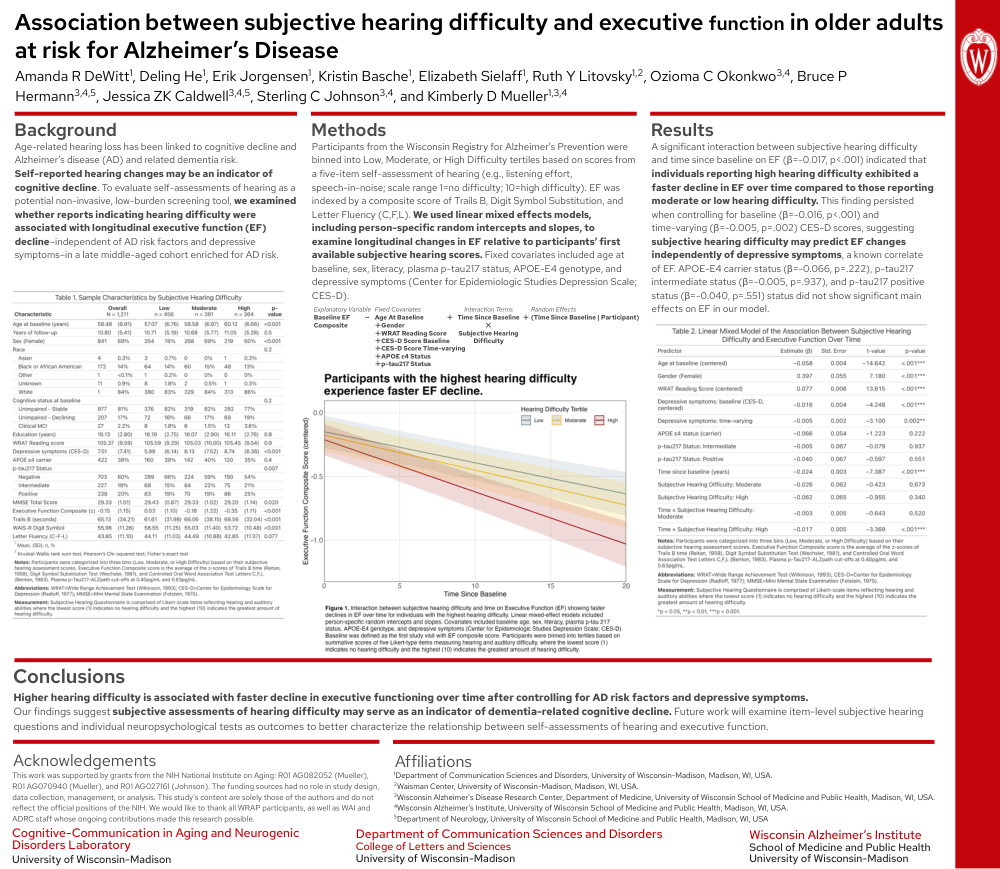
Background: Age-related hearing loss has been linked to cognitive decline and Alzheimer’s disease (AD) and related dementia risk. Self-reported hearing difficulties may be an indicator of cognitive decline. To evaluate self-assessments of hearing as a potential non-invasive, low-burden screening tool, we examined whether self-reported hearing difficulty was associated with longitudinal executive function (EF) decline-independent of AD risk factors and depressive symptoms-in a late middle-aged cohort enriched for AD risk.
Methods: Participants (n=1211; n=977 Cognitively Unimpaired-Stable; n=207 Cognitively Unimpaired-Declining; n=27 MCI; mean(SD) age 58.48(6.91)) from the Wisconsin Registry for Alzheimer’s Prevention were binned into Low, Moderate, or High Difficulty tertiles based on scores from a five-item self-assessment of hearing (e.g., listening effort, speech-in-noise; scale range 1=no difficulty; 10=high difficulty). EF was indexed by a composite of neuropsychological test scores (Trails B, Digit Symbol Substitution, and Letter Fluency [C-F-L]). Linear mixed effects models, including person-specific random intercepts and slopes, examined longitudinal changes in EF relative to participants’ first available subjective hearing scores. Fixed covariates included age at baseline, sex, literacy, plasma p-tau217 status, APOE-E4 genotype, and depressive symptoms (Center for Epidemiologic Studies Depression Scale; CES-D).
Results: A significant interaction between subjective hearing difficulty and time since baseline on EF (β=-0.017, p<.001) indicated that individuals reporting high hearing difficulty exhibited a faster decline in EF over time compared to those reporting moderate or low hearing difficulty. This finding persisted when controlling for baseline (β=-0.016, p<.001) and time-varying (β=-0.005, p=.002) CES-D scores, suggesting subjective hearing difficulty may predict EF changes independently of depressive symptoms, a known correlate of EF. APOE-E4 carrier status (β=-0.066, p=.222) and most recent p-tau217 status (Intermediate: β=-0.005, p=.937; Positive: β=-0.040, p=.551) status did not show significant main effects on EF in our model.
Conclusion: Higher hearing difficulty is associated with faster decline in EF over time after controlling for AD risk factors and depressive symptoms. Our findings suggest subjective assessments of hearing may serve as an indicator of dementia-related cognitive decline. Future work will examine item-level subjective hearing questions and individual neuropsychological tests as outcomes to better characterize the relationship between self-assessments of hearing and EF.
Comments
Email is required but is not shown publicly.
Loading comments...