4,068 posters, 219 videos, 101 topics, 69 sessions, 14,365 authors, 6,128 institutions
ePostersLive by SciGen Technologies S.A. All rights reserved.
Alzheimer's Association International Conference 2026
July 12-15, 2026 | London, United Kingdom, and Online

13529
Assessing Motor And Cognitive Processes Using A Novel Performance-based Test Of Daily Functioning With Ultra-Low-Field Imaging
Poster Presenter
Authors
Alexandra M. Reed, Chung-Fu Sun, Matthew J. Huentelman, Michael Malek-Ahmadi, Scott C. Beeman, Megan Johnson, Matthew D. De Both, Saurabh Sharma, Darian Chambers, Sydney Y. Schaefer
Affiliations
School of Biological and Health Systems Engineering, Arizona State University; Arizona Alzheimer’s Consortium, Arizona Alzheimer’s Consortium; Department of Physical Therapy, Chapman University, Department of Physical Therapy, Chapman University
Part of Topic
Clinical Manifestations -> Neuropsychology -> Neuropsychological and Biomarker Correlations
Background: Performance-based tests of daily functioning may improve early dementia screening by reducing reliance on informant- or clinician-rated measures. However, conventional scores often reflect both motor and cognitive impairment, limiting clinical interpretation.
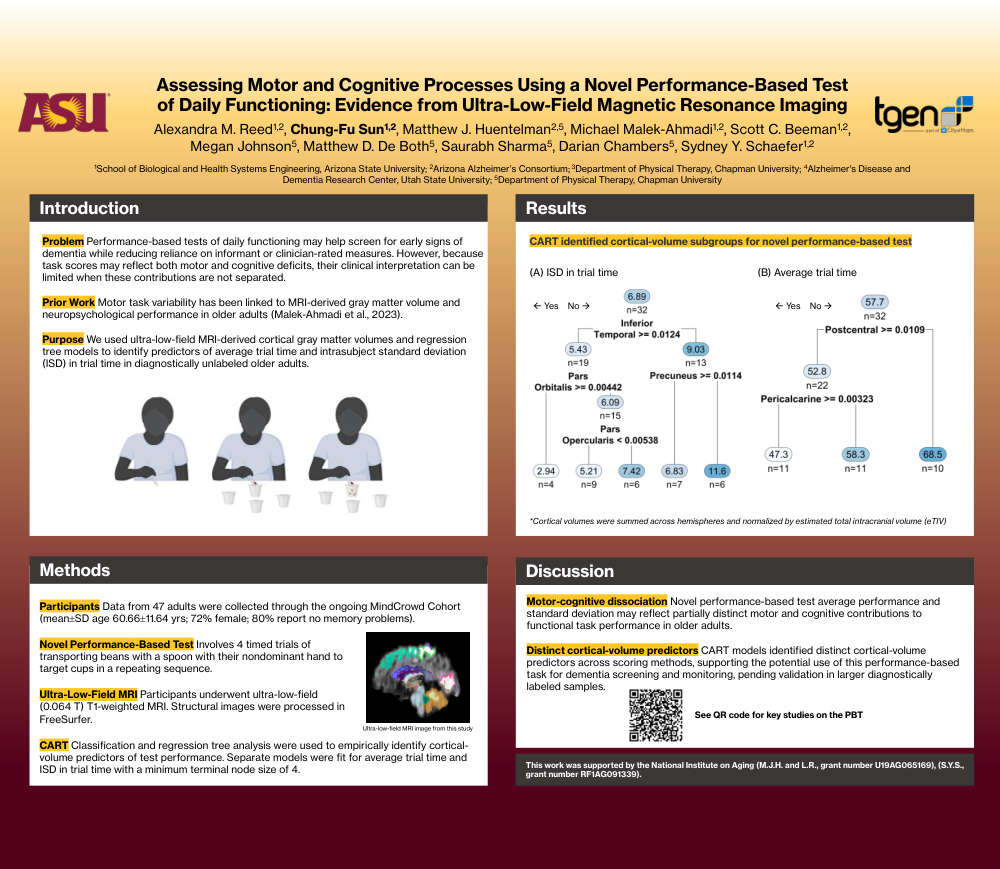
Objective: To identify cortical gray matter volume predictors of average trial time and intra-subject standard deviation (ISD) during a novel performance-based test of daily functioning using ultra-low-field MRI and classification and regression tree (CART) analysis.
Methods: Forty-seven community-dwelling older adults from the MindCrowd cohort (60.66 ± 11.64 years; 72% female) completed a four-trial functional upper-extremity task and underwent ultra-low-field (0.064 T) T1-weighted MRI. Structural images were processed using FreeSurfer. Separate CART models were developed for average trial time and ISD.
Results: CART identified distinct cortical-volume predictors for average trial time and ISD, suggesting that these two performance metrics reflect partially dissociable neural processes.
Conclusions: Average performance and trial-to-trial variability may capture different motor and cognitive contributions to functional task performance. These findings support the potential utility of this novel performance-based test for dementia screening and longitudinal monitoring, although validation in larger diagnostically characterized cohorts is warranted.
Comments
Email is required but is not shown publicly.
Loading comments...