4,068 posters, 219 videos, 101 topics, 69 sessions, 14,365 authors, 6,128 institutions
ePostersLive by SciGen Technologies S.A. All rights reserved.
Alzheimer's Association International Conference 2026
July 12-15, 2026 | London, United Kingdom, and Online

13105
Accelerated Forgetting: A Screen For Ruling Out Alzheimer’s Disease In Cognitive Clinics?
Poster Presenter
Authors
Part of Topic
Clinical Manifestations -> Neuropsychology -> Neuropsychological and Biomarker Correlations
Key Findings
Aim: To investigate whether 7-day delayed recall is a more sensitive cognitive marker of Alzheimer’s disease pathology than traditional 30-minute recall.
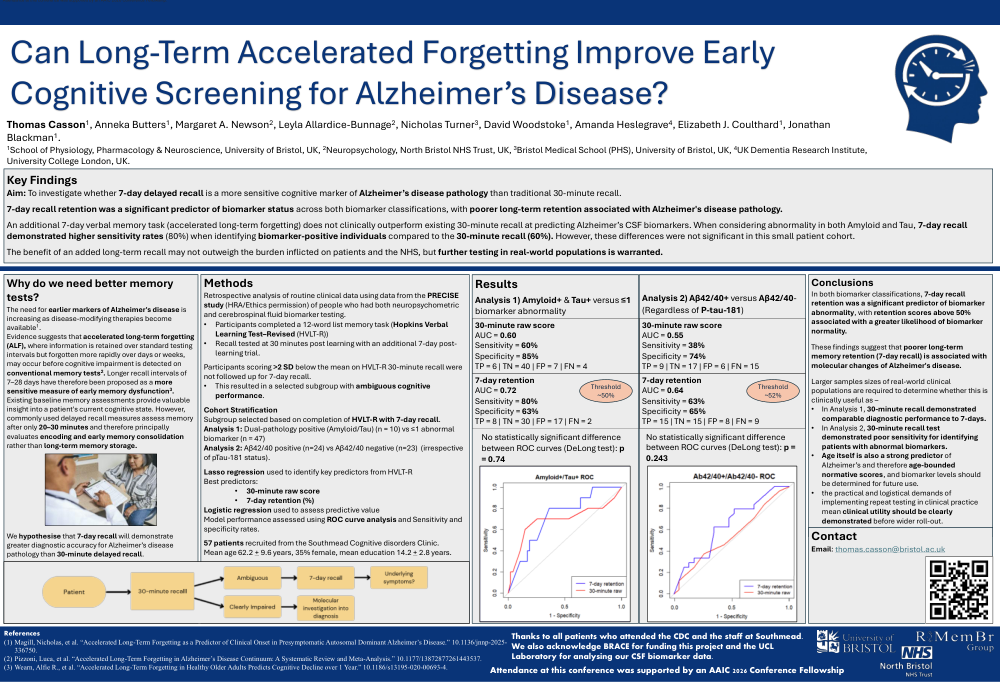
7-day recall retention was a significant predictor of biomarker status across both biomarker classifications, with poorer long-term retention associated with Alzheimer's disease pathology.
An additional 7-day verbal memory task (accelerated long-term forgetting) does not clinically outperform existing 30-minute recall at predicting Alzheimer’s CSF biomarkers. When considering abnormality in both Amyloid and Tau, 7-day recall demonstrated higher sensitivity rates (80%) when identifying biomarker-positive individuals compared to the 30-minute recall (60%). However, these differences were not significant in this small patient cohort.
The benefit of an added long-term recall may not outweigh the burden inflicted on patients and the NHS, but further testing in real-world populations is warranted.
Why do we need better memory tests?
The need for earlier markers of Alzheimer's disease is increasing as disease-modifying therapies become available1.
Evidence suggests that accelerated long-term forgetting (ALF), where information is retained over standard testing intervals but forgotten more rapidly over days or weeks, may occur before cognitive impairment is detected on conventional memory tests2. Longer recall intervals of 7–28 days have therefore been proposed as a more sensitive measure of early memory dysfunction3.
Existing baseline memory assessments provide valuable insight into a patient's current cognitive state. However, commonly used delayed recall measures assess memory after only 20–30 minutes and therefore principally evaluates encoding and early memory consolidation rather than long-term memory storage.
We hypothesise that 7-day recall will demonstrate greater diagnostic accuracy for Alzheimer’s disease pathology than 30-minute delayed recall.
Methods
Retrospective analysis of routine clinical data using data from the PRECISE study (HRA/Ethics permission) of people who had both neuropsychometric and cerebrospinal fluid biomarker testing.
Participants scoring >2 SD below the mean on HVLT-R 30-minute recall were not followed up for 7-day recall.
Cohort Stratification
Subgroup selected based on completion of HVLT-R with 7-day recall.
Analysis 1: Dual-pathology positive (Amyloid/Tau) (n = 10) vs ≤1 abnormal biomarker (n = 47)
Analysis 2: Aβ42/40 positive (n=24) vs Aβ42/40 negative (n=23) (irrespective of pTau-181 status).
Lasso regression used to identify key predictors from HVLT-R
Best predictors:
Logistic regression used to assess predictive value
Model performance assessed using ROC curve analysis and Sensitivity and specificity rates.
57 patients recruited from the Southmead Cognitive disorders Clinic.
Mean age 62.2 + 9.6 years, 35% female, mean education 14.2 + 2.8 years.
Conclusions
In both biomarker classifications, 7-day recall retention was a significant predictor of biomarker abnormality, with retention scores above 50% associated with a greater likelihood of biomarker normality.
These findings suggest that poorer long-term memory retention (7-day recall) is associated with molecular changes of Alzheimer's disease.
Larger samples sizes of real-world clinical populations are required to determine whether this is clinically useful as –
Comments
Email is required but is not shown publicly.
Loading comments...