4,068 posters, 219 videos, 101 topics, 69 sessions, 14,365 authors, 6,128 institutions
ePostersLive by SciGen Technologies S.A. All rights reserved.
Alzheimer's Association International Conference 2026
July 12-15, 2026 | London, United Kingdom, and Online

13782
Recurrent Falls In Alzheimer’S Disease: Exploring Their Psychological And Symbolic Dimensions
Poster Presenter
Authors
Affiliations
Part of Topic
Virtual
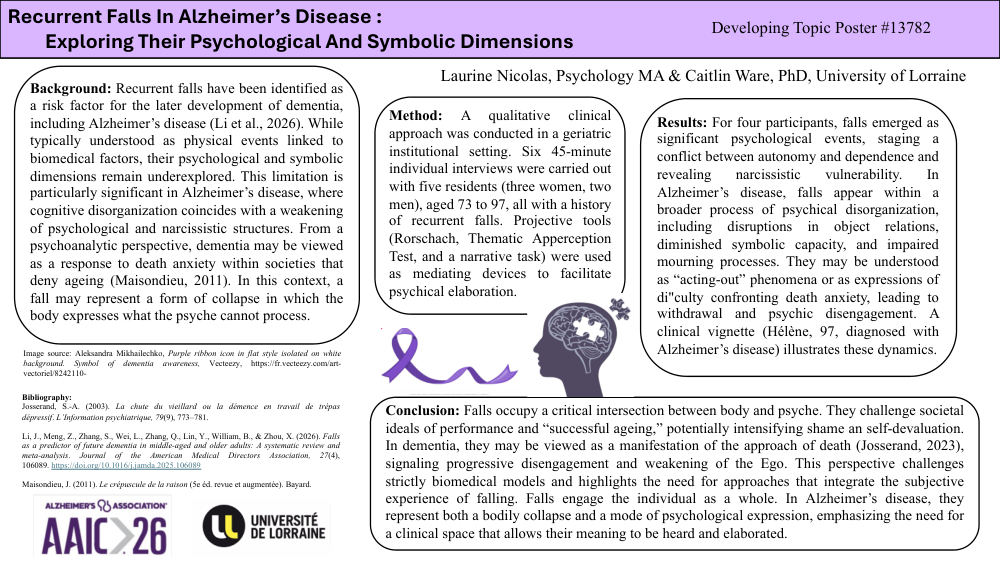
Recurrent Falls In Alzheimer’s Disease : Exploring Their Psychological And Symbolic Dimensions
Laurine Nicolas, Psychology MA & Caitlin Ware, PhD, University of Lorraine
Background: Recurrent falls have been identified as a risk factor for the later development of dementia,including Alzheimer’s disease (Li et al., 2026). While typically understood as physical events linked to biomedical factors, their psychological and symbolic dimensions remain underexplored. This limitation is particularly significant in Alzheimer’s disease, where cognitive disorganization coincides with a weakening of psychological and narcissistic structures. From a psychoanalytic perspective, dementiamay be viewed as a response to death anxiety within societies that deny ageing (Maisondieu, 2011). In this context, a fall may represent a form of collapse in which the body expresses what the psyche cannotprocess.
Method: A qualitative clinical approach was conducted in a geriatric institutional setting. Six 45-minute individual interviews were carried out with five residents (three women, two men), aged 73 to 97, all with a history of recurrent falls. Projective tools (Rorschach, Thematic Apperception Test, and a narrative task) were used as mediating devices to facilitate psychical elaboration.
Results: For four participants, falls emerged as significant psychological events, staging a conflictbetween autonomy and dependence and revealing narcissistic vulnerability. In Alzheimer’s disease, fallsappear within a broader process of psychical disorganization, including disruptions in object relations, diminished symbolic capacity, and impaired mourning processes. They may be understood as “acting-out” phenomena or as expressions of di"culty confronting death anxiety, leading to withdrawal and psychic disengagement. A clinical vignette (Hélène, 97, diagnosed with Alzheimer’s disease) illustratesthese dynamics.
Conclusion: Falls occupy a critical intersection between body and psyche. They challenge societalideals of performance and “successful ageing,” potentially intensifying shame an self-devaluation. In dementia, they may be viewed as a manifestation of the approach of death (Josserand, 2023), signalingprogressive disengagement and weakening of the Ego. This perspective challenges strictly biomedicalmodels and highlights the need for approaches that integrate the subjective experience of falling. Falls engage the individual as a whole. In Alzheimer’s disease, they represent both a bodily collapse and a mode of psychological expression, emphasizing the need for a clinical space that allows their meaning to be heard and elaborated.
Bibliography:
- Josserand, S.-A. (2003). La chute du vieillard ou la démence en travail de trépas dépressif. L’Information psychiatrique, 79(9), 773–781.
- Li, J., Meng, Z., Zhang, S., Wei, L., Zhang, Q., Lin, Y., William, B., & Zhou, X. (2026). Falls as a predictor of future dementia in middle-aged and older adults: A systematic reviewand meta-analysis. Journal of the American Medical Directors Association, 27(4), 106089. https://doi.org/10.1016/j.jamda.2025.106089
- Maisondieu, J. (2011). Le crépuscule de la raison (5e éd. revue et augmentée). Bayard.
Comments
Email is required but is not shown publicly.
Loading comments...