4,068 posters, 219 videos, 101 topics, 69 sessions, 14,365 authors, 6,128 institutions
ePostersLive by SciGen Technologies S.A. All rights reserved.
Alzheimer's Association International Conference 2026
July 12-15, 2026 | London, United Kingdom, and Online

11777
Mass Spectrometry Profiling Of Pns-tau Reveals Tissue-specific Signatures In Heart And Kidney
Poster Presenter
Authors
Part of Topic
Virtual
Title: Mass Spectrometry Profiling of PNS-Tau Reveals Tissue-Specific Signatures in Heart and Kidney
Authors: Monika R. Sanotra, Xuemei Zeng, Thomas K. Karikari
Abstract
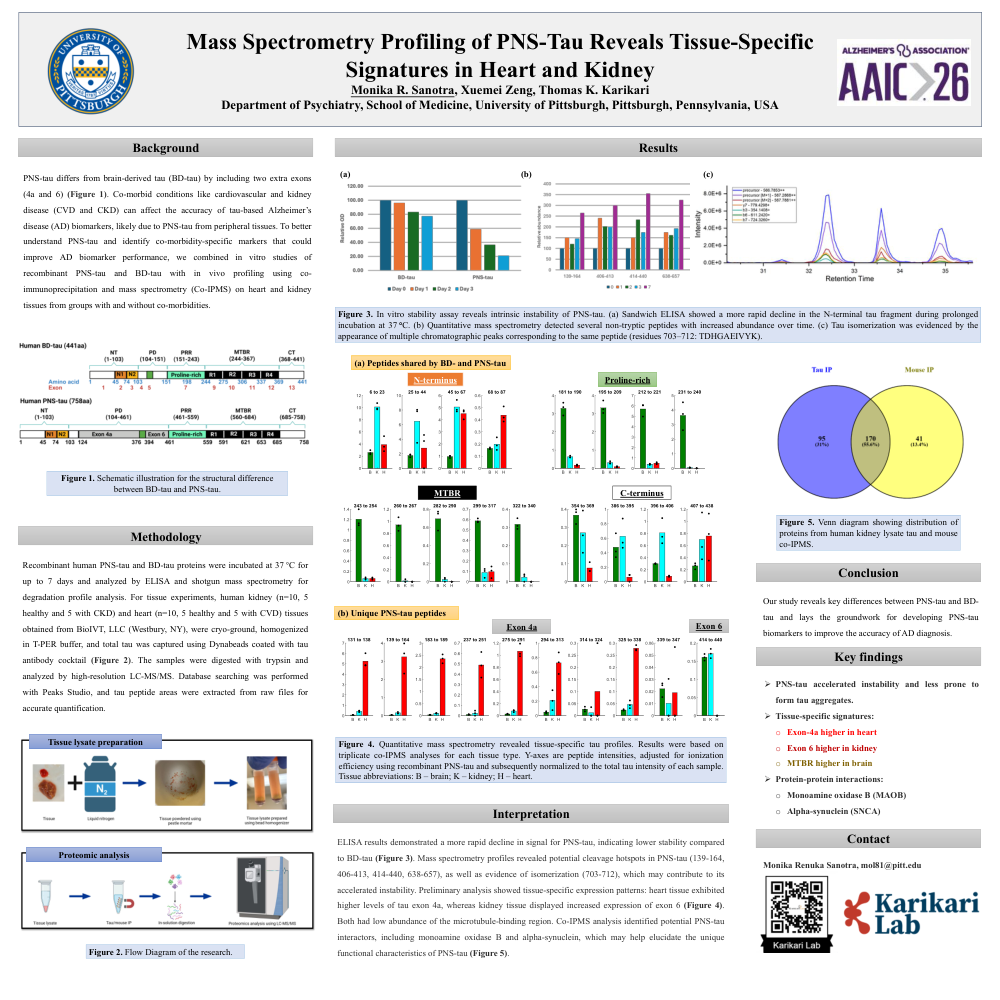
Purpose: PNS-tau differs from brain-derived tau (BD-tau) by including two extra exons (4a and 6). Co-morbid conditions like cardiovascular and kidney disease can affect the accuracy of tau-based Alzheimer’s disease (AD) biomarkers, likely due to PNS-tau from peripheral tissues. To better understand PNS-tau and identify co-morbidity-specific markers that could improve AD biomarker performance, we combined in vitro studies of recombinant PNS-tau and BD-tau with in vivo profiling using co-immunoprecipitation and mass spectrometry (Co-IPMS) on heart and kidney tissues from groups with and without co-morbidities.
Methods: Recombinant human PNS-tau and BD-tau proteins were incubated at 37 °C for up to 7 days and analyzed by ELISA and shotgun mass spectrometry for degradation profile analysis. For tissue experiments, human kidney and heart samples (n = 5 per group) were cryo-ground, homogenized in T-PER buffer, and total tau was captured using Dynabeads coated with tau antibody cocktail. The samples were digested with trypsin and analyzed by high-resolution LC-MS/MS. Database searching was performed with Peaks Studio, and tau peptide areas were extracted from raw files for accurate quantification.
Results: ELISA results demonstrated a more rapid decline in signal for PNS-tau, indicating lower stability compared to BD-tau. Mass spectrometry profiles revealed potential cleavage hotspots in PNS-tau (139-164, 406-413, 414-440, 638-657), as well as evidence of isomerization (703-712), which may contribute to its accelerated instability. Preliminary analysis showed tissue-specific expression patterns: heart tissue exhibited higher levels of tau exon 4a, whereas kidney tissue displayed increased expression of exon 6. Both had low abundance of the microtubule-binding region. Co-IPMS analysis identified potential PNS-tau interactors, including monoamine oxidase B and alpha-synuclein, which may help elucidate the unique functional characteristics of PNS-tau.
Conclusion: Our study reveals key differences between PNS-tau and BD-tau and lays the groundwork for developing PNS-tau biomarkers to improve the accuracy of AD diagnosis.
Comments
Email is required but is not shown publicly.
Loading comments...