4,068 posters, 219 videos, 101 topics, 69 sessions, 14,365 authors, 6,128 institutions
ePostersLive by SciGen Technologies S.A. All rights reserved.
Alzheimer's Association International Conference 2026
July 12-15, 2026 | London, United Kingdom, and Online

11789
Oligomeric Amyloid β: Association With Dysfunctional Presynaptic Organelles And Visualization During Life With A Novel P.E.T. Ligand
Poster Presenter
Authors
Sam Gandy, Emilie Castranio, Elentina Argyrousi, Kuldeep Tripathi, Graeme Preston, Charles Glabe, Efrat Levy, Minghui Wang, Bin Zhang, William Lubell, Brigitte Guerin, Tomas Kozics, Shai Rahimipour, Dara Dickstein, Ottavio Arancio, Michelle Ehrlich
Affiliations
Icahn School of Medicine at Mount Sinai, University of California, Irvine, Taub Institute and Department of Pathology, Vagelos College of Physicians & Surgeons, Bar-Ilan University, NYU Langone and Nathan Kline Institute, Universite de Montreal, Universite de Sherbrooke, Uniformed Services University of the Health Sciences
Part of Topic
Virtual
Video
Oligomeric Amyloid β: Association With Dysfunctional Presynaptic Organelles And Visualization During Life With A Novel PET Ligand
S. Gandy1, E. Castranio1, M. Varghese1, E. Argyrousi2, K. Tripathi3, G. Preston1, C. Glabe4, E. Levy5, M. Wang1, B. Zhang1, W. Lubell6, B. Guerin7, T. Kozics1,
S. Rahimipour3, D. Dickstein8, O. Arancio2, M.E. Ehrlich1.
1Icahn School of Medicine at Mount Sinai - New York (United States); 2Columbia University, New York (United States); 3Bar Ilan University, Ramat Gan (Israel); 4 University of California Irvine – Irvine (United States); 5New York University & Nathan Kline Institute - New York (United States); 6Universite de Montreal – Montreal (Canada); 7. Universite de Sherbrooke – Sherbrooke (Canada); 8. Uniformed Services University of the Health Sciences – Bethesda (United States)
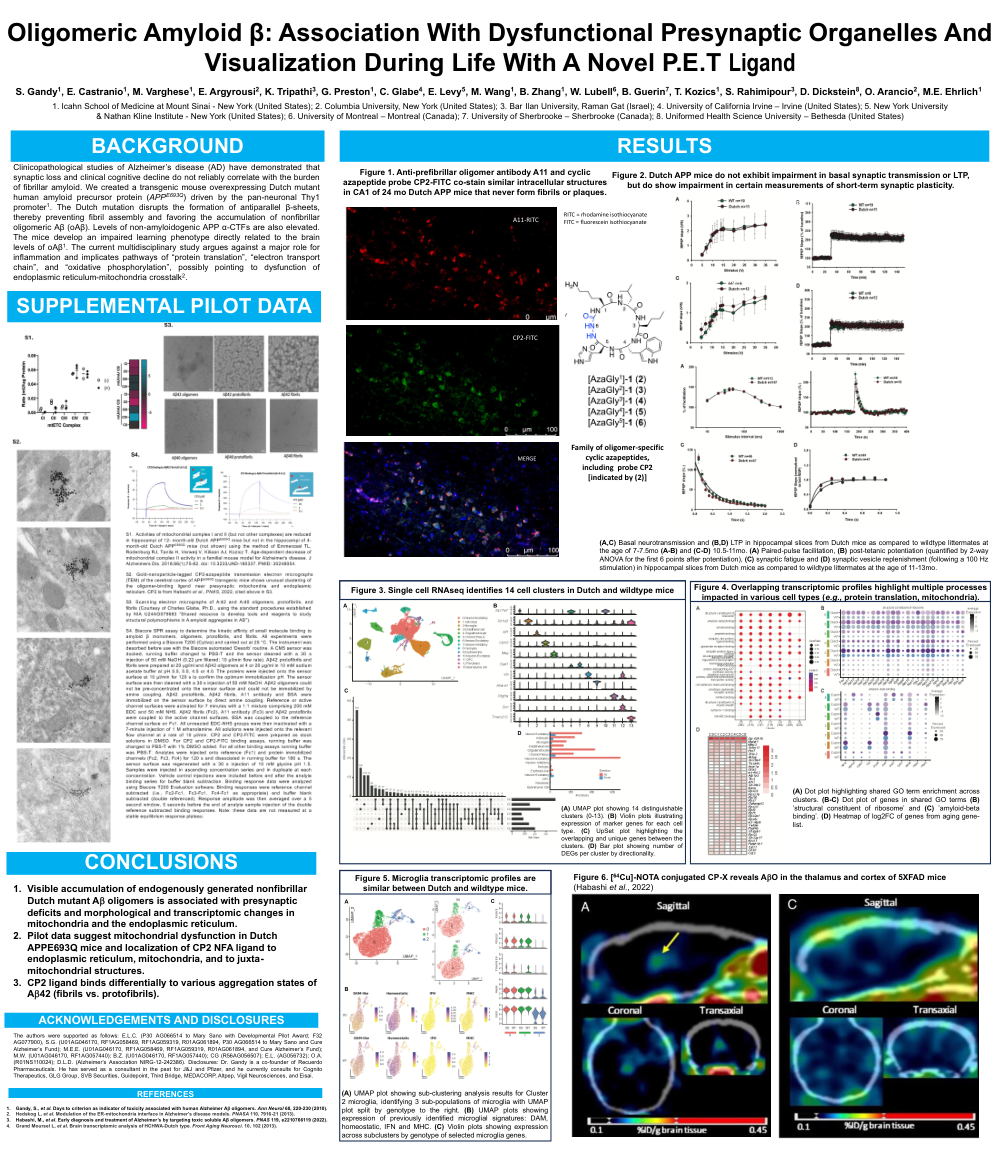
Clinicopathological studies of Alzheimer’s disease (AD) have demonstrated that synaptic loss and clinical cognitive decline do not reliably correlate with the burden of fibrillar amyloid. We created a transgenic mouse overexpressing Dutch mutant human amyloid precursor protein (APPE693Q) driven by the pan-neuronal Thy1 promoter1. The Dutch mutation disrupts the formation of antiparallel β-sheets, thereby preventing fibril assembly and favoring the accumulation of nonfibrillar oligomeric Aβ (oAβ). Levels of non-amyloidogenic APP α-CTFs are also elevated. The mice develop an impaired learning phenotype directly related to the brain levels of oAβ1. The current multidisciplinary study argues against a major role for inflammation and implicates pathways of “protein translation”, “electron transport chain”, and “oxidative phosphorylation”, possibly pointing to dysfunction of endoplasmic reticulum-mitochondria crosstalk2.
Background. Clinicopathological studies of Alzheimer’s disease (AD) have demonstrated that synaptic loss and clinical cognitive decline correlate better with levels of nonfibrillar oligomeric Aβ than with the burden of fibrillar amyloid.
Methods. We created a transgenic mouse overexpressing Dutch mutant human amyloid precursor protein (hAPPE693Q) driven by the pan-neuronal Thy1 promoter. The Dutch mutation disrupts the formation of antiparallel β-sheets, thereby preventing fibril assembly and favoring the accumulation of nonfibrillar oligomeric Aβ (oAβ). Non-amyloidogenic APP α-carboxyl terminal fragments (α-CTFs) also accumulate in these mice. We assessed the physiological, transcriptomic, ultrastructural, histological, and metabolic changes associated with the accumulation of nonfibrillar oligomeric Dutch Aβ in the brains of hAPPE693Q mice ("Dutch mice").
Results. Dutch mice developed an aging-related impaired learning phenotype directly related to the brain levels of nonfibrillar oAβ. Dutch APPE693Q mice have no impairment in basal synaptic transmission or LTP but do show impairment in certain measurements of short-term synaptic plasticity. Presynaptic termini of APPE693Q mice developed electrophysiological abnormalities in post-tetanic potentiation, synaptic fatigue, synaptic vesicle replenishment, and an aging-related reduction in mitochondrial complex I activity. RITC-conjugated Glabe antibody A11 and FITC-conjugated oligomer-binding ligand cyclic D,L-α-peptide-CP2 co-stained similar structures in the cytoplasm of hippocampal CA1 neurons of 24-month-old Dutch APPE693Q mice. Transmission electron microscopic (TEM) localization of gold nanoparticle-conjugated oligomer-binding ligand cyclic D,L-α-peptide-CP2 in Dutch APPE693Q mouse brain revealed a concentration of ligand binding implying that oligomers cluster within or adjacent to the mitochondria and endoplasmic reticulum of excitatory neurons. PET imaging with [64Cu] cyclic D,L-α-peptide ligands revealed amyloid beta oligomers in 5XFAD mice are detectable in the thalamus before the cortex.
Single-cell RNA-seq identified 14 cell clusters in wild-type and Dutch mice. Microglia transcriptomic profiles were similar between wildtype and Dutch mice. Pathways of “protein translation," “electron transport chain," and “oxidative phosphorylation” suggest dysfunction of endoplasmic reticulum-mitochondria crosstalk in excitatory neurons. Accumulation of nonfibrillar oligomeric Aβ altered neuronal metabolism but did not activate inflammation, though we observed an approximately 3-fold increase in co-localization of C1q with synaptic puncta in Dutch mice (p = 0.0181). These data strengthen the conclusion that C1q–synapse association is significantly elevated in Dutch mice at 12 months of age, as has reported in J20 mice. Mitochondrial dysfunction was highlighted in the transcriptomic response of excitatory neurons. Fewer mitochondria were present in presynaptic boutons in the hippocampal CA1 of 12-mo-old Dutch mice. Mitochondrial complex I activity (but not II-IV) was reduced in the brains of 12-month-old Dutch APPE693Q mice.
Implications. Detailed analysis of Dutch mice revealed alterations in synaptic physiology, gene expression, and protein translation in excitatory neurons, as well as changes in the transcriptomic profile and in mitochondrial morphology and activity. Using TEM, gold-conjugated cyclic D,L-α-peptide oligomer ligands were observed to cluster within or near mitochondria and endoplasmic reticulum profiles. The high sensitivity of scRNA-seq excluded neuroinflammation as a major contributor to pathogenesis in the hippocampi of Dutch mice. Among few studies focusing on changes associated with physiologically generated nonfibrillar oligomeric Aβ without confounding presence of either Aβ fibrils nor synthetic Aβ peptides, our findings support the notion that fibrillar Aβ is unnecessary for the aging-related learning deficit observed in Dutch mice. Considering implications in the genesis of cognitive impairment in humans, our results indicate that modest clinical response to anti-amyloid antibody therapy may be attributable, at least in part, to the persistence of toxic nonfibrillar Aβ oligomers that go undetected in standard analyses of either biofluid biomarkers or amyloid fibril positron emission tomography (PET) imaging. Soluble oligomer binding assays (SOBA) and PET imaging with [64Cu]-NOTA-cyclic D,L-α-peptide oligomer ligand offer new promise for detecting biomarkers that reveal the presence and distribution, respectively, of residual cryptic toxic nonfibrillar Aβ oligomers, that persist even after an 18-month course of anti-amyloid antibody infusions. Depletion or neutralization of residual nonfibrillar oligomeric Aβ may provide improved clinical responses to anti-amyloid antibody infusions.
Funding. The authors were supported as follows: E.L.C. (P30 AG066514 to Mary Sano with Developmental Pilot Award; F32 AG077900), S.G. (U01AG046170, RF1AG058469, RF1AG059319, R01AG061894, P30 AG066514 to Mary Sano, the I.M.B. Ertegun Project for Cognitive Health Extension at ISMMS, and Cure Alzheimer’s Fund); M.E.E. (U01AG046170, RF1AG058469, RF1AG059319, R01AG061894, the I.M.B. Ertegun Project for Cognitive Health Extension at ISMMS, and Cure Alzheimer’s Fund); M.W. (U01AG046170, RF1AG057440); B.Z. (U01AG046170, RF1AG057440); CG (R56AG056507); E.L. (AG056732); O.A. (R01NS110024); D.L.D. (Alzheimer’s Association NIRG-12-242386); B.G., S. R., W.L. (Cure Alzheimer's Fund, Canadian Institute of Health Research); B.T. (Cure Alzheimer's Fund). S.G. declares his membership on the SABs of Altpep and Alzheon.
SUMMARY
Comments
Email is required but is not shown publicly.
Loading comments...