4,068 posters, 219 videos, 101 topics, 69 sessions, 14,365 authors, 6,128 institutions
ePostersLive by SciGen Technologies S.A. All rights reserved.
Alzheimer's Association International Conference 2026
July 12-15, 2026 | London, United Kingdom, and Online

11787
Plasma Brain Derived P-tau217 Predicts Future Tau Pet Accumulation
Poster Presenter
Authors
Hillary Protas, Marisa Denkinger, Valentina Ghisays, Alpana Singh, Shan Li, Ji Luo, Javad Sohankar, Yinghua Chen, Dhruman Goradia, Michael Malek- Ahmadi, Wendy Lee, Vivek Devadas, Eric Reiman, Nicholas Ashton, Yi Su
Affiliations
Banner Alzheimer's Institute & Sun Health Research Institute, Banner Research
Part of Topic
Virtual
Introduction
Background
- Plasma p‑tau217 is a leading blood‑based biomarker for Alzheimer’s disease (AD), yet its temporal relationship to tau PET remains unclear.
- Determining whether circulating p‑tau217 captures tau pathology earlier than PET is central to disease staging, therapeutic targeting, and clinical trial design
Study aims
- We evaluated whether brain‑derived p‑tau217 (BD‑pTau217) associates with and predicts tau PET burden across disease stages.
- Evaluated whether BD-pTau217 predicted 2-year tau PET taking into effect the baseline tau.
- Further assess whether BD-pTau217 predicted individual trajectories of tau accumulation.
- See whether BD-pTau217 statistically mediates the association between amyloid PET and subsequent tau accumulation.
- Compare whether BD-pTau217 better predicts downstream tau PET then non-specific pTau217 from conventional assays.
Methods
Study Design
- Predicting longitudinal tau PET changes in ADNI participants from cross-sectional plasma NULISAseq measurements
Participants / Samples
- ADNI participants with plasma NULISAseq CNS panel
- Total sample: N = 1,427-223 AD, 675 MCI, 529 CU
- A longitudinal subset (41 impaired, 53 CU) underwent FTP PET, with the first scan 2.8 ± 2.9 years from plasma baseline and follow‑up imaging ~2.0 ± 0.2 years later.
Measurements
- Plasma biomarkers: BD-pTau217, pTau217
- Plasma: 3 levels for each plasma biomarker determined by 95% sensitivity and specificity.
- FTP tau PET: metatemporal (MT) tau PET SUVR and entorhinal (BK1) SUVR and strength(str).
Statistical Analysis
- Predictive models evaluated whether plasma predicted 2‑year tau PET, adjusting for baseline tau, age, sex, diagnosis, and plasma‑to‑PET interval.
- Linear mixed effects model to look at whether plasma predicted individual trajectories of tau accumulation
- Parallel mediation analyses with residual covariance estimated to account for overlap between plasma biomarkers.
Results
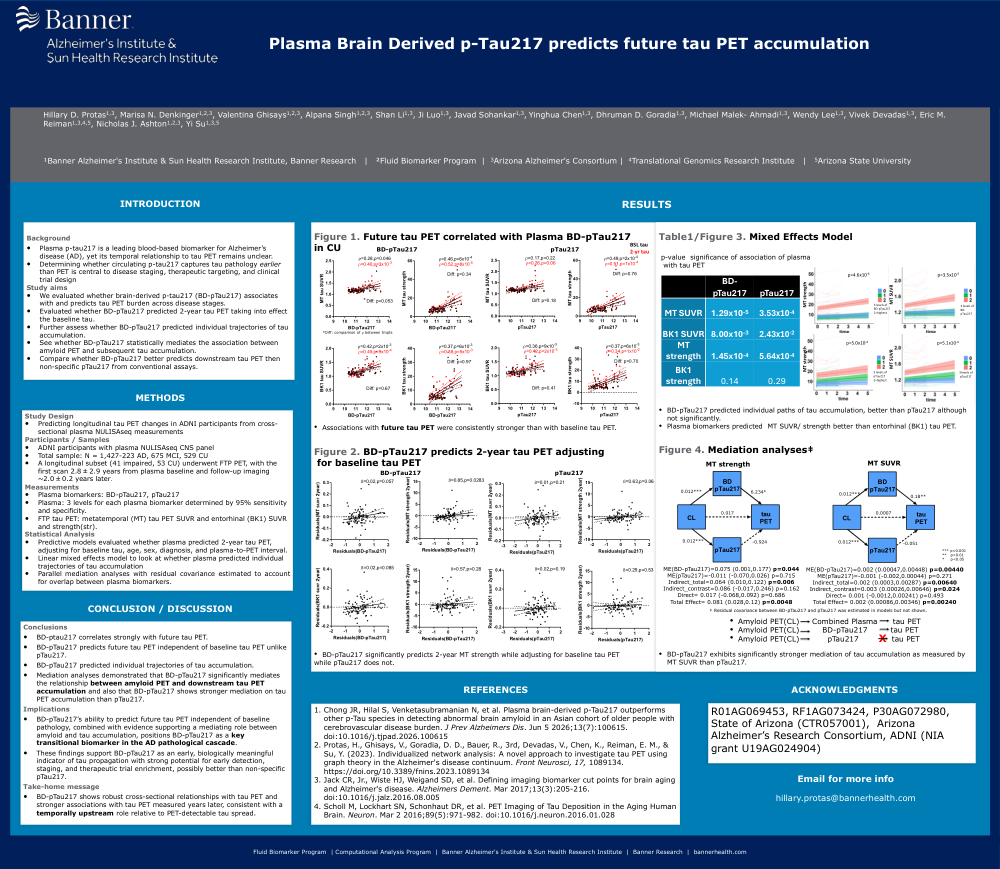
Figure 1. Future tau PET correlated with Plasma BD-pTau217
in CU
- Associations with future tau PET were consistently stronger than with baseline tau PET.
Figure 2. BD-pTau217 predicts 2-year tau PET adjusting
for baseline tau PET
- BD-pTau217 significantly predicts 2-year MT strength while adjusting for baseline tau PET while pTau217 does not.
Table1/Figure 3. Mixed Effects Model
- BD-pTau217 predicted individual paths of tau accumulation, better than pTau217 although not significantly.
- Plasma biomarkers predicted MT SUVR/ strength better than entorhinal (BK1) tau PET.
Figure 4. Mediation analyses
- BD-pTau217 exhibits significantly stronger mediation of tau accumulation as measured by MT SUVR than pTau217.
Conclusion/Discussion
Conclusions
- BD-ptau217 correlates strongly with future tau PET.
- BD-pTau217 predicts future tau PET independent of baseline tau PET unlike pTau217.
- BD-pTau217 predicted individual trajectories of tau accumulation.
- Mediation analyses demonstrated that BD‑pTau217 significantly mediates the relationship between amyloid PET and downstream tau PET accumulation and also that BD-pTau217 shows stronger mediation on tau PET accumulation than pTau217.
Implications
- BD-pTau217’s ability to predict future tau PET independent of baseline pathology, combined with evidence supporting a mediating role between amyloid and tau accumulation, positions BD‑pTau217 as a key transitional biomarker in the AD pathological cascade.
- These findings support BD‑pTau217 as an early, biologically meaningful indicator of tau propagation with strong potential for early detection, staging, and therapeutic trial enrichment, possibly better than non-specific pTau217.
Take-home message
- BD‑pTau217 shows robust cross‑sectional relationships with tau PET and stronger associations with tau PET measured years later, consistent with a temporally upstream role relative to PET‑detectable tau spread.
References
- Chong JR, Hilal S, Venketasubramanian N, et al. Plasma brain-derived p-Tau217 outperforms other p-Tau species in detecting abnormal brain amyloid in an Asian cohort of older people with cerebrovascular disease burden. J Prev Alzheimers Dis. Jun 5 2026;13(7):100615. doi:10.1016/j.tjpad.2026.100615
- Protas, H., Ghisays, V., Goradia, D. D., Bauer, R., 3rd, Devadas, V., Chen, K., Reiman, E. M., & Su, Y. (2023). Individualized network analysis: A novel approach to investigate tau PET using graph theory in the Alzheimer's disease continuum. Front Neurosci, 17, 1089134. https://doi.org/10.3389/fnins.2023.1089134
- Jack CR, Jr., Wiste HJ, Weigand SD, et al. Defining imaging biomarker cut points for brain aging and Alzheimer's disease. Alzheimers Dement. Mar 2017;13(3):205-216. doi:10.1016/j.jalz.2016.08.005
- Scholl M, Lockhart SN, Schonhaut DR, et al. PET Imaging of Tau Deposition in the Aging Human Brain. Neuron. Mar 2 2016;89(5):971-982. doi:10.1016/j.neuron.2016.01.028
Acknowledgements
R01AG069453, RF1AG073424, P30AG072980, State of Arizona (CTR057001), Arizona Alzheimer’s Research Consortium, ADNI (NIA grant U19AG024904)
Comments
Email is required but is not shown publicly.
Loading comments...