4,068 posters, 219 videos, 101 topics, 69 sessions, 14,365 authors, 6,128 institutions
ePostersLive by SciGen Technologies S.A. All rights reserved.
Alzheimer's Association International Conference 2026
July 12-15, 2026 | London, United Kingdom, and Online

13467
Prediction Of 5-year Future Dementia Onset Using A Novel ADL Scale Designed By Mathematical Optimization
Poster Presenter
Authors
Yu Yang, Ermanno Attardo, Igor Stefanini, Daniel Press, Maurice Smith
Affiliations
School of Engineering and Applied Sciences, Harvard University, Allston, MA, USA, University of Applied Sciences and Arts of Southern Switzerland, Ticino, Switzerland, Beth Israel Deaconess Medical Center, Boston, MA, USA
Part of Topic
Virtual
Abstract:
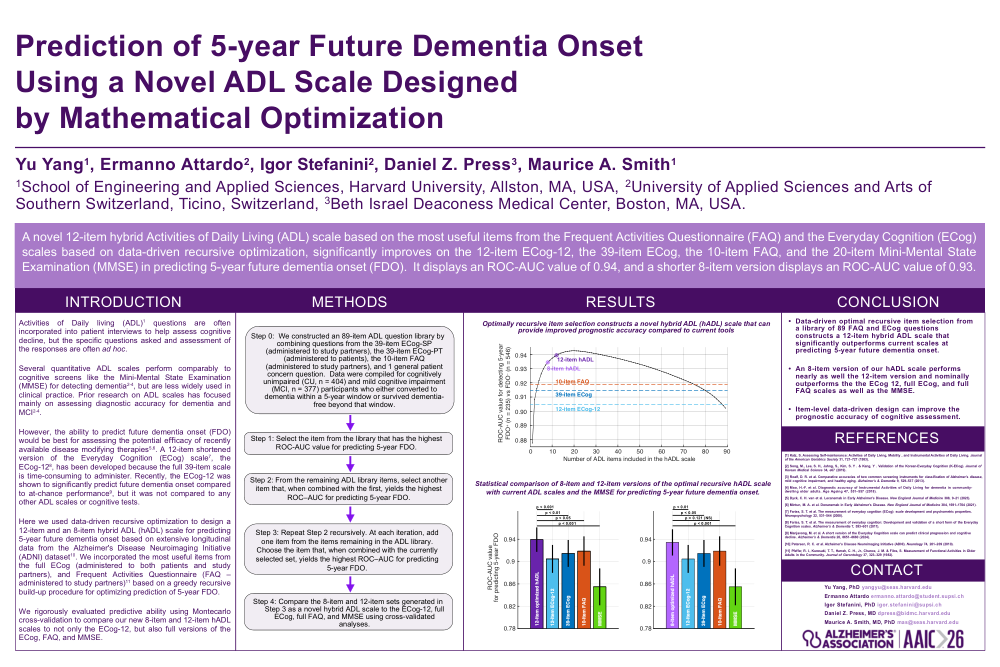
Background: Activities of Daily Living (ADL) questions are commonly asked by dementia specialists in patient interviews to help assess cognitive decline, but the specific questions asked and assessment of the responses are often somewhat ad hoc. While several formal quantitative ADL scales have been developed and demonstrate performance comparable to cognitive screening tests like the Montreal Cognitive Assessment (MoCA) for detecting dementia, they are not widely used in clinical settings. Existing work has focused on their diagnostic accuracy - the ability to detect dementia and, to a lesser extent, MCI. However, the ability to predict future dementia onset (FDO) would be best for assessing the potential efficacy of recently available disease modifying therapies. Therefore, using extensive longitudinal data, we first compared the ability of current ADL assessments to predict FDO and then developed optimized combinations of ADL items that significantly improve this ability.
Methods: Using the ADNI dataset, we analyzed data from 2609 individuals diagnosed as cognitively unimpaired (CU, n=1281) or mild cognitive impairment (MCI, n=1328). We compared two ADL scales, the Functional Activities Questionnaire (FAQ) and the Everyday Cognition (ECog) scale, with the MoCA for their ability to predict the 5-year FDO. We then applied item-level data-driven mathematical optimization to build a novel hybrid ADL scale with improved prediction accuracy for 5-year FDO drawing items from the 39-question ECog-SP and ECog-PT scales (the ECog scale administered to Study-Partners and Patients, respectively) and the 10-question FAQ.
Results: We found that both the FAQ and the ECog-SP outperformed the MoCA for predicting the 5-year FDO (ROC-AUC=0.90, 95% CI=[0.88,0.91] and 0.89 [0.88,0.91] vs 0.84 [0.82,0.85], p<0.0001) but the ECog-PT did not (0.69 [0.67,0.71]). Critically, we found that data-driven selection of the most useful ADL items from the FAQ, ECog-SP, and ECog-PT to form a 12-item hybrid ADL scale yielded a significant additional improvement in performance (ROC-AUC=0.93 [0.92,0.94]) compared with both the FAQ (p<0.01) and ECog-SP (p<0.001).
Conclusion: Our results indicate that standardized ADL scales like the FAQ and the ECog exceed the MoCA in prognostic accuracy and that combining 12 items from these ADL scales can yield further improvement.
Comments
Email is required but is not shown publicly.
Loading comments...