4,068 posters, 219 videos, 101 topics, 69 sessions, 14,365 authors, 6,128 institutions
ePostersLive by SciGen Technologies S.A. All rights reserved.
Alzheimer's Association International Conference 2026
July 12-15, 2026 | London, United Kingdom, and Online

13580
Plasma P-tau217 Performs Comparably To Centiloid For Predicting Memory Changes In Cognitively Healthy Apoe ε4 Carriers
Poster Presenter
Part of Topic
Virtual
TITLE:
Plasma p-tau217 Performs Comparably to Centiloid for Predicting Memory Changes in Cognitively Healthy APOE ε4 Carriers
AUTHORS:
Colt M. Halter, John L. Woodard, Kristy A. Nielson, J. Carson Smith, Frank P. DiFilippo, Lynn M. Bekris, Maria Khrestian, Audrey Zhu, Sally Durgerian, & Stephen M. Rao
INTRO:
• Amyloid and tau biomarkers are essential for preclinical detection of Alzheimer’s disease (AD).
• However, biomarkers differ in invasiveness, and less is known about how plasma-based markers compare with PET-derived measures in predicting subtle cognitive changes early in the disease trajectory.
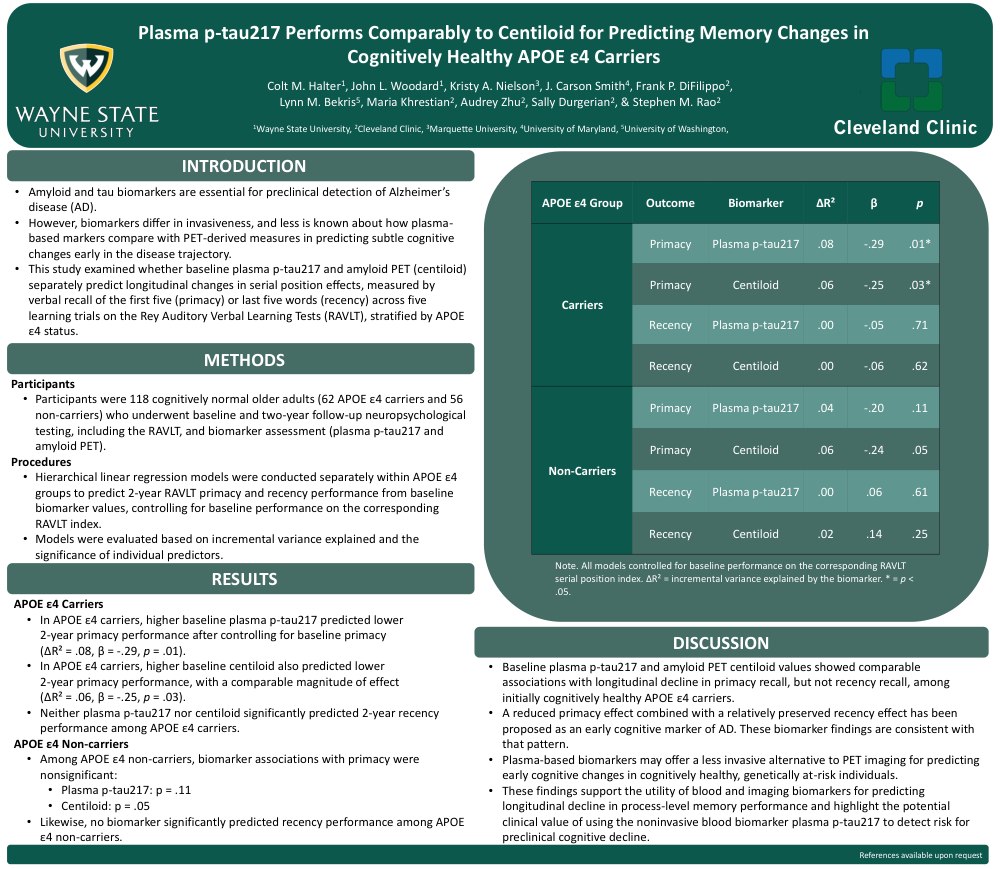
• This study examined whether baseline plasma p-tau217 and amyloid PET (centiloid) separately predict longitudinal changes in serial position effects, measured by verbal recall of the first five (primacy) or last five words (recency) across five learning trials on the Rey Auditory Verbal Learning Tests (RAVLT), stratified by APOE ε4 status.
METHODS:
Participants
• Participants were 118 cognitively normal older adults (62 APOE ε4 carriers and 56 non-carriers) who underwent baseline and two-year follow-up neuropsychological testing, including the RAVLT, and biomarker assessment (plasma p-tau217 and amyloid PET).
Procedures
• Hierarchical linear regression models were conducted separately within APOE ε4 groups to predict 2-year RAVLT primacy and recency performance from baseline biomarker values, controlling for baseline performance on the corresponding RAVLT index.
• Models were evaluated based on incremental variance explained and the significance of individual predictors.
RESULTS:
APOE ε4 Carriers
• In APOE ε4 carriers, higher baseline plasma p-tau217 predicted lower 2-year primacy performance after controlling for baseline primacy (ΔR² = .08, β = -.29, p = .01).
• In APOE ε4 carriers, higher baseline centiloid also predicted lower 2-year primacy performance, with a comparable magnitude of effect (ΔR² = .06, β = -.25, p = .03).
• Neither plasma p-tau217 nor centiloid significantly predicted 2-year recency performance among APOE ε4 carriers.
APOE ε4 Non-carriers
• Among APOE ε4 non-carriers, biomarker associations with primacy were nonsignificant:
• Plasma p-tau217: p = .11
• Centiloid: p = .05
• Likewise, no biomarker significantly predicted recency performance among APOE ε4 non-carriers.
DISCUSSION:
• Baseline plasma p-tau217 and amyloid PET centiloid values showed comparable associations with longitudinal decline in primacy recall, but not recency recall, among initially cognitively healthy APOE ε4 carriers.
• A reduced primacy effect combined with a relatively preserved recency effect has been proposed as an early cognitive marker of AD. These biomarker findings are consistent with that pattern.
• Plasma-based biomarkers may offer a less invasive alternative to PET imaging for predicting early cognitive changes in cognitively healthy, genetically at-risk individuals.
• These findings support the utility of blood and imaging biomarkers for predicting longitudinal decline in process-level memory performance and highlight the potential clinical value of using the noninvasive blood biomarker plasma p-tau217 to detect risk for preclinical cognitive decline.
Comments
Email is required but is not shown publicly.
Loading comments...