4,068 posters, 219 videos, 101 topics, 69 sessions, 14,365 authors, 6,128 institutions
ePostersLive by SciGen Technologies S.A. All rights reserved.
Alzheimer's Association International Conference 2026
July 12-15, 2026 | London, United Kingdom, and Online

13383
Is Subjective Cognitive Decline Associated With Alzheimer’S Disease Pathology In Individuals Without Cognitive Impairment?
Poster Presenter
Part of Topic
Virtual
Is subjective cognitive decline associated with Alzheimer’s disease pathologyin individuals without cognitive impairment?
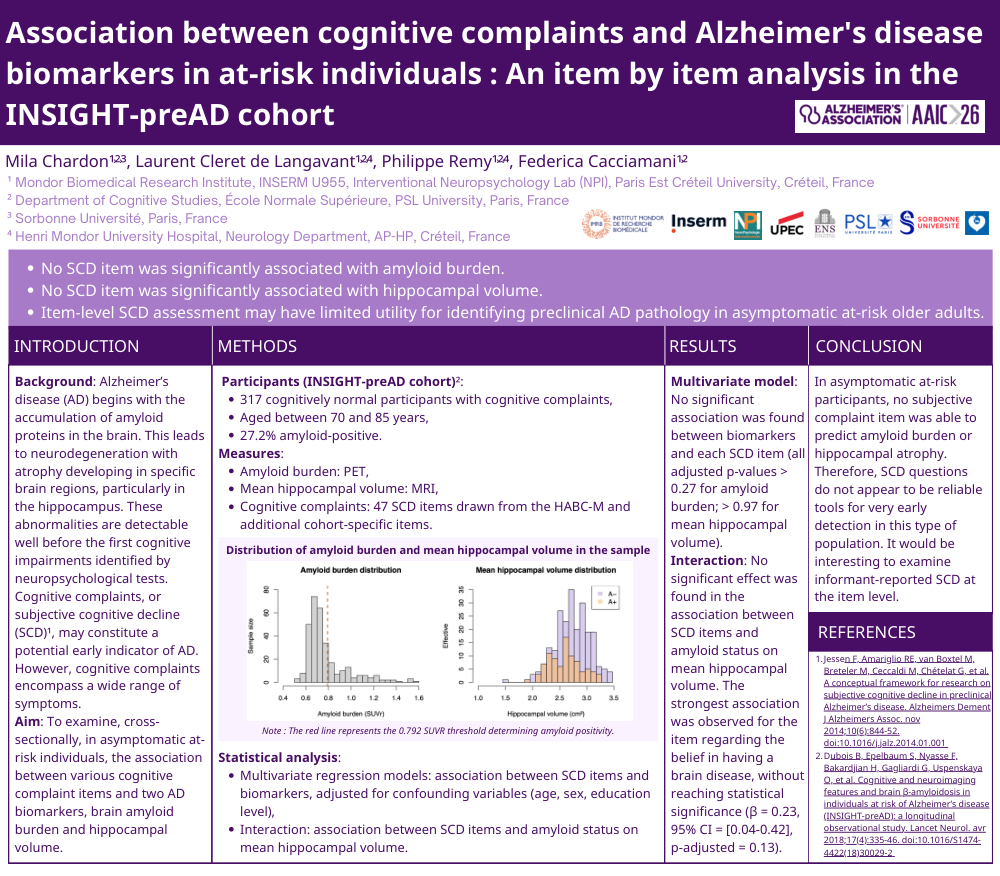
Background: Cognitive complaints or subjective cognitive decline (SCD) may constitute a potential early indicator of Alzheimer’s disease (AD). However, cognitive complaints encompass a wide range of symptoms. In order to test the hypothesis that specific cognitive complaints could predict AD pathology, we examine cross-sectionally in a population without significant cognitive impairment the association between various cognitive complaint items and 2 objective AD biomarkers, cerebral amyloid burden and hippocampal volume.
Methods: 317 cognitively-normal participants from the INSIGHT-preAD cohort, aged between 70 and 85 years, 27.8% amyloid-positive were included. Amyloid burden was measured using florbetapir (AV-45) amyloid positron emission tomography and mean hippocampal volume was assessed using magnetic resonance imaging and Freesurfer segmentation. Forty-seven SCD items were tested in the study, coming from the Healthy Aging Brain Care Monitor questionnaire and additional cohort specific items. They were analyzed using multivariate regression models evaluating the association between SCD items and amyloid burden, adjusted for confounding variables (age, sex and education level) and corrected for multiple comparisons. A linear regression model for mean hippocampal volume, including SCD items and amyloid status, was used to evaluate whether the association between cognitive complaints and hippocampal volume varied according to amyloid status.
Results: Multivariate model examining the association between amyloid burden and each SCD item revealed no significant association (strongest association with the item “mood”: ß = 0.10, CI = [-0.05 - 0.25], p adjusted = 0.83). Adjusted linear regression models for mean hippocampal volume without an interaction termfailed to reveal any significant association (all adjusted p-values > 0.97). Interaction analyses between SCD items and amyloid status on mean hippocampal volume showed no significant effect. The strongest association was observed for the item regarding the belief in having a cerebral pathology, without reaching statistical significance (believe_disease_brain: ß = 0.23, CI = [0,04 - 0,42], p adjusted = 0.13).
Conclusion: In participants without cognitive impairment, no subjective complaint item was able to predict amyloid burden or hippocampal atrophy. Therefore, SCD questions do not appear to be reliable tools for very early detection in individuals without cognitive impairment.
Keywords: amyloid, hippocampus, subjective cognitive decline, cognitive complaints, early-stage Alzheimer’s disease
Mila Chardon, Laurent Cleret de Langavant, Federica Cacciamani and Philippe Remy
Comments
Email is required but is not shown publicly.
Loading comments...