4,068 posters, 219 videos, 101 topics, 69 sessions, 14,365 authors, 6,128 institutions
ePostersLive by SciGen Technologies S.A. All rights reserved.
Alzheimer's Association International Conference 2026
July 12-15, 2026 | London, United Kingdom, and Online

13049
A Process-aware, Llm-driven Digital Clock Drawing Test For Scalable Cognitive Screening: Development And Preliminary Validation
Poster Presenter
Authors
Affiliations
Part of Topic
Virtual
A Process-Aware, LLM-Driven Digital Clock Drawing Test for Scalable Cognitive Screening: Development and Preliminary Validation
Zhixing Zhou, Nan Chen, Huanhuan Xia
Highlight:
LLM-driven dCDT enables independent, scalable cognitive screening by integrating voice guidance, AI-based clock-face scoring (84.3%–99.8% accuracy), and multimodal process capture—extending beyond traditional CDT without specialized hardware.
INTRODUCTION
The Clock Drawing Test (CDT) is a widely used cognitive screening instrument. However, existing digital implementations face three key barriers to scalable preclinical deployment:
1. Reliance on human administration: precludes unsupervised, self-directed completion by older adults.
2. Small modeling datasets: prior digital scoring models trained on limited samples may exhibit instability on out-of-sample data [1].
3. Specialized hardware requirements: requirement for dedicated devices impedes large-scale deployment in community settings [1].
To address these limitations, we developed a process-aware, LLM-driven digital CDT (dCDT).
METHODS
The dCDT integrates three modules
Validation: 427 open-access scanned CDT images [2]
RESULTS
LLM scoring agreement with human annotations (n = 427):
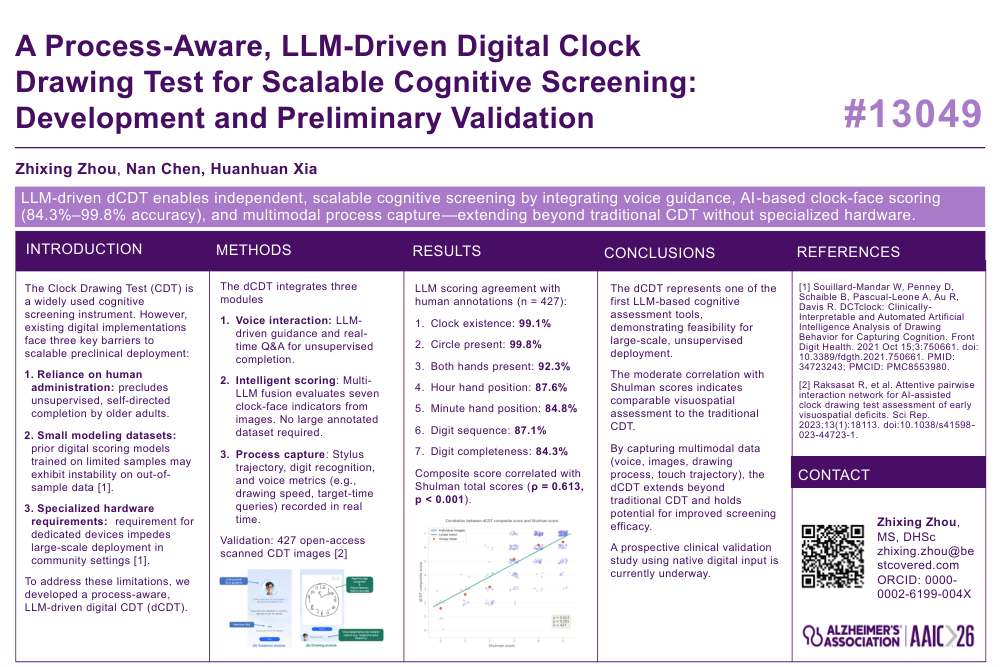
Composite score correlated with Shulman total scores (ρ = 0.613, p < 0.001).
CONCLUSIONS
The dCDT represents one of the first LLM-based cognitive assessment tools, demonstrating feasibility for large-scale, unsupervised deployment.
The moderate correlation with Shulman scores indicates comparable visuospatial assessment to the traditional CDT.
By capturing multimodal data (voice, images, drawing process, touch trajectory), the dCDT extends beyond traditional CDT and holds potential for improved screening efficacy.
A prospective clinical validation study using native digital input is currently underway.
REFERENCES
[1] Souillard-Mandar W, Penney D, Schaible B, Pascual-Leone A, Au R, Davis R. DCTclock: Clinically-Interpretable and Automated Artificial Intelligence Analysis of Drawing Behavior for Capturing Cognition. Front Digit Health. 2021 Oct 15;3:750661. doi: 10.3389/fdgth.2021.750661. PMID: 34723243; PMCID: PMC8553980.
[2] Raksasat R, et al. Attentive pairwise interaction network for AI-assisted clock drawing test assessment of early visuospatial deficits. Sci Rep. 2023;13(1):18113. doi:10.1038/s41598-023-44723-1.
Comments
Email is required but is not shown publicly.
Loading comments...