4,068 posters, 219 videos, 101 topics, 69 sessions, 14,365 authors, 6,128 institutions
ePostersLive by SciGen Technologies S.A. All rights reserved.
Alzheimer's Association International Conference 2026
July 12-15, 2026 | London, United Kingdom, and Online

13152
The Roles Of Biological Sex And Cognitive Reserve In Shaping Sleep-Cognition Dynamics
Poster Presenter
Authors
Alana Brown, Andrew Lim, Jason Steffener, Sylvie Belleville, Malcolm Binns, Nicole Anderson, The CIMA-Q The CIMA-Q, The COMPASS-ND Group The COMPASS-ND Group
Affiliations
Rotman Research Institute, Baycrest Academy for Research and Education, University of Ottawa, University of Toronto, Research Center Institut, Universitairede Gériatriede Montréal, Université de Montréal, Rotman Research Institute, Baycrest Academy for Research and Education, University of Toronto, The Consortium for the Early Identification of Alzheimer's Disease-Quebec, The Comprehensive Assessment of Neurodegeneration and Dementia Group
Part of Topic
Virtual
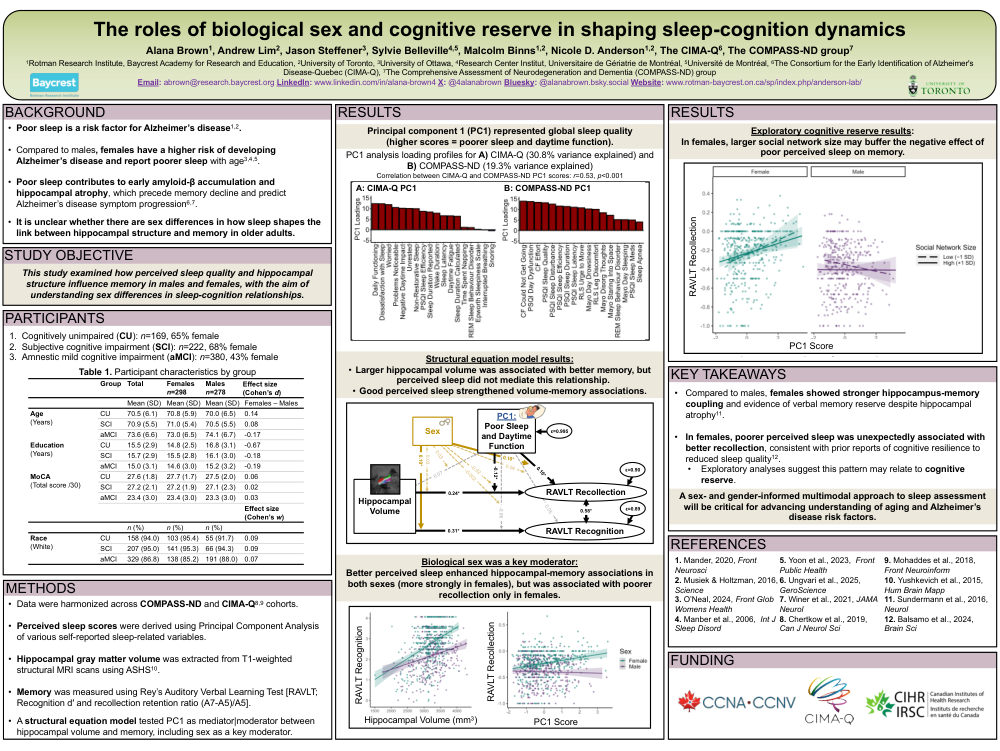
Background: Hippocampal structural integrity is critical for memory, yet it remains unclear whether sleep quality determines when and for whom hippocampal structure supports memory. Compared to males, females are at higher risk for Alzheimer's disease and sleep disturbances. We examined whether perceived sleep quality mediates or moderates the relationship between anterior and posterior hippocampal volumes and memory, and whether these pathways are influenced by biological sex and proxies of cognitive reserve.
Methods: Data from the Comprehensive Assessment of Neurodegeneration and Dementia (COMPASS-ND) and the Consortium for the Early Identification of Alzheimer's Disease-Quebec (CIMA-Q) were harmonized across cognitively unimpaired (CU, n=169), subjective cognitive impairment (SCI, n=222), and amnestic mild cognitive impairment (aMCI, n=380) groups. Principal component analysis of self-reported sleep variables yielded a principal component (PC1) reflecting overall perceived sleep quality. Structural equation models tested whether PC1 mediated or moderated hippocampal volume-memory relationships, including sex as a moderator. When sex moderated relationships, exploratory linear models were used to assess whether various cognitive reserve proxies moderated sleep-memory relationships.
Results: Larger hippocampal volume was associated with better memory, but perceived sleep quality did not mediate this relationship. Good perceived sleep quality strengthened volume-memory associations, with a stronger effect in females compared to males. In females, better perceived sleep quality was associated with poorer recollection memory. Exploratory analyses suggest that higher self-reported social participation (a cognitive reserve proxy) may have a role to play in buffering the negative effect of poor sleep quality on memory in females.
Conclusion: These findings emphasize the importance of considering sex and cognitive reserve factors when evaluating sleep-cognition relationships in the contexts of aging and Alzheimer’s disease risk.
Comments
Email is required but is not shown publicly.
Loading comments...