4,068 posters, 219 videos, 101 topics, 69 sessions, 14,365 authors, 6,128 institutions
ePostersLive by SciGen Technologies S.A. All rights reserved.
Alzheimer's Association International Conference 2026
July 12-15, 2026 | London, United Kingdom, and Online

12003
Multilingualism And Cognitive Performance In Older Adults: Evidence From Indonesia
Poster Presenter
Authors
Part of Topic
Virtual
Association Between Multilingualism and Cognitive Performance in Older Adults: Evidence from Indonesia
Rizky Rafiqoh Afdin1, Fasihah Irfani Fitri1, Irina Kemala Nasution1
1Department of Neurology, Faculty of Medicine, Universitas Sumatera Utara, Medan, Indonesia
Background
Multilingualism has been proposed as a potential contributor to cognitive resilience and may delay age-related cognitive decline, possibly through mechanisms related to cognitive reserve. However, evidence remains inconsistent, particularly regarding specific cognitive domains, and data from understudied Southeast Asian populations are scarce. This study aimed to examine the association between multilingualism and cognitive performance among older adults in Indonesia.
Methods
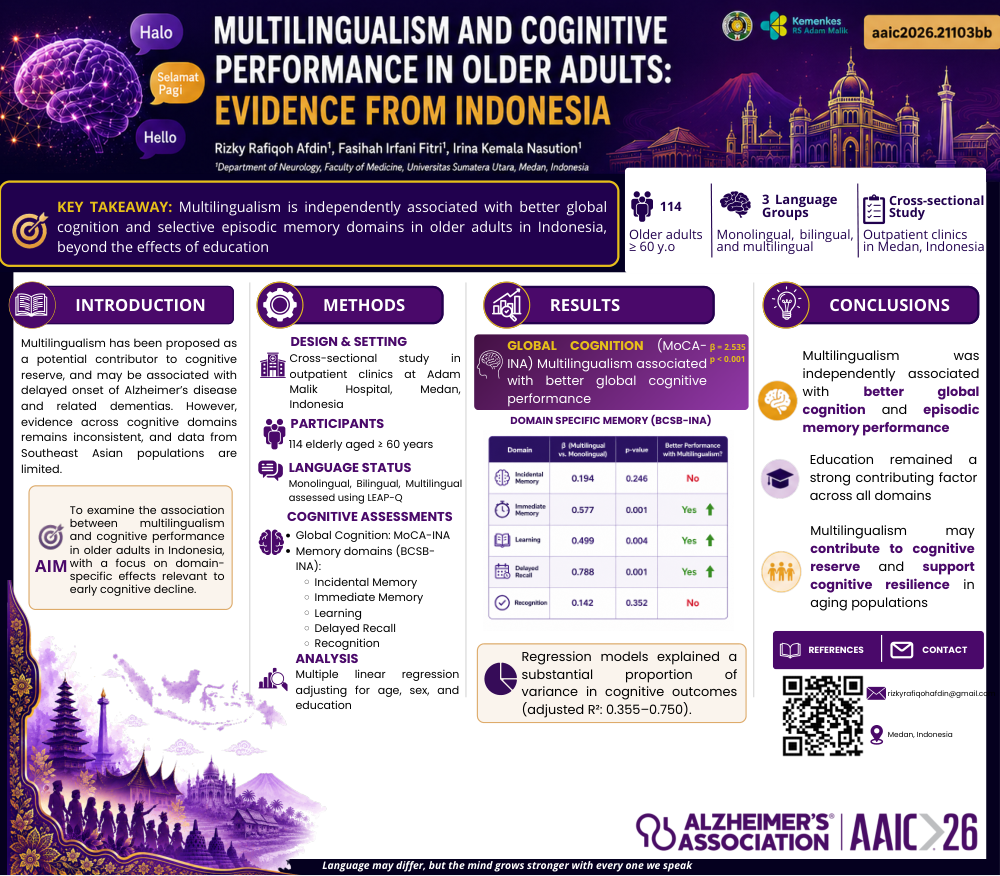
This cross-sectional study included 114 older adults aged ≥60 years attending outpatient clinics at Adam Malik Hospital and Prof. Dr. Chairuddin P. Lubis Universitas Sumatera Utara Hospital in Medan, Indonesia. Language status (monolingual, bilingual, multilingual) was assessed using the Language Experience and Proficiency Questionnaire (LEAP-Q). Global cognitive performance was evaluated using the Indonesian version of the Montreal Cognitive Assessment (MoCA-Ina), while memory domains were assessed using the Brief Cognitive Screening Battery (BCSB), including incidental memory, immediate memory, learning, delayed recall, and recognition. Multiple linear regression analyses were conducted to examine the association between language status and cognitive outcomes, adjusting for age, sex, and education.
Results
Multilingualism was independently associated with higher global cognitive performance measured by MoCA after adjustment for age, sex, and education (β = 2.535, p < 0.001). In the BCSB assessment, multilingualism was also associated with better performance in immediate memory (β = 0.577, p = 0.001), learning (β = 0.499, p = 0.004), and delayed recall (β = 0.788, p = 0.001). No significant association was observed between language status and incidental memory or recognition performance after adjustment. The regression models explained a substantial proportion of variance in cognitive scores (adjusted R² range: 0.355–0.750). Education emerged as a strong independent predictor across cognitive outcomes.
Conclusions
Multilingualism was associated with better global cognitive performance and selected episodic memory domains, independent of key demographic factors. Notably, the absence of associations in incidental memory and recognition suggests domain-specific effects of multilingual experience. These findings highlight the complexity of cognitive reserve mechanisms and provide novel population-based evidence from an understudied Southeast Asian population.
Comments
Email is required but is not shown publicly.
Loading comments...