4,068 posters, 219 videos, 101 topics, 69 sessions, 14,365 authors, 6,128 institutions
ePostersLive by SciGen Technologies S.A. All rights reserved.
Alzheimer's Association International Conference 2026
July 12-15, 2026 | London, United Kingdom, and Online

11989
Global And Regional Trends In Air Pollution-attributable Alzheimer Disease And Other Dementias Burden (1990-2023)
Poster Presenter
Authors
Affiliations
Part of Topic
Virtual
Global And Regional Trends In Air Pollution-attributable Alzheimer Disease And Other Dementias Burden (1990-2023):
Author Block: Saad Arsalan Wasti1, Areesha Wasti2, Sabreena Ahmer3.
1King Edward Medical University, Lahore, Pakistan, 2Continental Medical College, Lahore, Pakistan, 3CMH Multan Institute of Medical Sciences, Multan, Pakistan.
Abstract:
Background: Alzheimer disease and other dementias (ADOD) are major contributors to global morbidity and mortality. Environmental risk factors, particularly air pollution, have been implicated in neurodegenerative processes through mechanisms such as neuroinflammation and oxidative stress. However, long-term global and regional patterns of ADOD burden attributable to air pollution remain insufficiently characterized. This study aimed to assess temporal trends in air pollution-attributable ADOD from 1990-2023.
Methods: Data from the Global Burden of Disease 2023 study, particularly the age-standardised death rates (ASDR) and disability-adjusted life years (DALYs) attributable to air pollution exposure, were analysed using Joinpoint regression to calculate annual percent change (APC) and average annual percent change (AAPC), with 95% confidence intervals.
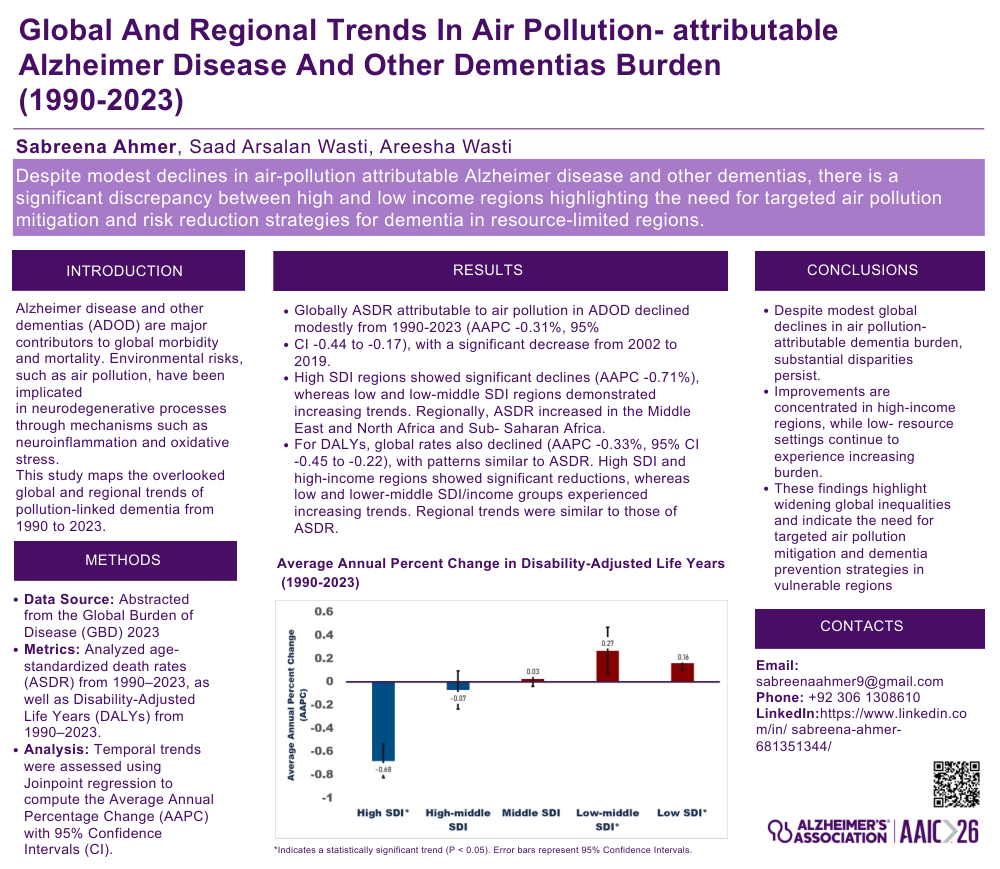
Results: Globally, ASDR attributable to air pollution in Alzheimer’s disease and other dementias declined modestly from 1990-2023 (AAPC -0.31%, 95% CI -0.44 to -0.17), with a significant decrease from 2002 to 2019 followed by a non-significant trend thereafter. By SDI, high SDI regions showed significant declines (AAPC -0.71%), whereas low and low-middle SDI regions demonstrated increasing trends. By World Bank income, ASDR decreased substantially in high-income countries (AAPC -1.28%) but increased in low-income countries (AAPC 0.30%), with no significant change in upper and lower middle-income groups. Regionally, ASDR increased in the Middle East and North Africa and Sub-Saharan Africa. For DALYs, global rates also declined (AAPC -0.33%, 95% CI -0.45 to -0.22), with patterns similar to ASDR. High SDI and high-income regions showed significant reductions, whereas low and lower-middle SDI/income groups experienced increasing trends. Regionally, increases were seen in the Middle East and North Africa and Sub-Saharan Africa.
Conclusion: Despite modest global declines in air pollution-attributable dementia burden, substantial disparities persist. Improvements are concentrated in high-income and high SDI regions, while low-resource settings continue to experience increasing burden. These findings highlight widening global inequalities and indicate the need for targeted air pollution mitigation and dementia prevention strategies in vulnerable regions.
Key Takeaway: Despite modest declines in air-pollution attributable Alzheimer disease and other dementias, there is a significant discrepancy between high and low income regions highlighting the need for targeted air pollution mitigation and risk reduction strategies for dementia in resource-limited regions.
Keywords: Air pollution, Alzheimer's disease, dementia, ADOD, Global Burden of Disease, GBD 2023, environmental risk factors, neuroinflammation, oxidative stress, epidemiological trend analysis, Joinpoint regression, annual percent change, APC, average annual percent change, AAPC, age-standardised death rates, ASDR, disability-adjusted life years, DALYs, socio-demographic index, SDI, global health disparities, World Bank income regions, Middle East and North Africa, Sub-Saharan Africa, public health policy.
Comments
Email is required but is not shown publicly.
Loading comments...