4,068 posters, 219 videos, 101 topics, 69 sessions, 14,365 authors, 6,128 institutions
ePostersLive by SciGen Technologies S.A. All rights reserved.
Alzheimer's Association International Conference 2026
July 12-15, 2026 | London, United Kingdom, and Online

13840
Focusing On Resilience To Increase Dementia Health:awareness & Prevention
Poster Presenter
Authors
Part of Topic
Virtual
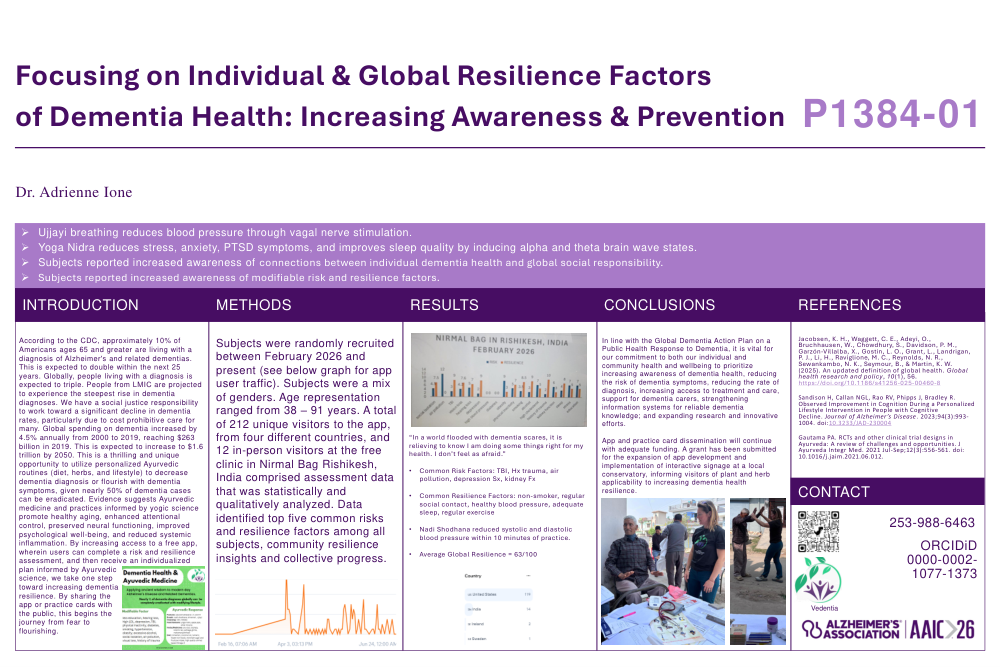
Focusing on Individual & Global Resilience Factors of Dementia Health: Increasing Awareness & Prevention
KEYS
ØUjjayi breathing reduces blood pressure through vagal nerve stimulation.
ØYoga Nidra reduces stress, anxiety, PTSD symptoms, and improves sleep quality by inducing alpha and theta brain wave states.
ØSubjects reported increased awareness of connections between individual dementia health and global social responsibility.
ØSubjects reported increased awareness of modifiable risk and resilience factors.
Introduction
According to the CDC, approximately 10% of Americans ages 65 and greater are living with a diagnosis of Alzheimer's and related dementias. This is expected to double within the next 25 years. Globally, people living with a diagnosis is expected to triple. People from LMIC are projected to experience the steepest rise in dementia diagnoses. We have a social justice responsibility to work toward a significant decline in dementia rates, particularly due to cost prohibitive care for many. Global spending on dementia increased by 4.5% annually from 2000 to 2019, reaching $263 billion in 2019. This is expected to increase to $1.6 trillion by 2050. This is a thrilling and unique opportunity to utilize personalized Ayurvedic routines (diet, herbs, and lifestyle) to decrease dementia diagnosis or flourish with dementia symptoms, given nearly 50% of dementia cases can be eradicated. Evidence suggests Ayurvedic medicine and practices informed by yogic science promote healthy aging, enhanced attentional control, preserved neural functioning, improved psychological well-being, and reduced systemic inflammation. By increasing access to a free app, wherein users can complete a risk and resilience assessment, and then receive an individualized plan informed by Ayurvedic science, we take one step toward increasing dementia resilience. By sharing the app or practice card with the public, this begins the journey from fear to flourishing.
Methods
Subjects were randomly recruited between February 2026 and present (see below graph for app user traffic). Subjects were a mix of genders. Age representation ranged from 38 – 91 years. A total of 212 unique visitors to the app, from four different countries, and 12 in-person visitors at the free clinic in Nirmal Bag Rishikesh, India comprised assessment data that was statistically and qualitatively analyzed. Data identified top five common risks and resilience factors among all subjects, community resilience insights and collective progress.
Results
“In a world flooded with dementia scares, it is relieving to know I am doing some things right for my health. I don’t feel as afraid.”
•Common Risk Factors: TBI, Hx trauma, air pollution, depression Sx, kidney Fx
•Common Resilience Factors: non-smoker, regular social contact, healthy blood pressure, adequate sleep, regular exercise
•Nadi Shodhana reduced systolic and diastolic blood pressure within 10 minutes of practice.
•Average Global Resilience = 63/100
Conclusion
In line with the Global Dementia Action Plan on a Public Health Response to Dementia, it is vital for our commitment to both our individual and community health and wellbeing to prioritize increasing awareness of dementia health, reducing the risk of dementia symptoms, reducing the rate of diagnosis, increasing access to treatment and care, support for dementia carers, strengthening information systems for reliable dementia knowledge; and expanding research and innovative efforts.
App and practice card dissemination will continue with adequate funding. A grant has been submitted for the expansion of app development and implementation of interactive signage at a local conservatory, informing visitors of plant and herb applicability to increasing dementia health resilience.
References
Jacobsen, K. H., Waggett, C. E., Adeyi, O., Bruchhausen, W., Chowdhury, S., Davidson, P. M., Garzón-Villalba, X., Gostin, L. O., Grant, L., Landrigan, P. J., Li, H., Raviglione, M. C., Reynolds, N. R., Sewankambo, N. K., Seymour, B., & Martin, K. W. (2025). An updated definition of global health. Global health research and policy, 10(1), 56. https://doi.org/10.1186/s41256-025-00460-8
Sandison H, Callan NGL, Rao RV, Phipps J, Bradley R. Observed Improvement in Cognition During a Personalized Lifestyle Intervention in People with Cognitive Decline. Journal of Alzheimer’s Disease. 2023;94(3):993-1004. doi:10.3233/JAD-230004
Gautama PA. RCTs and other clinical trial designs in Ayurveda: A review of challenges and opportunities. J Ayurveda Integr Med. 2021 Jul-Sep;12(3):556-561. doi: 10.1016/j.jaim.2021.06.012.

Comments
Email is required but is not shown publicly.
Loading comments...