4,068 posters, 219 videos, 101 topics, 69 sessions, 14,365 authors, 6,128 institutions
ePostersLive by SciGen Technologies S.A. All rights reserved.
Alzheimer's Association International Conference 2026
July 12-15, 2026 | London, United Kingdom, and Online

13459
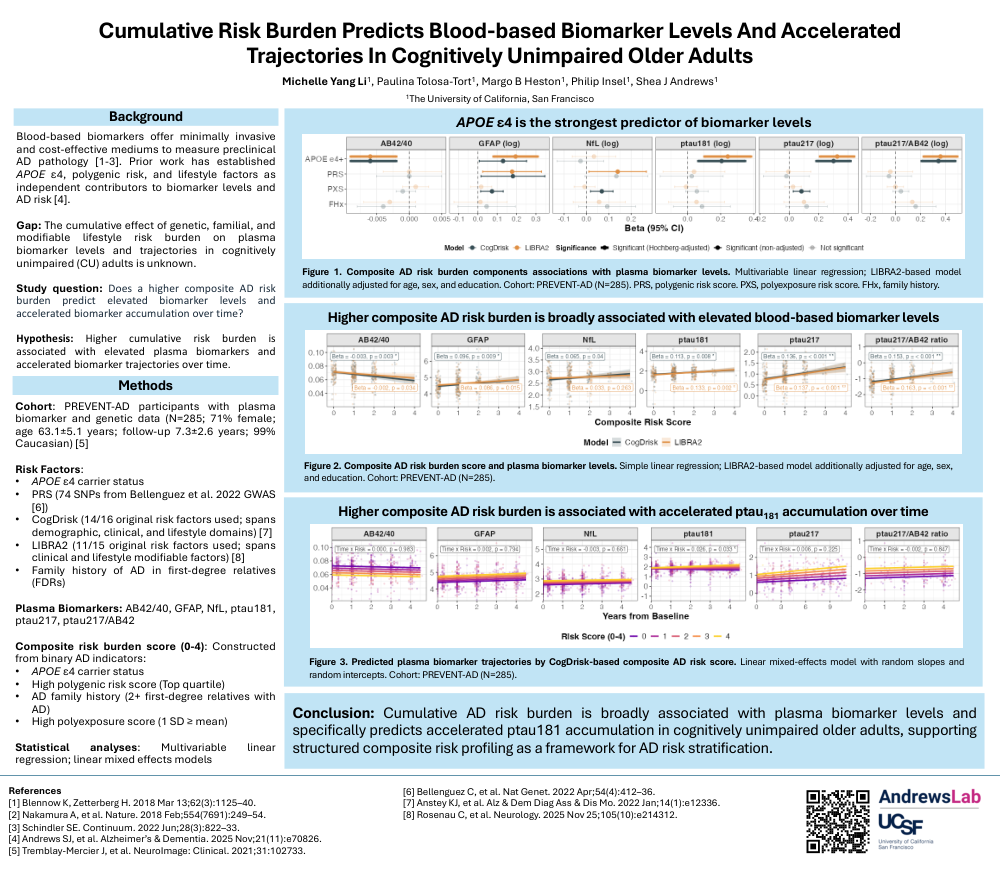
Cumulative Risk Burden Predicts Blood-based Biomarker Levels And Accelerated Trajectories In Cognitively Unimpaired Older Adults
Poster Presenter
Part of Topic
Virtual
Background
Blood-based biomarkers offer minimally invasive and cost-effective mediums to measure preclinical AD pathology [1-3]. Prior work has established APOE ε4, polygenic risk, and lifestyle factors as independent contributors to biomarker levels and AD risk [4].
Gap: The cumulative effect of genetic, familial, and modifiable lifestyle risk burden on plasma biomarker levels and trajectories in cognitively unimpaired (CU) adults is unknown.
Study question: Does a higher composite AD risk burden predict elevated biomarker levels and accelerated biomarker accumulation over time?
Hypothesis: Higher cumulative risk burden is associated with elevated plasma biomarkers and accelerated biomarker trajectories over time.
Methods
Cohort: PREVENT-AD participants with plasma biomarker and genetic data (N=285; 71% female; age 63.1±5.1 years; follow-up 7.3±2.6 years; 99% Caucasian) [5]
Risk Factors:
Plasma Biomarkers: AB42/40, GFAP, NfL, ptau181, ptau217, ptau217/AB42
Composite risk burden score (0-4): Constructed from binary AD indicators:
Statistical analyses: Multivariable linear regression; linear mixed effects models
Results
APOE ε4 is the strongest predictor of biomarker levels
Figure 1. Composite AD risk burden components associations with plasma biomarker levels. Multivariable linear regression; LIBRA2-based model additionally adjusted for age, sex, and education. Cohort: PREVENT-AD (N=285). PRS, polygenic risk score. PXS, polyexposure risk score. FHx, family history.
Higher composite AD risk burden is broadly associated with elevated blood-based biomarker levels
Figure 2. Composite AD risk burden score and plasma biomarker levels. Simple linear regression; LIBRA2-based model additionally adjusted for age, sex, and education. Cohort: PREVENT-AD (N=285).
Higher composite AD risk burden is associated with accelerated ptau181 accumulation over time
Figure 3. Predicted plasma biomarker trajectories by CogDrisk-based composite AD risk score. Linear mixed-effects model with random slopes and random intercepts. Cohort: PREVENT-AD (N=285).
Conclusion
Cumulative AD risk burden is broadly associated with plasma biomarker levels and specifically predicts accelerated ptau181 accumulation in cognitively unimpaired older adults, supporting structured composite risk profiling as a framework for AD risk stratification.
References
[1] Blennow K, Zetterberg H. 2018 Mar 13;62(3):1125–40.
[2] Nakamura A, et al. Nature. 2018 Feb;554(7691):249–54.
[3] Schindler SE. Continuum. 2022 Jun;28(3):822–33.
[4] Andrews SJ, et al. Alzheimer’s & Dementia. 2025 Nov;21(11):e70826.
[5] Tremblay-Mercier J, et al. NeuroImage: Clinical. 2021;31:102733.
[6] Bellenguez C, et al. Nat Genet. 2022 Apr;54(4):412–36.
[7] Anstey KJ, et al. Alz & Dem Diag Ass & Dis Mo. 2022 Jan;14(1):e12336.
[8] Rosenau C, et al. Neurology. 2025 Nov 25;105(10):e214312.
Comments
Email is required but is not shown publicly.
Loading comments...