4,068 posters, 219 videos, 101 topics, 69 sessions, 14,365 authors, 6,128 institutions
ePostersLive by SciGen Technologies S.A. All rights reserved.
Alzheimer's Association International Conference 2026
July 12-15, 2026 | London, United Kingdom, and Online

13862
Could Bilingualism Contribute To Cognitive And Affective Reserve In Psychosis?
Poster Presenter
Authors
Affiliations
Part of Topic
Virtual
Author Block: Caitlin Ware1, Jesus Mario Serna2.
1Psychology, University de Lorraine InterPsy, Nancy, France, 2University de Lorraine InterPsy, Nancy, France.
Abstract:
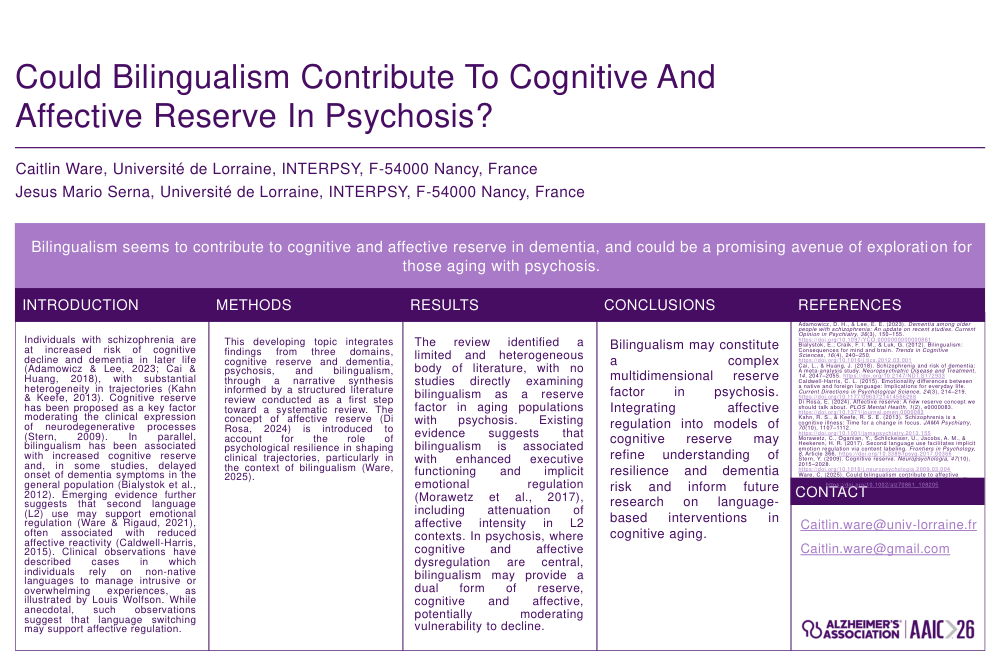
Background: Individuals with schizophrenia are at increased risk of cognitive decline and dementia in later life (Adamowicz & Lee, 2023; Cai & Huang, 2018), with substantial heterogeneity in trajectories (Kahn & Keefe, 2013). Cognitive reserve has been proposed as a key factor moderating the clinical expression of neurodegenerative processes (Stern, 2009). In parallel, bilingualism has been associated with increased cognitive reserve and, in some studies, delayed onset of dementia symptoms in the general population (Bialystok et al., 2012). Emerging evidence further suggests that second language (L2) use may support emotional regulation (Ware & Rigaud, 2021), often associated with reduced affective reactivity (Caldwell-Harris, 2015). Clinical and autobiographical observations have described cases in which individuals rely on non-native languages to manage intrusive or overwhelming experiences (Wolfson & Deleuze, 2009). While anecdotal, such observations suggest that language switching may support affective regulation. We propose a framework examining bilingualism as a contributor to both cognitive and affective reserve in psychosis, and its potential role in modulating cognitive decline and dementia-related outcomes.
Methods: This developing topic integrates findings from the domains of cognitive reserve and dementia, psychosis, and bilingualism, through a narrative synthesis informed by a structured literature review conducted as a first step toward a systematic review. The concept of affective reserve (Di Rosa, 2024) is introduced to account for the role of psychological resilience in shaping clinical trajectories, particularly in the context of bilingualism (Ware, 2025).
Results: The review identified a limited and heterogeneous body of literature, with no studies directly examining bilingualism as a reserve factor in aging populations with psychosis. Existing evidence suggests that bilingualism is associated with enhanced executive functioning and implicit emotional regulation (Morawetz et al., 2017), including attenuation of affective intensity in L2 contexts. In psychosis, where cognitive and affective dysregulation are central, bilingualism may provide a dual form of reserve, cognitive and affective, potentially moderating vulnerability to decline.
Conclusion: Bilingualism may constitute a complex multidimensional reserve factor in psychosis. Integrating affective regulation into models of cognitive reserve may refine understanding of resilience and dementia risk and inform future research on language-based interventions in cognitive aging.
Author Disclosure Information:
Comments
Email is required but is not shown publicly.
Loading comments...