4,068 posters, 219 videos, 101 topics, 69 sessions, 14,365 authors, 6,128 institutions
ePostersLive by SciGen Technologies S.A. All rights reserved.
Alzheimer's Association International Conference 2026
July 12-15, 2026 | London, United Kingdom, and Online

13201
Chronic Back Pain And 26-year Risk Of Alzheimer's Disease And Related Dementias
Poster Presenter
Authors
Affiliations
Part of Topic
Virtual
Background: Chronic Pain (CP) has been associated with increased risk of Alzheimer's disease and related dementias (ADRD), with risk rising as pain sites accumulate. CP is also associated with higher mortality. However, evidence on Chronic Back Pain (CBP) remains sparse and inconsistent, with one study reporting paradoxical protection in adults ≥80 - potentially reflecting survival bias. To our knowledge, no CBP-ADRD study has accounted for the competing risk of death. We evaluated this association in the Health and Retirement Study (HRS).
Methods: We analyzed 10,005 HRS adults free of ADRD at their first cognitive assessment (Langa-Weir classification; median follow-up 18 years). CBP was defined as self-reported back pain in two consecutive waves (1992, 1994) and incident ADRD by Langa-Weir classification. Cox cause-specific hazard models estimated the CBP-ADRD association with sequential adjustment for demographic, behavioral, cardiometabolic, and socioeconomic status (SES); SES was derived via latent class analysis. Fine-Gray and inverse probability of censoring weighting (IPCW) addressed the competing risk of death, with cumulative incidence estimated via Aalen-Johansen. As a positive control, we pre-specified an arthritis-ADRD analysis. Population Attributable Fraction (PAF) was calculated using Miettinen's formula.
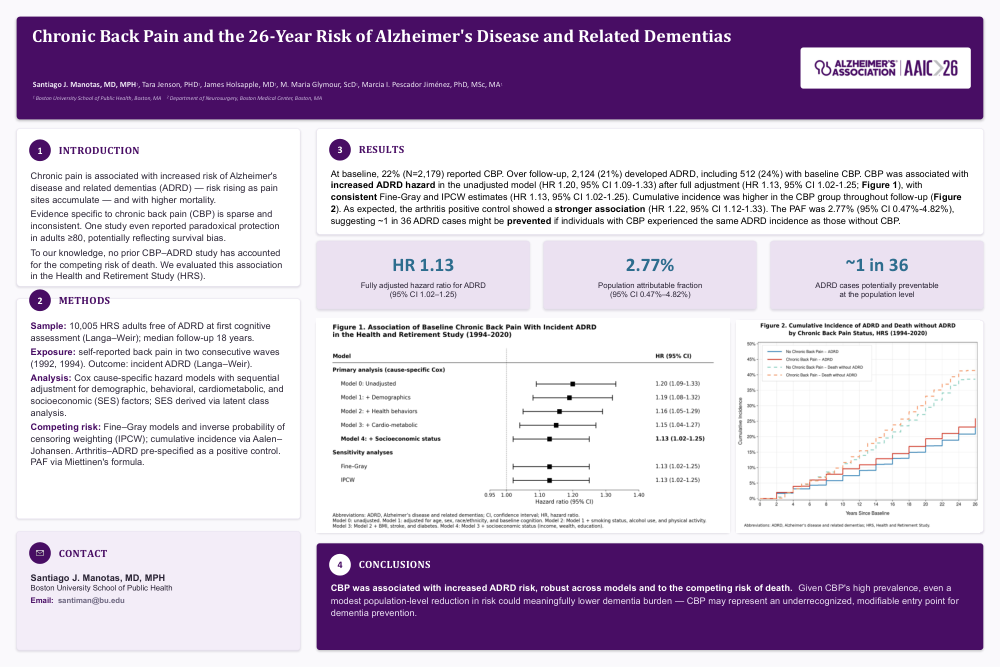
Results: At baseline, 22% (N=2,179) reported CBP. Over follow-up, 2,124 (21%) developed ADRD, including 512 (24%) with baseline CBP. CBP was associated with increased ADRD hazard in the unadjusted model (HR 1.20, 95% CI 1.09-1.33) after full adjustment (HR 1.13, 95% CI 1.02-1.25; Figure 1), with consistent Fine-Gray and IPCW estimates (HR 1.13, 95% CI 1.02-1.25). Cumulative incidence was higher in the CBP group throughout follow-up (Figure 2). As expected, the arthritis positive control showed a stronger association (HR 1.22, 95% CI 1.12-1.33). The PAF was 2.77% (95% CI 0.47%-4.82%), suggesting ~1 in 36 ADRD cases might be prevented if individuals with CBP experienced the same ADRD incidence as those without CBP.
Conclusion: CBP was associated with increased ADRD risk, robust across models. Given CBP's high prevalence, this association carries substantial public health implications — even a modest reduction in risk at the population level could translate to a meaningful decrease in dementia burden. CBP may represent an underrecognized, modifiable entry point in dementia prevention.
Comments
Email is required but is not shown publicly.
Loading comments...