4,068 posters, 219 videos, 101 topics, 69 sessions, 14,365 authors, 6,128 institutions
ePostersLive by SciGen Technologies S.A. All rights reserved.
Alzheimer's Association International Conference 2026
July 12-15, 2026 | London, United Kingdom, and Online

11801
Alzheimer Disease And Other Dementia Burden In The Balkan Region: A Secondary Analysis Of The GBD 2023 Study
Poster Presenter
Authors
Suleman Khalid, Saad Arsalan Wasti, Sabreena Ahmer, Areesha Wasti
Affiliations
Part of Topic
Virtual
Alzheimer Disease And Other Dementia Burden In The Balkan Region: A Secondary Analysis Of The GBD 2023 Study:
Author Block: Saad Arsalan Wasti1, Suleman Khalid2, Sabreena Ahmer2, Areesha Wasti3.
1King Edward Medical University, Lahore, Pakistan, 2CMH Multan Institute of Medical Sciences, Multan, Pakistan, 3Continental Medical College, Lahore, Pakistan.
Abstract:
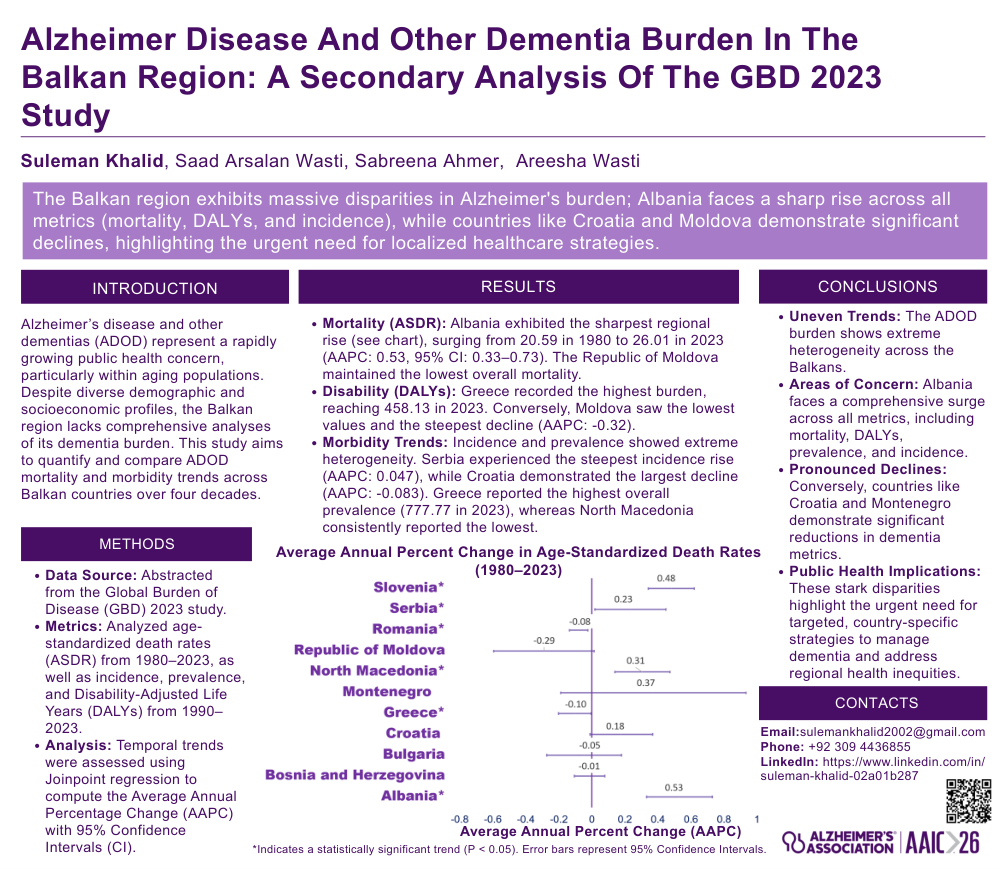
Background: Alzheimer’s disease and other dementias (ADOD) represent a growing public health concern worldwide, particularly in aging populations. The Balkan region, characterized by diverse demographic, socioeconomic, and healthcare profiles, lacks comprehensive regional analyses of dementia burden. This study aims to quantify ADOD trends in Balkan countries.
Methods: We abstracted data from the GBD 2023 study to analyze age-standardized death rates (ASDR), incidence, prevalence, and DALYs for each Balkan country. Due to data availability, ASDR were analyzed from 1980 to 2023 and other metrics from 1990-2023. Temporal trends were assessed using Joinpoint regression to compute annual percentage change (APC) and average APC (AAPC) with 95% confidence intervals (CI).
Results: Between 1980 and 2023, Albania exhibited the highest rise in ASDR (AAPC 0.53, 95% CI 0.33-0.73) and in DALYs (AAPC 0.34, 95% CI 0.14-0.53). Prevalence and incidence trends in the Balkan region showed heterogeneity in trends. Albania showed a modest rise in prevalence (AAPC 0.036), while Bosnia and Herzegovina, North Macedonia and Republic of Moldova demonstrated stability. Bulgaria had a significant increase whereas Croatia, Greece, Slovenia and Montenegro showed pronounced declines. Romania (AAPC 0.0059) and Serbia (AAPC 0.044) demonstrated modest increases. Regarding incidence, Serbia experienced the steepest rise (AAPC 0.047), followed by Albania (AAPC 0.042), whereas Croatia showed the largest decline (AAPC -0.0834).
Conclusion: ADOD burden shows uneven trends across the Balkans. Albania faces rising mortality, DALYs, prevalence, and incidence, whilst countries such as Croatia and Montenegro show declines. These disparities highlight the need for country-specific strategies to reduce dementia burden and address regional disparities.
Key Takeaways:
-
The Balkan region exhibits massive disparities in Alzheimer's burden; Albania faces a sharp rise across all metrics (mortality, DALYs, and incidence), while countries like Croatia and Moldova demonstrate significant declines, highlighting the urgent need for localized healthcare strategies.
-
Pronounced declines in dementia prevalence were observed in Croatia, Greece, Slovenia, and Montenegro.
-
Incidence trends varied sharply, with Serbia experiencing the steepest rise and Croatia showing the largest decline.
-
The stark heterogeneity across the Balkan region underscores the necessity for targeted, country-specific public health interventions.
Keywords: Alzheimer's disease, dementia, ADOD, Global Burden of Disease, GBD 2023, epidemiological trend analysis, Joinpoint regression, annual percentage change, AAPC, age-standardized death rates, ASDR, DALYs, Balkan region, Albania, Bosnia and Herzegovina, North Macedonia, Republic of Moldova, Bulgaria, Croatia, Greece, Slovenia, Montenegro, Romania, Serbia, public health policy.
Comments
Email is required but is not shown publicly.
Loading comments...