4,068 posters, 219 videos, 101 topics, 69 sessions, 14,365 authors, 6,128 institutions
ePostersLive by SciGen Technologies S.A. All rights reserved.
Alzheimer's Association International Conference 2026
July 12-15, 2026 | London, United Kingdom, and Online

13526
Striatal Tau Burden In Autopsy Confirmed FTLD-Tau And Its Relationship To Neuropsychiatric Symptoms
Poster Presenter
Authors
Part of Topic
Virtual
Author Block:Jillian Brunner1,2, Rachel Keszycki1, Caroline Nelson1, Sandra Weintraub1, Marek Marsel Mesulam, Professor of Neurology1, Rudolph Castellani1, Pouya Jamshidi1, Changiz Geula1, Tamar Gefen1.
1Mesulam Institute for Cognitive Neurology and Alzheimer's Disease, Northwestern University, Chicago, IL, USA, 2College of Medicine, University of Illinois Chicago, Chicago, IL, USA.
Abstract:
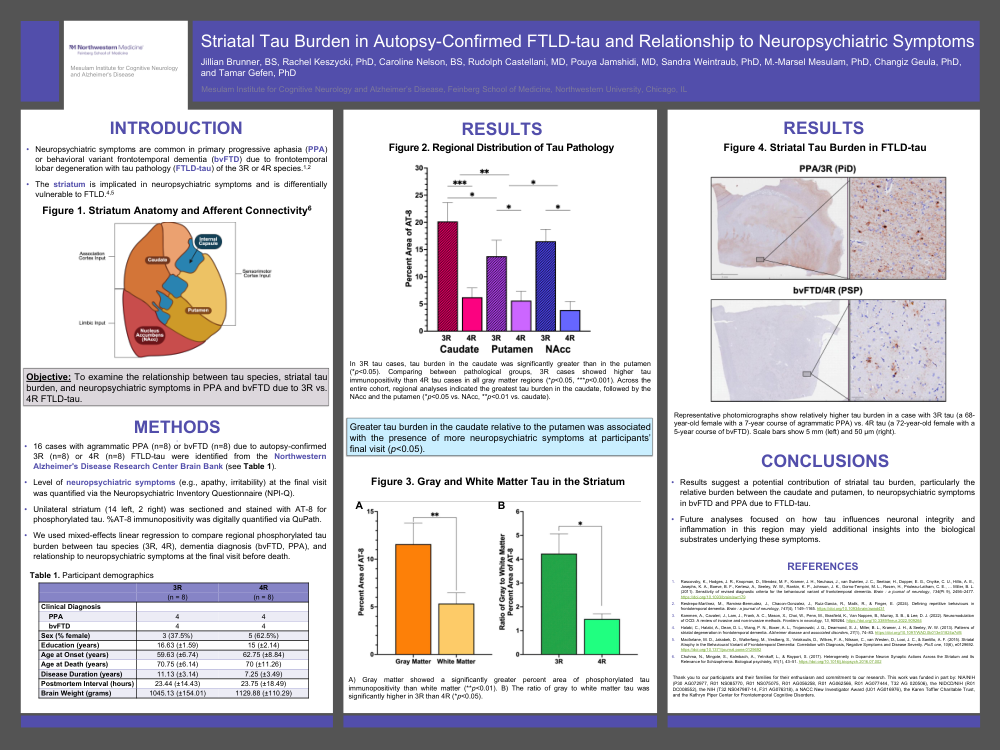
Background: Neuropsychiatric symptoms are common in behavioral variant frontotemporal dementia (bvFTD) and primary progressive aphasia (PPA) due to frontotemporal lobar degeneration with tau pathology (FTLD-tau). In addition to cortical regions, dysfunction in the striatum, a subcortical region, has been implicated in neuropsychiatric symptoms. The objective of this study was to examine the relationship between striatal tau pathology and neuropsychiatric symptoms, representing a target for intervention.
Methods: We identified 16 right-handed participants with autopsy-confirmed FTLD-tau from the Northwestern Alzheimer’s Disease Research Center (NU-ADRC) brain bank (bvFTD: n = 8; PPA: n = 8; 3R tau: n = 8; 4R tau: n = 8). Participants completed annual research visits through the NU-ADRC PPA Research Program or clinical core. Level of neuropsychiatric symptoms was quantified via the Neuropsychiatric Inventory Questionnaire (NPI-Q). For each participant, unilateral anterior striatum was sectioned and immunostained with AT-8 to detect phosphorylated tau, and percent AT8-positive area was quantified in QuPath. We compared regional phosphorylated tau burden in the striatum between tau species (3R, 4R), dementia diagnosis (bvFTD, PPA), and relationship to neuropsychiatric symptoms endorsed at the final visit before death via mixed-effects linear regression.
Results: 3R tau cases showed significantly greater percent area of phosphorylated tau immunopositivity vs. 4R tau cases in the nucleus accumbens (p<0.05), putamen (p<0.05) and caudate (p<0.001). Dementia diagnosis or presence of neuropsychiatric symptoms were not significantly associated with striatal tau burden. However, the ratio of putamen to caudate AT-8 was significantly related to final visit NPI-Q score (p<0.05), such that a greater relative burden of caudate tau was associated with more neuropsychiatric symptoms.
Conclusion: Results suggest a potential contribution of striatal tau burden, particularly in the caudate relative to the putamen, to neuropsychiatric symptoms in bvFTD and PPA due to FTLD-tau. Future analyses focused on how tau influences neuronal integrity and inflammation in this region may yield additional insights into the biological substrates underlying these symptoms.
Comments
Email is required but is not shown publicly.
Loading comments...