4,068 posters, 219 videos, 101 topics, 69 sessions, 14,365 authors, 6,128 institutions
ePostersLive by SciGen Technologies S.A. All rights reserved.
Alzheimer's Association International Conference 2026
July 12-15, 2026 | London, United Kingdom, and Online

11988
Neuroticism Contributes To Development Of Alzheimer's Disease Through Dysregulation Of Excitatory Neurons
Poster Presenter
Authors
Sneha Sharma, Natacha Comandante-Lou, Yiyi Ma, Masashi Fujita, David Bennett, Andrea Zammit, Philip De Jager
Affiliations
Columbia University Irving Medical Center, Department of Neurology, RUSH University, Rush Alzheimer’s Disease Center, 1Columbia University Irving Medical Center, Department of Neurology
Part of Topic
Virtual
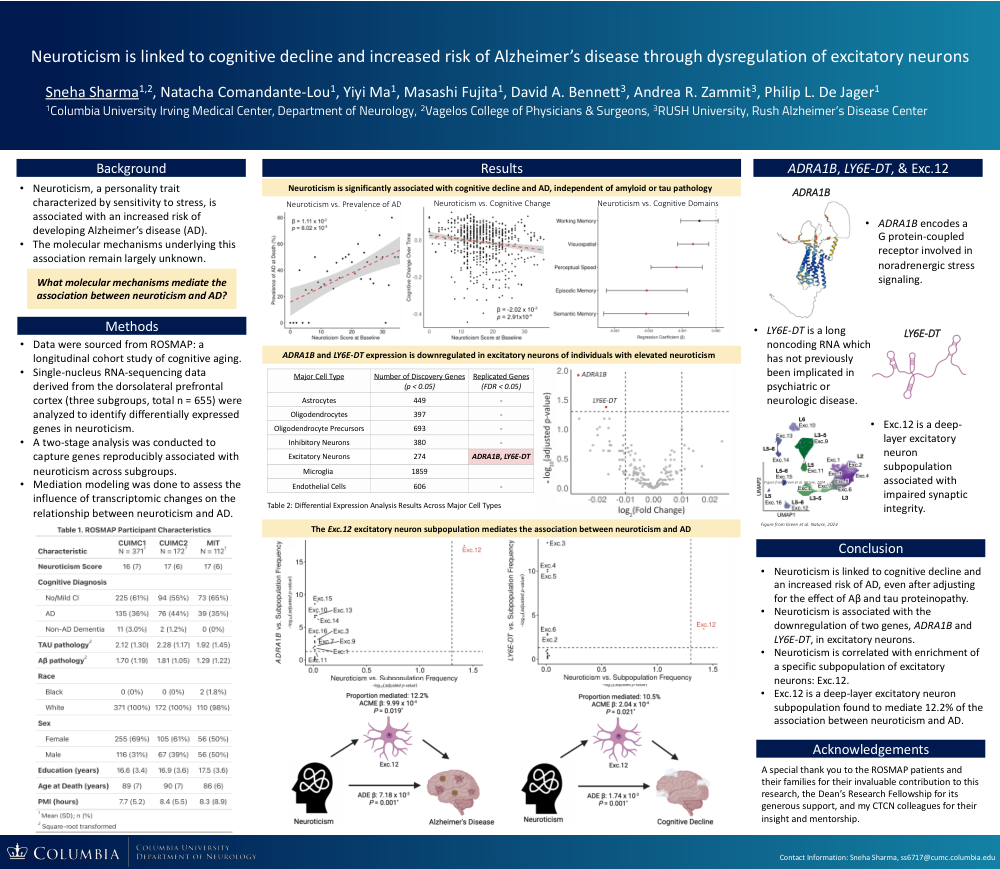
TITLE: Neuroticism is linked to cognitive decline and increased risk of Alzheimer’s disease through dysregulation of excitatory neurons
INTRODUCTION: Neuroticism is an established risk factor for Alzheimer’s disease (AD), yet the molecular mechanisms linking this personality trait to neurodegeneration remain poorly understood.
METHODS: We leveraged single-nucleus RNA-sequencing data from longitudinal cohort studies of cognitive aging (n = 655) to investigate the mechanisms mediating the association between neuroticism and AD.
RESULTS: We identified two genes associated with neuroticism, both of which are downregulated in excitatory neurons: ADRA1B and LY6E-DT. In addition, we found that neuroticism is associated with enrichment of a specific excitatory neuron subpopulation: Exc.12. Further analysis revealed that Exc.12 partially mediates the relationship between neuroticism and AD, accounting for 12.2% of the total effect.
DISCUSSION: The dysregulation of excitatory neurons may represent a key cellular change that links neuroticism to AD.
Key Words: neuroticism, Alzheimer’s disease, cognitive decline, excitatory neurons
Comments
Email is required but is not shown publicly.
Loading comments...