4,068 posters, 219 videos, 101 topics, 69 sessions, 14,365 authors, 6,128 institutions
ePostersLive by SciGen Technologies S.A. All rights reserved.
Alzheimer's Association International Conference 2026
July 12-15, 2026 | London, United Kingdom, and Online

13670
Investigation Of The Effect Of The Spock1 Protein Associated With Alzheimer's Disease On Apoptosis In Neuronal Cell Lines
Part of Topic
Virtual
Background
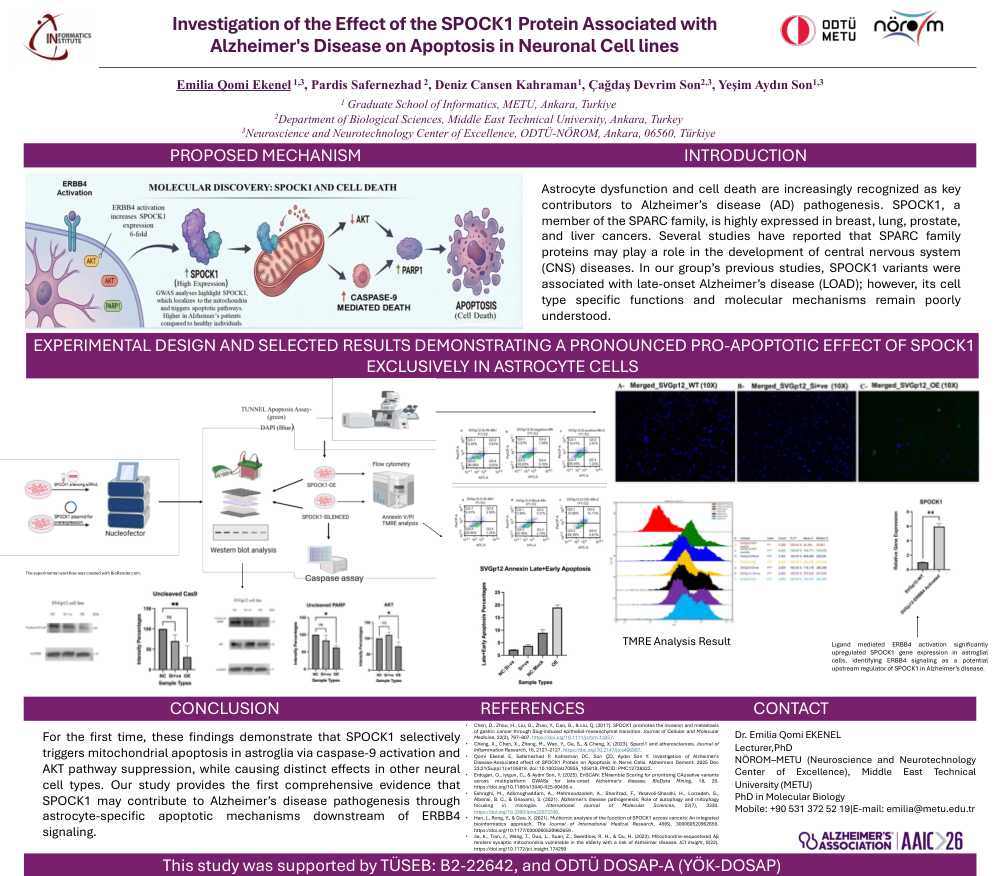
Astrocyte dysfunction and cell death are increasingly recognized as key contributors to Alzheimer’s disease (AD) pathogenesis. SPOCK1, a member of the SPARC family, is highly expressed in breast, lung, prostate, and liver cancers. Several studies have reported that SPARC family proteins may play a role in the development of central nervous system (CNS) diseases. In our group’s previous studies, SPOCK1 variants were associated with late-onset Alzheimer’s disease (LOAD); however, its cell type specific functions and molecular mechanisms remain poorly understood.
Methods
In this study, we investigated the role of SPOCK1 in regulating cell death pathways in astrocyte, microglia, and neuroblastoma cell lines, and explored its potential association with ERBB4 signaling. Using Annexin V/PI staining and analysis by flow cytometry, TUNEL assays, TMRE-based mitochondrial membrane potential measurements, caspase activity assays, and Western blot analyses.
Results
We demonstrate that SPOCK1 shows a strong pro-apoptotic effect specifically in astrocyte cells. SPOCK1 overexpression in astrocyte resulted in significantly increased apoptotic cell ratios, loss of mitochondrial membrane potential. In western blot analysis results, decreased levels of uncleaved procaspase-9 further supported activation of the intrinsic (mitochondrial) apoptotic pathway. In astroglia, SPOCK1 expression was accompanied by reduced PARP1 levels and suppression of AKT signaling, consistent with a pro-apoptotic cellular environment.
In contrast, neither SPOCK1 overexpression nor knockdown induced consistent apoptotic changes in microglia or neuroblastoma cells. Notably, SPOCK1 overexpression promoted cell proliferation in neuroblastoma cells.
Furthermore, ligand mediated ERBB4 activation significantly upregulated SPOCK1 gene expression in astroglial cells, identifying ERBB4 signaling as a potential upstream regulator of SPOCK1 in Alzheimer’s disease.
Conclusions
For the first time, these findings demonstrate that SPOCK1 selectively triggers mitochondrial apoptosis in astroglia via caspase-9 activation and AKT pathway suppression, while causing distinct effects in other neural cell types. Our study provides the first comprehensive evidence that SPOCK1 may contribute to Alzheimer’s disease pathogenesis through astrocyte-specific apoptotic mechanisms downstream of ERBB4 signaling.
Comments
Email is required but is not shown publicly.
Loading comments...