4,068 posters, 219 videos, 101 topics, 69 sessions, 14,365 authors, 6,128 institutions
ePostersLive by SciGen Technologies S.A. All rights reserved.
Alzheimer's Association International Conference 2026
July 12-15, 2026 | London, United Kingdom, and Online

11937
Hippocampal Snrna-seq In Collaborative Cross Reveals Molecular Signatures Of Cognitive Resilience Independent Of Chronological Aging
Part of Topic
Virtual
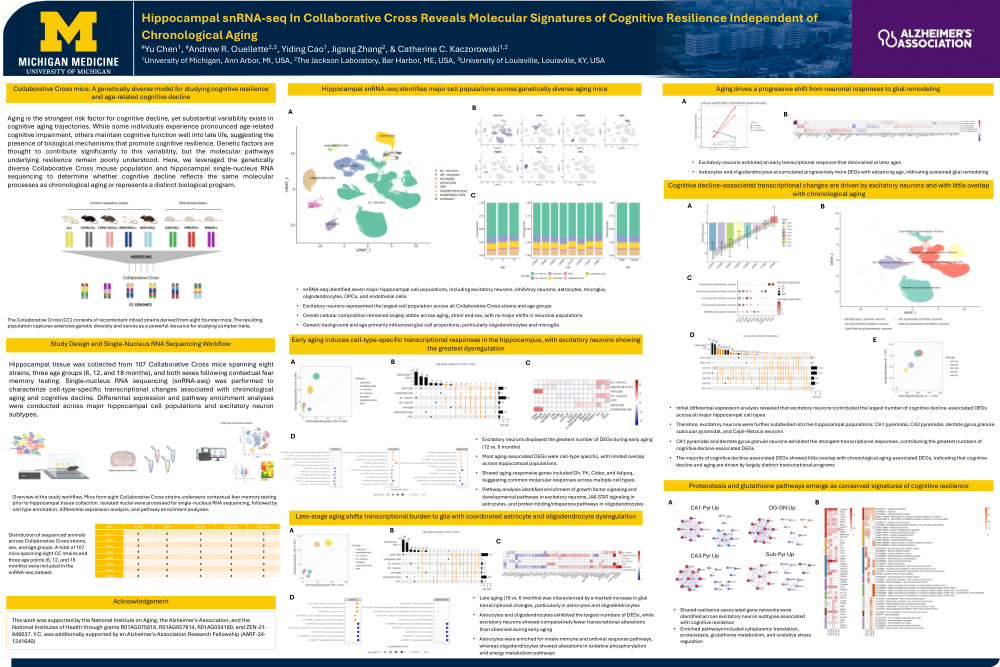
Background Although aging is the predominant risk factor for cognitive decline and dementia, chronological aging and cognitive decline do not inevitably coincide. Genetic factors are thought to play a major role in this variability, yet the precise variants and molecular pathways conferring resilience to age-related cognitive impairment remain poorly understood. Most animal studies rely on a single inbred background, limiting their ability to capture this complexity. The Collaborative Cross (CC), a recombinant inbred mouse panel derived from eight founder strains, provides a level of genetic diversity comparable to human populations and offers a powerful system for dissecting the molecular basis of cognitive aging.
Methods We performed single-nucleus RNA sequencing on hippocampal tissue from 107 mice spanning eight CC strains, three age groups (6, 12, and 18 months), and both sexes. Contextual fear memory served as a continuous measure of cognitive function and was assessed immediately prior to tissue collection. Pseudobulk differential expression analysis was used to identify transcriptional changes associated with chronological age and with strain-specific cognitive decline trajectories. Findings were further Interpret through gene set enrichment and protein-protein interaction network analyses.
Results We identified five major hippocampal cell populations. Transcriptional responses to early aging (12 vs. 6 months) were most prominent in excitatory neurons, while late aging (18 vs. 6 months) shifted this burden to astrocytes and oligodendrocytes, with coordinated glial dysregulation in immune, synaptic, and metabolic pathways. Microglial changes were minimal across both comparisons. Strikingly, cognitive decline-associated gene expression signatures were largely non-overlapping with aging-associated signatures, suggesting these represent distinct biological processes. CA1 pyramidal and dentate gyrus granule neurons showed the greatest number of cognitive resilience-associated differentially expressed genes. Cross-subtype network analysis highlighted consistent upregulation of ribosomal and glutathione metabolism genes, and downregulation of extracellular matrix components, in animals with steeper cognitive decline.
Conclusion Chronological aging and cognitive decline engage largely distinct transcriptional programs across hippocampal cell types. Glial populations are the primary responders to chronological aging, while excitatory neuron subtypes harbor the strongest signatures of cognitive susceptibility. Proteostatic regulation and glutathione metabolism emerge as candidate pathways underlying cognitive resilience.
Comments
Email is required but is not shown publicly.
Loading comments...