4,068 posters, 219 videos, 101 topics, 69 sessions, 14,365 authors, 6,128 institutions
ePostersLive by SciGen Technologies S.A. All rights reserved.
Alzheimer's Association International Conference 2026
July 12-15, 2026 | London, United Kingdom, and Online

13584
High Molecular Weight Isoforms Of DPP4 With Distinct Patterns In The Serum Of Patients With Alzheimer’S And Parkinson’S Disease.
Poster Presenter
Authors
Part of Topic
Virtual
Video
Control/Tracking Number: 2026-DTA-13584-AAIC
Activity: Developing Topics Abstract
Current Date/Time: 27, June 2026 16:26:9 Central European Time
Activity: Developing Topics Abstract
Current Date/Time: 27, June 2026 16:26:9 Central European Time
High Molecular Weight Isoforms Of DPP4 With Distinct Patterns In The Serum Of Patients With Alzheimer’S And Parkinson’S Disease.:
Author Block: Dionysia Amanatidou1, Ioannis Gavriilidis1, Anastasios Bampaitis1, Vasileios Fouskas1, Magda Tsolaki2, Anna Anastasiou3, Phaedra Eleftheriou1.
1Department of Biomedical Sciences, International Hellenic University, Thessaloniki, Greece, 23Department of Biomedical Sciences, Laboratory of Neurodegenerative Diseases, Center for Interdisciplinary Research and Innovation (CIRI-AUTh), Balkan Center, Aristotle University of Thessaloniki, Building A, 57001, Thessaloniki, Greece.
Abstract:
Background: Dipeptidyl peptidase 4 (DPP4) is a multifunctional serine protease that cleaves N-terminal dipeptides adjacent to proline or alanine residues, thereby regulating the activity of multiple bioactive peptides, including glucagon-like peptide-1 (GLP-1), stromal cell-derived factor-1 (SDF-1), PACAP, brain natriuretic peptide (BNP), eotaxin, and substance P. Increasing evidence implicates DPP4 in neurobiological processes and neurodegenerative disorders such as Alzheimer’s disease (AD) and Parkinson’s disease (PD). DPP4 has been shown to cleave amyloid-β (Aβ) peptides, generating N-terminally truncated forms (Aβ3-x), which can subsequently undergo cyclization to form pyroglutamate-modified Aβ (pE3-Aβ), a highly aggregation-prone and neurotoxic species. Additionally, through modulation of the GLP-1 axis, DPP4 regulates incretin signaling, with downstream effects on insulin signaling, neuroinflammation, and neuronal survival pathways that may contribute to neurodegenerative processes. Furthermore, DPP4 activity may influence synaptic function and neuroinflammation, partly through modulation of chemokine signaling and immune cell migration within the central nervous system. This study aimed to evaluate serum DPP4 isoform profiles in patients with AD and PD compared to healthy controls.
Methods: Serum samples were subjected to ion-exchange chromatography (DEAE) and size-exclusion chromatography (Sephacryl S-300) for isoform separation. Fractions were tested for DPP4 activity and were further characterized using SDS-PAGE and Western blot analysis to assess molecular weight distribution.
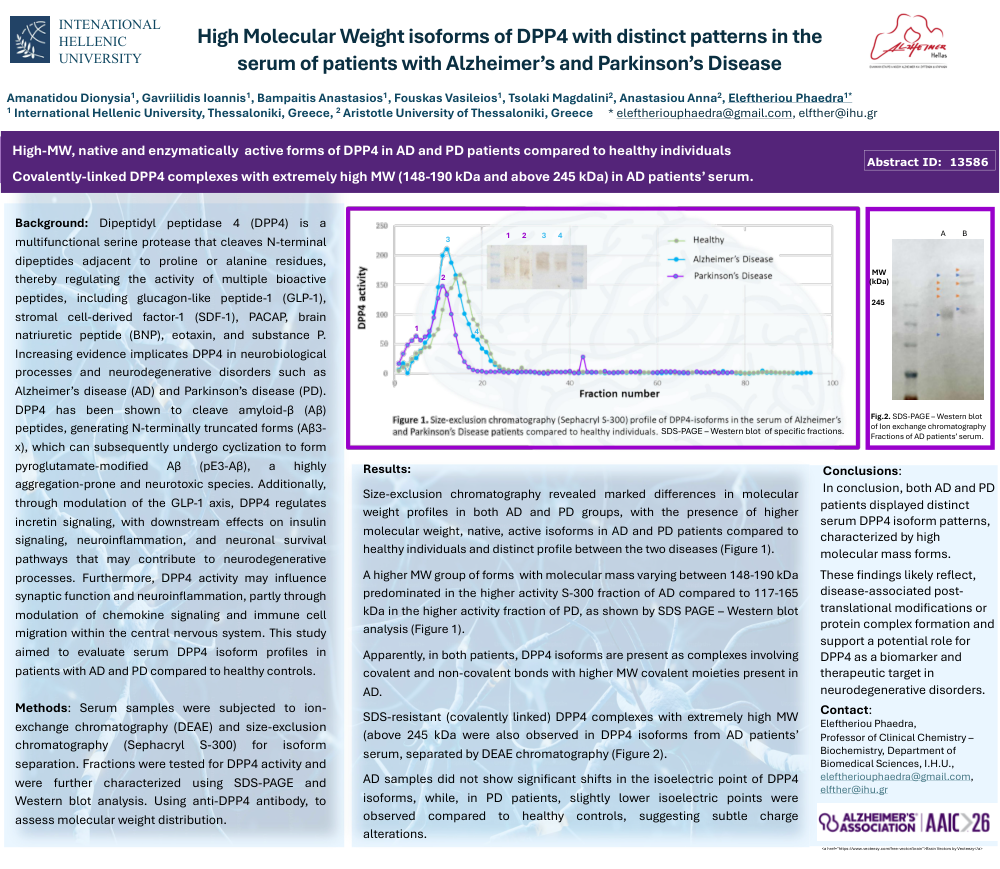
Results: Size-exclusion chromatography revealed marked differences in molecular weight profiles in both AD and PD groups, with the presence of higher molecular weight active isoforms compared to healthy individuals and distinct profile between AD and PD patients. The alterations were also reflected in the SDS PAGE. AD samples did not show significant shifts in the isoelectric point of DPP4 isoforms, while, in PD patients, slightly lower isoelectric points were observed compared to healthy controls, suggesting subtle charge alterations.
Conclusion: In conclusion, both AD and PD patients displayed distinct serum DPP4 isoform patterns, characterized by changes in molecular mass and, in PD, isoelectric properties. These findings likely reflect disease-associated post-translational modifications or protein complex formation and support a potential role for DPP4 as a biomarker and therapeutic target in neurodegenerative disorders.
Comments
Email is required but is not shown publicly.
Loading comments...